Pope apologizes for ‘catastrophic’ school policy in Canada

Advertisement

Advertise with us

MASKWACIS, Alberta (AP) — Pope Francis issued a historic apology Monday for the Catholic Church’s cooperation with Canada’s “catastrophic” policy of Indigenous residential schools, saying the forced assimilation of Native peoples into Christian society destroyed their cultures, severed families and marginalized generations.

Read this article for free:


By clicking the button above, an account will be created and you will begin to receive some of our recommended newsletters. You may opt out of any newsletter by visiting your Email and Communication Preferences page or by clicking "unsubscribe" at the bottom of any email.

or

Already have an account? Log in here »

To continue reading, please subscribe:

Subscribe and receive a limited-edition Free Press branded hat or tote.

Digital Subscription

One year of digital access for only $205*

  • Enjoy unlimited reading on winnipegfreepress.com
  • Read the E-Edition, our digital replica newspaper
  • Access News Break, our award-winning app
  • Play interactive puzzles

*First annual payment billed as $205.00 + GST for one year. This annual subscription will automatically renew at $233.00 + GST every 52 weeks (10% off the regular annual price of $259.35). Offer available to new and qualified returning subscribers only. Cancel any time.

To continue reading, please subscribe:

Add Free Press access to your Brandon Sun subscription for only an additional

$1 for the first 4 weeks*

  • Enjoy unlimited reading on winnipegfreepress.com
  • Read the E-Edition, our digital replica newspaper
  • Access News Break, our award-winning app
  • Play interactive puzzles
Start now

*Your next Brandon Sun subscription payment will increase by $1.00 and you will be charged $17.95 plus GST for four weeks. After four weeks, your payment will increase to $24.95 plus GST every four weeks.

Hey there, time traveller!
This article was published 26/07/2022 (1538 days ago), so information in it may no longer be current.

MASKWACIS, Alberta (AP) — Pope Francis issued a historic apology Monday for the Catholic Church’s cooperation with Canada’s “catastrophic” policy of Indigenous residential schools, saying the forced assimilation of Native peoples into Christian society destroyed their cultures, severed families and marginalized generations.

“I am deeply sorry,” Francis said to applause from school survivors and Indigenous community members gathered at a former residential school south of Edmonton, Alberta. He called the school policy a “disastrous error” that was incompatible with the Gospel and said further investigation and healing is needed.

“I humbly beg forgiveness for the evil committed by so many Christians against the Indigenous peoples,” Francis said.
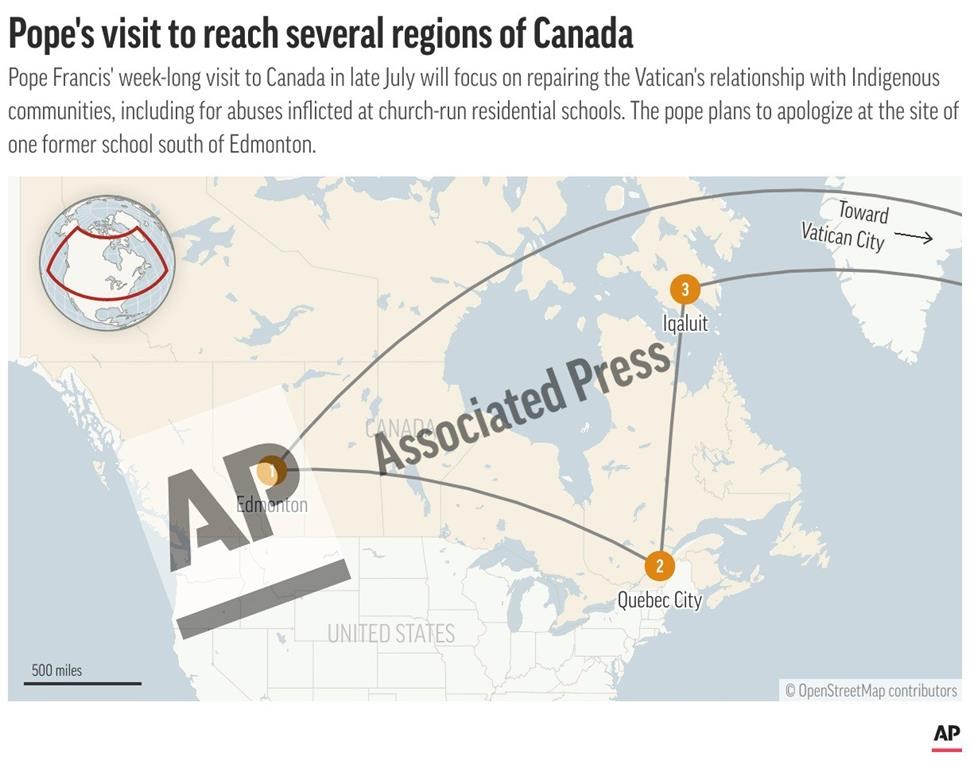
This preview of a digital embed shows the areas in Canada where Pope Francis plans to visit in late July. (AP Digital Embed)

In the first event of his weeklong “penitential pilgrimage,” Francis traveled to the lands of four Cree nations to pray at a cemetery and then deliver the long-sought apology at nearby powwow ceremonial grounds. Four chiefs escorted the pontiff in a wheelchair to the site near the former Ermineskin Indian Residential School, and presented him with a feathered headdress after he spoke, making him an honorary leader of the community.

Francis’ words went beyond his earlier apology for the “deplorable” abuses committed by missionaries and instead took institutional responsibility for the church’s cooperation with Canada’s “catastrophic” assimilation policy, which the country’s Truth and Reconciliation Commission said amounted to a “cultural genocide.”

More than 150,000 native children in Canada were forced to attend government-funded Christian schools from the 19th century until the 1970s in an effort to isolate them from the influence of their homes and culture. The aim was to Christianize and assimilate them into mainstream society, which previous Canadian governments considered superior.

Ottawa has admitted that physical and sexual abuse was rampant at the schools, with students beaten for speaking their native languages. That legacy of that abuse and isolation from family has been cited by Indigenous leaders as a root cause of the epidemic rates of alcohol and drug addiction now on Canadian reservations.

The discoveries of hundreds of potential burial sites at former schools in the past year drew international attention to the schools in Canada and their counterparts in the United States. The revelations prompted Francis to comply with the truth commission’s call for an apology on Canadian soil; Catholic religious orders operated 66 of the country’s 139 residential schools.
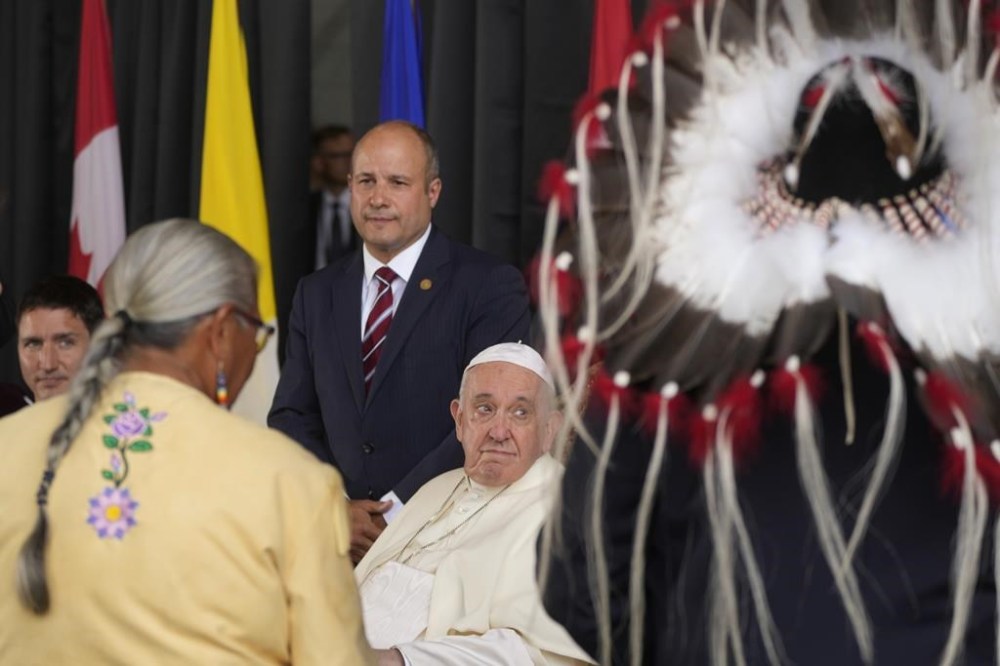
Pope Francis meets the Canadian Indigenous people as he arrives at Edmonton's International airport, Canada, Sunday, July 24, 2022. Pope Francis begins a weeklong trip to Canada on Sunday to apologize to Indigenous peoples for the abuses committed by Catholic missionaries in the country's notorious residential schools. (AP Photo/Gregorio Borgia)

Reflecting the conflicting emotions of the day, some in the crowd wept as Francis spoke, while others applauded or stayed silent listening to his words, delivered in his native Spanish with English translations. Others chose not to attend at all.

“I’ve waited 50 years for this apology, and finally today I heard it,” survivor Evelyn Korkmaz said. “Part of me is rejoiced, part of me is sad, part of me is numb.” She added, however, that she had hoped to hear a “work plan” from the pope on what he would do next to reconcile, including releasing church files on children who died at the schools.

Many in the crowd wore traditional dress, including colorful ribbon skirts and vests with Native motifs. Others donned orange shirts, which have become a symbol of school survivors, recalling the story of one woman whose beloved orange shirt, a gift from her grandmother, was confiscated at a school and replaced with a uniform.

“It’s something that is needed, not only for people to hear but for the church to be accountable,” said Sandi Harper, who traveled with her sister and a church group from Saskatchewan in honor of their late mother, who attended a residential school.

“He recognizes this road to reconciliation is going to take time, but he is really on board with us,” she said, calling the apology “genuine.”

A view of the cemetery where Pope Francis will pray, in Maskwacis, near Edmonton, Canada, Monday, July 25, 2022. Pope Francis begins a
A view of the cemetery where Pope Francis will pray, in Maskwacis, near Edmonton, Canada, Monday, July 25, 2022. Pope Francis begins a "penitential" visit to Canada to beg forgiveness from survivors of the country's residential schools, where Catholic missionaries contributed to the "cultural genocide" of generations of Indigenous children by trying to stamp out their languages, cultures and traditions. Francis set to visit the cemetery at the former residential school in Maskwacis. (AP Photo/Gregorio Borgia)

Despite the solemnity of the event, the atmosphere seemed at times joyful: Chiefs processed into the site venue to a hypnotic drumbeat, elders danced and the crowd cheered and chanted war songs, victory songs and finally a healing song. Participants paraded a long red banner through the grounds bearing the names of more than 4,000 children who died at or never came home from residential schools; Francis later kissed it.

“I wasn’t disappointed. It was quite a momentous occasion,” said Phil Fontaine, a residential school survivor and former chief of the Assembly of First Nations who went public with his story of sexual abuse in the 1990s.

Prime Minister Justin Trudeau, who last year apologized for the “incredibly harmful government policy,” also attended, along with other officials.

As part of a lawsuit settlement involving the government, churches and approximately 90,000 survivors, Canada paid reparations that amounted to billions of dollars being transferred to Indigenous communities. Canada’s Catholic Church says its dioceses and religious orders have provided more than $50 million in cash and in-kind contributions and hope to add $30 million more over the next five years.

While the pope acknowledged blame, he also made clear that Catholic missionaries were merely cooperating with and implementing the government policy, which he termed the “colonizing mentality of the powers.” Notably he didn’t refer to 15th-century papal decrees that provided religious backing to European colonial powers in the first place.
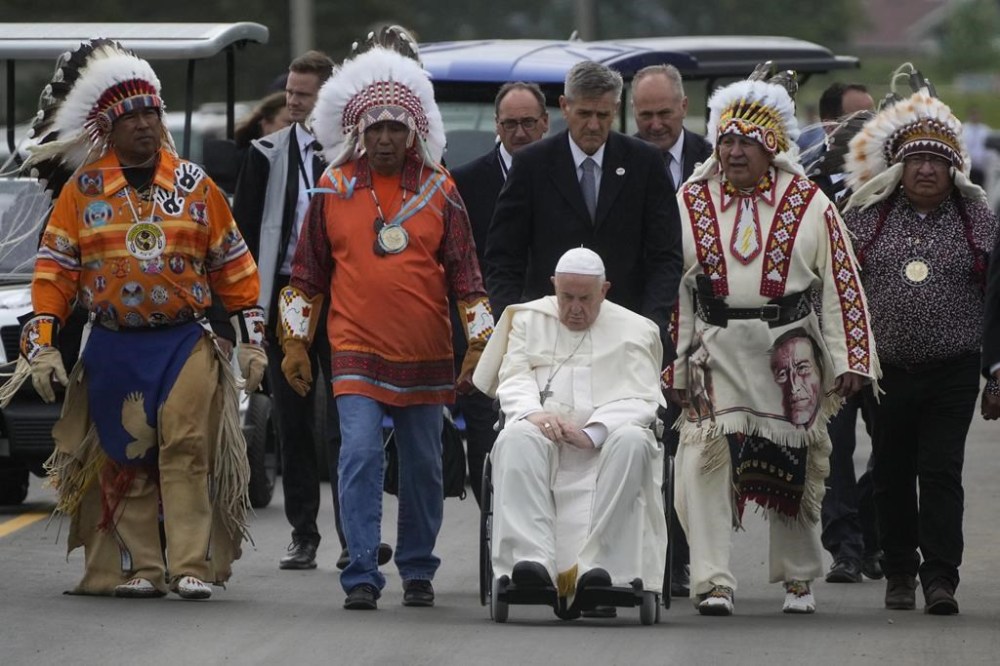
Pope Francis leaves with Indigenous peoples after praying in a cemetery at the former residential school, in Maskwacis, near Edmonton, Canada, Monday, July 25, 2022. Pope Francis begins a
Pope Francis leaves with Indigenous peoples after praying in a cemetery at the former residential school, in Maskwacis, near Edmonton, Canada, Monday, July 25, 2022. Pope Francis begins a "penitential" visit to Canada to beg forgiveness from survivors of the country's residential schools, where Catholic missionaries contributed to the "cultural genocide" of generations of Indigenous children by trying to stamp out their languages, cultures and traditions. Francis set to visit the cemetery at the former residential school in Maskwacis. (AP Photo/Gregorio Borgia)

Jeremy Bergen, a church apology expert and professor of religious and theological studies at Conrad Grebel University College in Waterloo, Ontario, said Francis made clear he was asking forgiveness for the actions of “members of the church” but not the institution in its entirety.

“The idea is that, as the Body of Christ, the church itself is sinless,” he said via email.

“So when Catholics do bad things, they are not truly acting on behalf of the church,” Bergen added, noting it’s a controversial idea on which many Catholic theologians disagree.

Francis said the schools marginalized generations, suppressed Indigenous languages, led to physical, verbal, psychological and spiritual abuse and “indelibly affected relationships between parents and children, grandparents and grandchildren.” He called for further investigation, a possible reference to demands for further access to church records and personnel files of priests and nuns to identify perpetrators of abuses.

“Although Christian charity was not absent, and there were many outstanding instances of devotion and care for children, the overall effects of the policies linked to the residential schools were catastrophic,” Francis said. “What our Christian faith tells us is that this was a disastrous error, incompatible with the Gospel of Jesus Christ.”
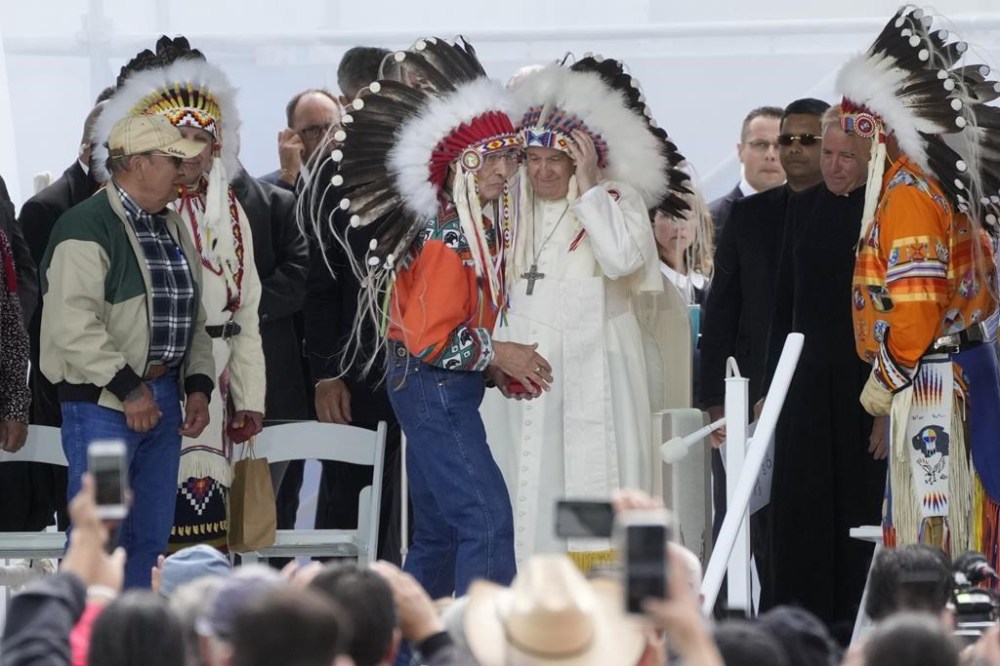
Pope Francis puts on an indigenous headdress during a meeting with indigenous communities, including First Nations, Metis and Inuit, at Our Lady of Seven Sorrows Catholic Church in Maskwacis, near Edmonton, Canada, Monday, July 25, 2022. Pope Francis begins a
Pope Francis puts on an indigenous headdress during a meeting with indigenous communities, including First Nations, Metis and Inuit, at Our Lady of Seven Sorrows Catholic Church in Maskwacis, near Edmonton, Canada, Monday, July 25, 2022. Pope Francis begins a "penitential" visit to Canada to beg forgiveness from survivors of the country's residential schools, where Catholic missionaries contributed to the "cultural genocide" of generations of Indigenous children by trying to stamp out their languages, cultures and traditions. Francis set to visit the cemetery at the former residential school in Maskwacis. (AP Photo/Gregorio Borgia)

The first pope from the Americas was determined to make this trip, even though torn knee ligaments forced him to cancel a visit to Africa earlier this month.

The six-day visit — which also includes stops in Quebec City and Iqaluit, Nunavut, in the far north — follows meetings Francis held in the spring at the Vatican with First Nations, Metis and Inuit delegations. Those encounters culminated with Francis’ apology April 1 for “deplorable” abuses at residential schools and a promise to do so again on Canadian soil.

Francis recalled that one of the delegations gave him a set of beaded moccasins as a symbol of children who never came back from the schools, and asked him to return them in Canada. Francis said in these months they “kept alive my sense of sorrow, indignation and shame” but that in returning them he hoped they can also represent a path to walk together.

Event organizers had mental health counselors on hand Monday, knowing the event could be traumatic for some people.

Later Monday, Francis visited Sacred Heart Church of the First Peoples, an Edmonton parish whose sanctuary was dedicated last week after being restored from a fire. The church incorporates Indigenous language and customs in liturgy, and both were on display during the event, with folksongs and drums and providing the backdrop to the pope’s visit.
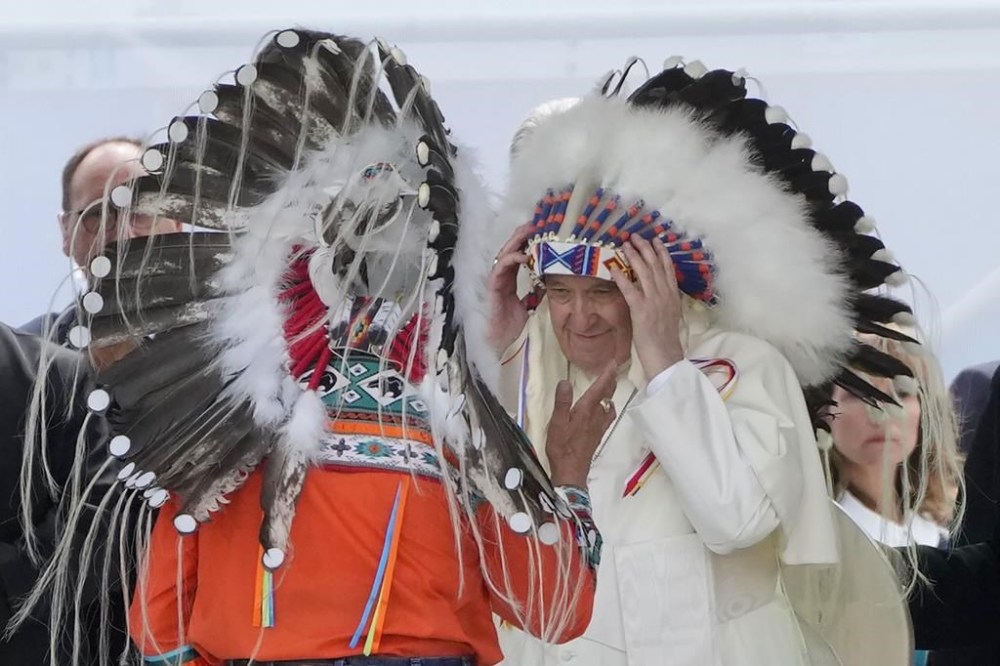
Pope Francis puts on an indigenous headdress during a meeting with indigenous communities, including First Nations, Metis and Inuit, at Our Lady of Seven Sorrows Catholic Church in Maskwacis, near Edmonton, Canada, Monday, July 25, 2022. Pope Francis begins a
Pope Francis puts on an indigenous headdress during a meeting with indigenous communities, including First Nations, Metis and Inuit, at Our Lady of Seven Sorrows Catholic Church in Maskwacis, near Edmonton, Canada, Monday, July 25, 2022. Pope Francis begins a "penitential" visit to Canada to beg forgiveness from survivors of the country's residential schools, where Catholic missionaries contributed to the "cultural genocide" of generations of Indigenous children by trying to stamp out their languages, cultures and traditions. Francis set to visit the cemetery at the former residential school in Maskwacis. (AP Photo/Gregorio Borgia)

___

Associated Press writers Rob Gillies in Toronto and Holly Meyer in Nashville, Tennessee, contributed.

___

Associated Press religion coverage receives support through the AP’s collaboration with The Conversation US, with funding from Lilly Endowment Inc. The AP is solely responsible for this content.

Members of indigenous communities, including First Nations, Metis and Inuit, hold a banner with the names of the victims during a meeting with Pope Frances, at Our Lady of Seven Sorrows Catholic Church in Maskwacis, near Edmonton, Canada, Monday, July 25, 2022. Pope Francis begins a
Members of indigenous communities, including First Nations, Metis and Inuit, hold a banner with the names of the victims during a meeting with Pope Frances, at Our Lady of Seven Sorrows Catholic Church in Maskwacis, near Edmonton, Canada, Monday, July 25, 2022. Pope Francis begins a "penitential" visit to Canada to beg forgiveness from survivors of the country's residential schools, where Catholic missionaries contributed to the "cultural genocide" of generations of Indigenous children by trying to stamp out their languages, cultures and traditions. Francis set to visit the cemetery at the former residential school in Maskwacis. (AP Photo/Gregorio Borgia)
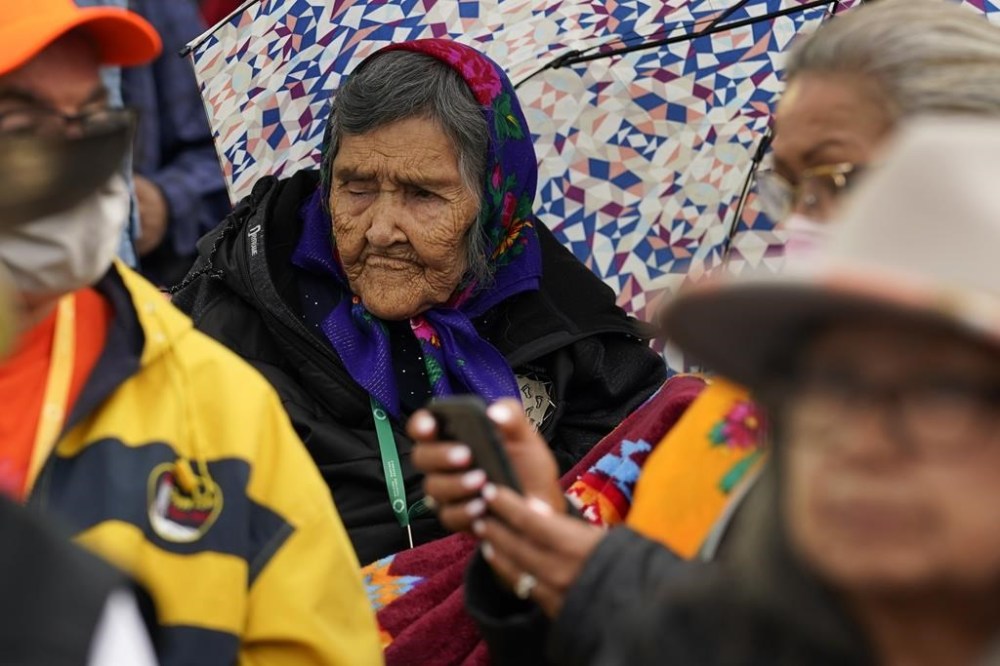
Indigenous people wait for Pope Francis during his visit to Maskwaci, the former Ermineskin Residential School, Monday, July 25, 2022, in Maskwacis, Alberta. Pope Francis traveled to Canada to apologize to Indigenous peoples for the abuses committed by Catholic missionaries in the country's notorious residential schools. (AP Photo/Eric Gay)
Report Error Submit a Tip

The Free Press acknowledges the financial support it receives from members of the city’s faith community, which makes our coverage of religion possible.

More Stories

Yielding attraction

Joel Schlesinger 6 minute read Preview

Yielding attraction

Joel Schlesinger 6 minute read Yesterday at 2:01 AM CDT

Yield is a Rorschach test for investors. Where one see opportunity in high payouts from an investment, another sees high risk.

Consider bonds: yields are moving higher, which implies higher risk in the market, but to an investor considering buying a bond, higher yields represent higher income.

For most of the past 18 years, bond yields have been near historical lows and investors have sought alternatives.

“Canada’s population is aging, with a growing number of investors approaching or entering retirement and looking for more income,” says Pat Sommerville, co-chief executive officer of Hamilton ETFs in Toronto.

Read
Yesterday at 2:01 AM CDT

A little work goes a long way at ballot box

Tom Brodbeck 5 minute read Preview

A little work goes a long way at ballot box

Tom Brodbeck 5 minute read Yesterday at 2:01 AM CDT

Who should I vote for in the upcoming municipal election? It’s question I get asked often. And it’s a fair one.

With election day approaching, voters are being bombarded with names, promises, slogans and campaign messages.

There are mayoral candidates to consider and candidates running in individual wards. There are competing promises about taxes, crime, infrastructure, transit, homelessness and a long list of other issues.

So how is a voter supposed to sort it all out?

Read
Yesterday at 2:01 AM CDT

Higher electricity rates may not deter data centres, consultant says

The Canadian Press 4 minute read Friday, Oct. 9, 2026

MONTREAL - Higher electricity prices may not discourage companies from building new data centres as demand for power continues to grow, a consultant hired by Hydro-Québec told the province's energy regulator on Friday.

The comments came as the first phase of hearings into the utility's proposal to nearly double electricity rates for large data centres wrapped up in Montreal, with lawyers representing Google and an environmental coalition questioning consultants about their study of electricity markets across North America.

Hydro-Québec is asking the province's energy regulator, the Régie de l'énergie, to approve a new rate averaging 13 cents per kilowatt hour for data centres requiring more than five megawatts of power, nearly double the average 6.82 cents currently paid by major industrial electricity users.

The utility has said the increased rate for data centres is not meant to slow down growth, but rather to ensure residential customers don't wind up seeing rate hikes to compensate for discounts offered to the rapidly growing industrial sector.

Religious groups must keep careful eye on artificial intelligence

John Longhurst 5 minute read Saturday, May. 23, 2026

Programmers, computer scientists and software, mechanical, data and prompt engineers — these are some of the professions behind the creation of artificial intelligence. Should theologians and faith leaders also be involved?

Meghan Sullivan, a Roman Catholic who teaches philosophy at the University of Notre Dame, says yes. That’s why she was glad to attend a meeting in March at the invitation of Anthropic, the creator of Claude AI, about the role religion can play in the creation of this life-changing technology.

Sullivan, who also directs the university’s Institute for Ethics and the Common Good, was there with 15 other Christian philosophers, theologians and leaders to discuss the implications of AI for society today — and how it can be taught to behave ethically and morally using religion as a guide.

I spoke with Sullivan this week about that meeting. “I’m very grateful for Anthropic’s leadership in this area with faith communities,” she said, noting that most AI companies are not doing that. “It should have happened sooner, but better late than never.”

Poilievre unveils five-point steel plan, urges Ottawa to sue Stelco’s U.S. owner

Brett Bundale, The Canadian Press 4 minute read Friday, Oct. 9, 2026

Conservative Leader Pierre Poilievre is calling on Ottawa to sue Stelco's American owner as part of a five-point plan aimed at protecting Canada's struggling steel industry.

Poilievre was in Burlington, Ont. on Friday, speaking at a site overlooking Stelco's operations across Hamilton Harbour. The steelmaker began issuing layoff notices this week after announcing plans to lay off up to 500 workers at its Hamilton and Lake Erie facilities.

He said the lawsuit should seek to bring back workers and restart idled operations at Stelco, or force its sale to a Canadian owner willing to resume production.

"The only thing that we would accept is these workers getting their paycheques, making Canadian steel to build our country," Poilievre said.

Letters, Oct. 10

6 minute read Yesterday at 2:01 AM CDT

Investing in adult vaccines

Last week, provincial and territorial health ministers held an emergency meeting on the looming expiration of federal health funding and the financial pressures facing health systems across the country.

As they gather again in Winnipeg later this month, there is a critical piece missing from the conversation — prevention.

Canada has a strong public-health tradition, but its gains cannot be taken for granted. In 2021, Canada reported zero measles cases. By 2025, more than 5,400 cases had been reported, costing Canada its measles elimination status and Manitoba saw this firsthand.