Canada to require nutrition warnings on front of some packaged food

Advertisement

Advertise with us

Canada will require nutrition warnings on the front of pre-packaged food with high levels of saturated fat, sugar or sodium starting in 2026 in an effort to help grocery shoppers make healthier choices with just a glance.

Read this article for free:


By clicking the button above, an account will be created and you will begin to receive some of our recommended newsletters. You may opt out of any newsletter by visiting your Email and Communication Preferences page or by clicking "unsubscribe" at the bottom of any email.

or

Already have an account? Log in here »

To continue reading, please subscribe:

Digital Subscription

One year of digital access for only $1.44 a week*

  • Enjoy unlimited reading on winnipegfreepress.com
  • Read the E-Edition, our digital replica newspaper
  • Access News Break, our award-winning app
  • Play interactive puzzles

*Billed as $5.77 plus GST every four weeks. After 52 weeks, price increases to the regular rate of $19.95 plus GST every four weeks. Offer available to new and qualified returning subscribers only. Cancel any time.

To continue reading, please subscribe:

Add Free Press access to your Brandon Sun subscription for only an additional

$1 for the first 4 weeks*

  • Enjoy unlimited reading on winnipegfreepress.com
  • Read the E-Edition, our digital replica newspaper
  • Access News Break, our award-winning app
  • Play interactive puzzles
Start now

*Your next Brandon Sun subscription payment will increase by $1.00 and you will be charged $17.95 plus GST for four weeks. After four weeks, your payment will increase to $24.95 plus GST every four weeks.

Hey there, time traveller!
This article was published 30/06/2022 (1583 days ago), so information in it may no longer be current.

Canada will require nutrition warnings on the front of pre-packaged food with high levels of saturated fat, sugar or sodium starting in 2026 in an effort to help grocery shoppers make healthier choices with just a glance.

The policy, more than five years in the making, will clearly label products with the so-called “nutrients of public health concern” that have been linked to conditions such as cardiovascular disease and Type 2 diabetes.

“These regulations are designed to make it easier for us to make informed, healthier choices,” Health Minister Jean-Yves Duclos said at a news conference Thursday morning.
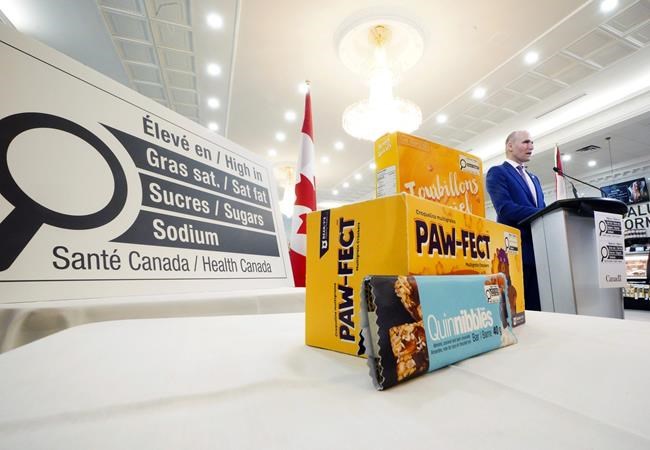
Minister of Health Jean-Yves Duclos announces new food labelling in Ottawa on Thursday, June 30, 2022. Canada will require that companies add nutrition warnings to the front of pre-packaged food with high levels of saturated fat, sugar or sodium, starting in 2026. THE CANADIAN PRESS/Sean Kilpatrick

Health Canada said the new labels will complement, rather than replace, the more detailed nutrition information that’s typically on the back of food packaging.

In general, they’ll be placed on pre-packaged foods that contain more than 15 per cent of the suggested daily value of saturated fat, sugars or sodium.

For pre-packaged meals, the warnings will only go on items with more than 30 per cent of the recommended daily intake, and for foods sold in increments of less than 30 grams, the labels will apply if they contain more than 10 per cent of the daily recommendation.

The proposed labels were at the centre of controversy earlier this month when a group of ranchers opposed the government’s plan to include warnings on ground meat.

At the time, the Canadian Cattlemen’s Association said the policy would “vilify” ground meat and make people think it’s a less healthy choice than whole cuts.

Now, Health Canada has exempted single-ingredient ground meat from the warning labels, even if it’s high in fat. The product was deemed to have health benefits in spite of the “nutrients of concern,” along with milk, many cheeses and fruit.

“Canadian families rely on ground beef as a nutritious and affordable food staple and an important contributor to food security. We are pleased with Health Canada’s decision to omit ground beef from requiring a misleading warning label,” Canadian Cattlemen’s Association President Reg Schellenberg said in a written statement.

Packages of sugar and salt will also be exempt, as the government said including labels on such products would be redundant.

The plan to put warnings on the front of food packages was first floated as part of Health Canada’s “healthy eating strategy” in 2016, and consultations continued in 2018.

But Duclos said the government is giving companies until 2026 to implement the change to help them manage the cost of packaging overhauls and potentially reformulate food so they won’t be subject to the labels at all.

He said that’s one of the program’s goals, which came to pass in Chile when that country mandated similar front-of-packaging labels.

A year after implementation, Health Canada said, the proportion of products in Chile required to carry the symbols was significantly reduced, suggesting companies changed their recipes to reduce sugar, fat and salt.

The regulation has seals of approval from the Heart and Stroke Foundation and Diabetes Canada.

Mary L’Abbé, a professor with the University of Toronto’s department of nutritional sciences and expert in public health nutrition, said she’s also pleased with the policy.

She said a shopper choosing between two spaghetti sauces will now be able to quickly tell if one is considerably healthier than the other and make a choice accordingly.

“We know most consumers don’t, in the grocery store, spend the time to turn packages over to compare one nutrition facts table to the other, so it will really help them make those comparisons,” she said.

L’Abbé said research shows that after these warnings are added, people are more likely to choose foods lower in sugar, salt and fat.

While it’s too soon to say whether it’s making a difference in levels of diet-related health conditions, she said, modelling suggests that it will if people continue to make these choices.

“Some products, people will always consume even if they do have warning labels,” L’Abbé said, giving the example of processed meat, which is a convenient and cheap option for many.

“I don’t think people will change all their food habits, but I think many of the categories where foods will have front-of-pack labels, it will be easy to spot the ones that do (have a warning label) and the ones that don’t. And that’s the type of change that has been seen in other countries.”

This report by The Canadian Press was first published June 30, 2022.

Report Error Submit a Tip

More Stories

Longtime councillor Eadie ‘knew it was going to be close,’ but expected to finish on top in Mynarski

Scott Billeck 5 minute read Preview

Longtime councillor Eadie ‘knew it was going to be close,’ but expected to finish on top in Mynarski

Scott Billeck 5 minute read Updated: Yesterday at 1:56 PM CDT

Ross Eadie knew his re-election bid would be close, but he didn’t anticipate losing in the neighbourhoods where he grew up.

The 16-year Mynarski councillor, who was defeated Wednesday by political newcomer Natalie Smith, said Thursday the result was difficult to accept because some of his strongest losses were in Luxton, St. John’s Park and surrounding neighbourhoods.

“I knew it was going to be close,” Eadie said. “But I thought it was going to be close with me in first place.”

“I really lost it where I live. So that’s the worst part of it.”

Read
Updated: Yesterday at 1:56 PM CDT

Two government bills left on table as NDP ends third year of term

Carol Sanders 4 minute read Preview

Two government bills left on table as NDP ends third year of term

Carol Sanders 4 minute read Yesterday at 6:59 PM CDT

Year 3 of the NDP government’s four-year mandate ended Thursday with more than 50 bills expected to become law and two that didn’t make it to the finish line.

“We’re on the final stages of passing 52 amazing bills,” government house leader Nahanni Fontaine said after the final question period of the 43rd legislature.

Most were passed before the house rose for the summer break, including getting rid of the provincial sales tax on pop, chips and packaged foods that took effect July 1. A handful of health-care bills that aim to restrict mandatory overtime, create a patient safety charter, establish nurse-to-patient ratios and do away with sick-note requirements for employees — unless they miss more than seven consecutive days or 10 in a year — were also passed.

Under rules of the legislature, the Progressive Conservatives held back three government bills until the fall session to allow for further debate before passage by the NDP majority Thursday. The most contentious was Bill 13, the Residential Tenancies Amendment Act, that aims to strengthen renter protections and increase maximum fines for landlords in breach of the act.

Read
Yesterday at 6:59 PM CDT

Cabbie, passenger dead after Salter Street collision

Free Press staff 2 minute read Preview

Cabbie, passenger dead after Salter Street collision

Free Press staff 2 minute read Updated: Yesterday at 5:46 PM CDT

Two men died in a Wednesday morning collision between a taxi and a sedan on Salter Street near Aberdeen Avenue, police said Thursday.

Winnipeg Police Service officers were sent to the intersection at about 6:30 a.m., where they found the cab driver, a man in his 40s, and his passenger, a man in his 50s, in critical condition. Paramedics took the men to hospital, where they later died.

The sedan driver, a woman in her late teens, and an adult passenger, had minor injuries.

Traffic investigators believe the sedan was travelling west on Aberdeen when it collided with the cab that was southbound on Salter.

Read
Updated: Yesterday at 5:46 PM CDT

Submit a news tip

1 minute read Monday, Mar. 16, 2026

Submit a news tip

Health officials ponder next steps as COVID cases surge in Southern Health region

Katie May 5 minute read Preview

Health officials ponder next steps as COVID cases surge in Southern Health region

Katie May 5 minute read Wednesday, Nov. 3, 2021

Public-health officials say they're trying to avoid ordering another lockdown in southern Manitoba, where COVID-19 infection rates are surging.

Deputy chief provincial public health officer Dr. Jazz Atwal told a news conference Wednesday he doesn't anticipate more lockdowns and suggested he will prioritize keeping schools open when considering future restrictions.

But he couldn't say what the next step will be in an area of the province where hospitalizations among unvaccinated residents are on the rise.

Average daily case counts in the southern part of the province are higher now than they were before lockdown measures went into effect last November, and officials are still figuring out what to do.

Read
Wednesday, Nov. 3, 2021

A timeline of the WE Charity controversy

The Canadian Press 9 minute read Wednesday, Aug. 19, 2020

OTTAWA - A timeline of events regarding the Canada Student Service Grant program, based on public documents, events and statements from cabinet ministers, government officials, and WE Charity:

March 6, 2020: WE Charity staff prepare a concept paper on service learning for public servants at Employment and Social Development Canada.

April 5: Finance Minister Bill Morneau and Prime Minister Justin Trudeau talk over the phone about how to help students whose summer job and volunteer opportunities were vanishing due to the COVID-19 pandemic. Finance Department officials are tasked with considering options the next morning.

April 7: Small Business Minister Mary Ng and WE co-founder Craig Kielburger have an introductory phone call in which Ng asks WE to send what it calls a ``pre-established proposal'' to help young people launch businesses.