Excerpts from the Supreme Court’s landmark abortion decision
Advertisement
Read this article for free:
or
Already have an account? Log in here »
To continue reading, please subscribe:

Digital Subscription
One year of digital access for only $205*
- Enjoy unlimited reading on winnipegfreepress.com
- Read the E-Edition, our digital replica newspaper
- Access News Break, our award-winning app
- Play interactive puzzles
*First annual payment billed as $205.00 + GST for one year. This annual subscription will automatically renew at $233.00 + GST every 52 weeks (10% off the regular annual price of $259.35). Offer available to new and qualified returning subscribers only. Cancel any time.
To continue reading, please subscribe:
Add Free Press access to your Brandon Sun subscription for only an additional
$1 for the first 4 weeks*
- Enjoy unlimited reading on winnipegfreepress.com
- Read the E-Edition, our digital replica newspaper
- Access News Break, our award-winning app
- Play interactive puzzles
*Your next Brandon Sun subscription payment will increase by $1.00 and you will be charged $17.95 plus GST for four weeks. After four weeks, your payment will increase to $24.95 plus GST every four weeks.
Read unlimited articles for free today:
or
Already have an account? Log in here »
Hey there, time traveller!
This article was published 24/06/2022 (1527 days ago), so information in it may no longer be current.
The Supreme Court, in a ruling Friday, ended constitutional protections for abortion that had been in place for nearly 50 years. The court’s conservative majority voted to overturn Roe v. Wade from 1973 and Planned Parenthood v. Casey, the 1992 decision that reaffirmed the right to abortion. The outcome is expected to lead to abortion bans in roughly half the states. A look at what some of the justices said in their opinions:
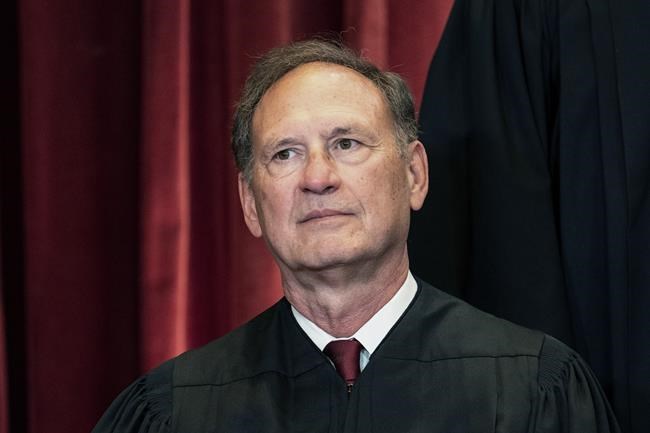
JUSTICE SAMUEL ALITO’S MAJORITY OPINION:
Alito’s opinion was joined by four other conservative justices. He wrote: “Roe was egregiously wrong from the start. Its reasoning was exceptionally weak, and the decision has had damaging consequences. And far from bringing about a national settlement of the abortion issue, Roe and Casey have enflamed debate and deepened division. It is time to heed the Constitution and return the issue of abortion to the people’s elected representatives.”
He said that “a right to abortion is not deeply rooted in the Nation’s history and traditions. On the contrary, an unbroken tradition of prohibiting abortion on pain of criminal punishment persisted from the earliest days of the common law until 1973.”
“Our Nation’s historical understanding of ordered liberty does not prevent the people’s elected representatives from deciding how abortion should be regulated.”
“Roe was also egregiously wrong and deeply damaging. For reasons already explained, Roe’s constitutional analysis was far outside the bounds of any reasonable interpretation of the various constitutional provisions to which it vaguely pointed. “
Alito said the justices who decided Roe v. Wade “usurped the power to address a question of profound moral and social importance that the Constitution unequivocally leaves for the people. Casey described itself as calling both sides of the national controversy to resolve their debate, but in doing so, Casey necessarily declared a winning side. Those on the losing side — those who sought to advance the State’s interest in fetal life — could no longer seek to persuade their elected representatives to adopt policies consistent with their views. The Court short-circuited the democratic process by closing it to the large number of Americans who dissented in any respect from Roe.”
He criticized the Roe decision by saying, “The scheme Roe produced looked like legislation, and the Court provided the sort of explanation that might be expected from a legislative body.”
“The contending sides in this case make impassioned and conflicting arguments about the effects of the abortion right on the lives of women. … The contending sides also make conflicting arguments about the status of the fetus. This Court has neither the authority nor the expertise to adjudicate those disputes.”
Alito responded to suggestions that the decision could imperil other rights such as a right to same-sex marriage and a right to contraception. He wrote that to “ensure that our decision is not misunderstood or mischaracterized, we emphasize that our decision concerns the constitutional right to abortion and no other right. Nothing in this opinion should be understood to cast doubt on precedents that do not concern abortion.”
Alito said the justices “cannot allow our decisions to be affected by any extraneous influences such as concern about the public’s reaction to our work.”
Near the end of his opinion, he wrote: “We do not pretend to know how our political system or society will respond to today’s decision overruling Roe and Casey. And even if we could foresee what will happen, we would have no authority to let that knowledge influence our decision. We can only do our job, which is to interpret the law … and decide this case accordingly.”
___
JUSTICE CLARENCE THOMAS JOINED THE MAJORITY BUT WROTE SEPARATELY:
Thomas called on the court to overturn rulings protecting same-sex marriage, gay sex and the use of contraceptives. He said that in “in future cases, we should reconsider all of this Court’s substantive due process precedents.”
___
JUSTICE BRETT KAVANAUGH ALSO JOINED THE MAJORITY BUT WROTE SEPARATELY:
Kavanaugh wrote to explain his belief that the Constitution is “neither pro-life nor pro-choice” but neutral and that the court’s decision “today properly returns the Court to a position of neutrality” and lets Americans decide the issue through the democratic process. He noted that the decision “does not outlaw abortion” throughout the country. He said his view is that a state can’t bar a resident from “traveling to another State to obtain an abortion” or “retroactively impose liability or punishment for an abortion that occurred before today’s decision.”
___
CHIEF JUSTICE JOHN ROBERTS:
Roberts didn’t join his conservative colleagues in overturning Roe and Casey. He wrote there was no need to overturn the broad precedents to rule in favor of a Mississippi abortion law at issue in the case.
“I would take a more measured course. I agree with the Court that the viability line established by Roe and Casey should be discarded under a straightforward stare decisis analysis. That line never made any sense. Our abortion precedents describe the right at issue as a woman’s right to choose to terminate her pregnancy. That right should therefore extend far enough to ensure a reasonable opportunity to choose, but need not extend any further — certainly not all the way to viability.”
___
THE JOINT DISSENT BY JUSTICES STEPHEN BREYER, SONIA SOTOMAYOR AND ELENA KAGAN:
The justices wrote that following the court’s decision “from the very moment of fertilization, a woman has no rights to speak of. A State can force her to bring a pregnancy to term, even at the steepest personal and familial costs.”
They put it another way: “As of today, this Court holds, a State can always force a woman to give birth, prohibiting even the earliest abortions.”
The justices said allowing each state to set its own abortion laws “is cold comfort, of course, for the poor woman who cannot get the money to fly to a distant State for a procedure. Above all others, women lacking financial resources will suffer from today’s decision.”
The justices warned more restrictions could come: “Most threatening of all, no language in today’s decision stops the Federal Government from prohibiting abortions nationwide, once again from the moment of conception and without exceptions for rape or incest.”
“The majority (or to be more accurate, most of it) is eager to tell us today that nothing it does” casts doubt on precedents that do not concern abortion. “But how could that be? The lone rationale for what the majority does today is that the right to elect an abortion is not ‘deeply rooted in history.’”

The dissenters noted the many years that Roe and Casey have been in effect: “The majority has no good reason for the upheaval in law and society it sets off. Roe and Casey have been the law of the land for decades, shaping women’s expectations of their choices when an unplanned pregnancy occurs.”
The liberal justices said the decision was attributable to that the court has become more conservative with the addition of new members: “The Court reverses course today for one reason and one reason only: because the composition of this Court has changed.”
They ended: “With sorrow — for this Court, but more, for the many millions of American women who have today lost a fundamental constitutional protection — we dissent.”
___
For AP’s full coverage of the Supreme Court ruling on abortion, go to https://apnews.com/hub/abortion
Related Articles
Supreme Court overturns Roe v. Wade; states can ban abortion
Advertisement Advertise With Us
Advertisement Advertise With Us