Manitobans open to private help to clear backlogs: poll

Advertisement
Read this article for free:
or
Already have an account? Log in here »
To continue reading, please subscribe:

Digital Subscription
One year of digital access for only $205*
- Enjoy unlimited reading on winnipegfreepress.com
- Read the E-Edition, our digital replica newspaper
- Access News Break, our award-winning app
- Play interactive puzzles
*First annual payment billed as $205.00 + GST for one year. This annual subscription will automatically renew at $233.00 + GST every 52 weeks (10% off the regular annual price of $259.35). Offer available to new and qualified returning subscribers only. Cancel any time.
To continue reading, please subscribe:
Add Free Press access to your Brandon Sun subscription for only an additional
$1 for the first 4 weeks*
- Enjoy unlimited reading on winnipegfreepress.com
- Read the E-Edition, our digital replica newspaper
- Access News Break, our award-winning app
- Play interactive puzzles
*Your next Brandon Sun subscription payment will increase by $1.00 and you will be charged $17.95 plus GST for four weeks. After four weeks, your payment will increase to $24.95 plus GST every four weeks.
Read unlimited articles for free today:
or
Already have an account? Log in here »
Hey there, time traveller!
This article was published 24/06/2022 (1539 days ago), so information in it may no longer be current.
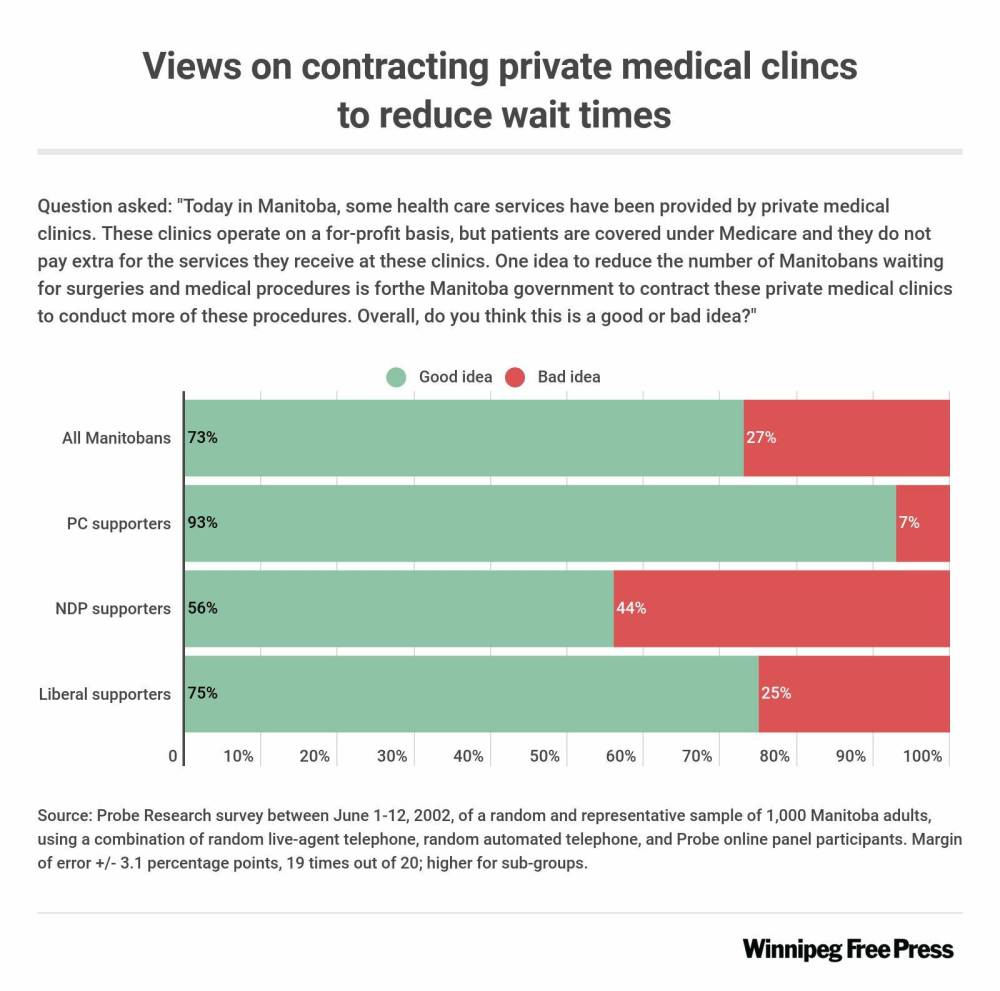
Nearly three-quarters of Manitobans think it’s a good idea for government to contract out more surgical and other medical procedures to private clinics to help clear the backlog created during the COVID-19 pandemic.
According to a Probe Research/Free Press poll conducted in early June, 74 per cent of respondents said it’s either a “very good” or “somewhat good” idea to increase capacity in the health-care system through private providers.
“It does show that there’s an openness to it, there’s a willingness to going in that direction,” said Curtis Brown, principal at Probe Research Inc.
It also depends what the details are around contracting out, said Brown. Probe made it clear in the polling question that fees charged by private clinics would be covered by the province, not the patient.

“People were looking at this and evaluating it on the basis that patients are covered under Medicare — they don’t have to pay,” said Brown. “If that caveat had not been in there then maybe support for that idea would be a little bit lower.”
The province has for decades used private clinics such as Western Surgery Centre in Winnipeg to provide surgical services to the public, at no cost to patients. With a backlog of surgeries now measuring in the tens of thousands, the province is looking to expand capacity by issuing requests for service (RFS) that both private and publicly administered health facilities can bid on.
According to the Probe poll, it’s an approach most Manitobans support. Even among NDP supporters — a political party not known for promoting the use of for-profit clinics — 56 per cent said they were in favour of their use (more than nine of 10 PC party supporters approve of the idea).
The Manitoba government has been using the RFS process for several years for services such as cataract surgeries and other procedures. Proponents of the move say doing so encourages publicly funded facilities to find efficiencies and help keep costs down. For less complex procedures, including those that don’t require high levels of anesthetic and nursing support (or overnight hospital stays), private clinics have played a key role in helping build capacity in Manitoba’s health-care system.
However, with the urgency around clearing surgical backlogs created by the pandemic, some within the system have expressed frustration that the procurement process is taking too long and is delaying efforts to bring down wait times. Some hospitals, such as Misericordia Health Centre, have had the capacity for several years to do more procedures, but have not always received the provincial funding required to do so. Misericordia has made several submissions in recent months to the province’s diagnostic and surgical recovery task force to increase the number of cataract surgeries it performs. However, due to changing approval requirements and other red tape, the awarding of contracts has been slow. Misericordia was forced to re-submit its latest proposal in early June.
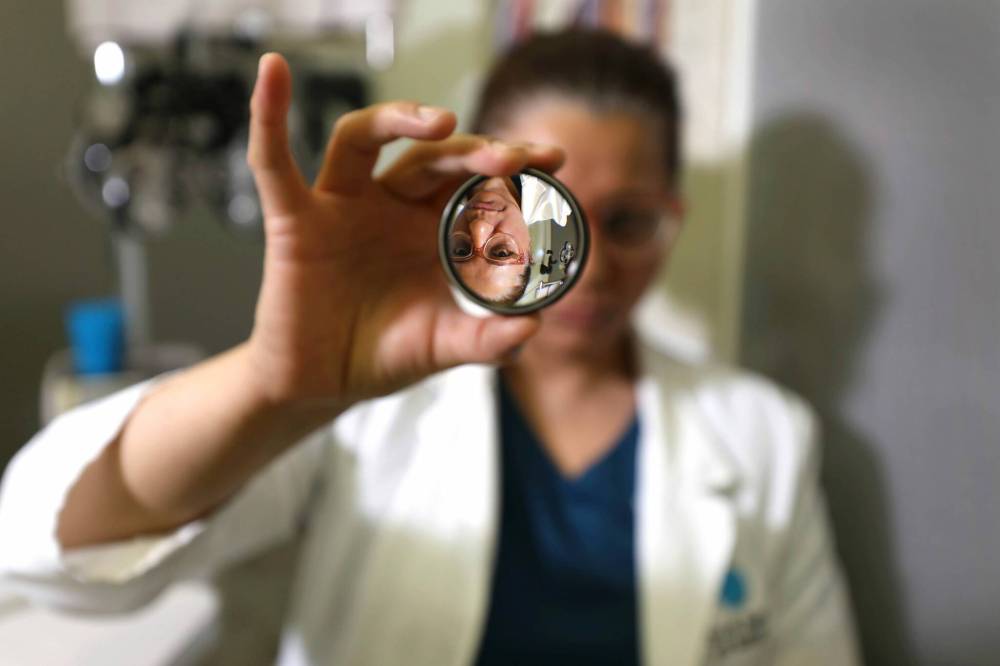
“I don’t really understand why Misericordia is being asked to compete with private centres,” said Dr. Jennifer Rahman, an ophthalmologist who performs cataract surgeries at Misericordia. Rahman, who is also president of the Eye Physicians and Surgeons of Manitoba, said given the massive backlog for cataract surgeries, the province should have funded Misericordia for more procedures long ago outside the RFS process.
Misericordia is budgeted to perform 9,045 cataract surgeries per year. Unless it gets additional funding from the province beyond that, its volume is capped at that level.
Rahman said even before the pandemic, Misericordia was forced to stop performing surgeries at certain times of the year because of the funding cap. It had the staff and operating room to do more, but not the funding from the province to pay for the incremental costs of each surgery.
“I don’t really understand why Misericordia is being asked to compete with private centres.” – Dr. Jennifer Rahman
“We sometimes approach that cap and then we’re told by the administrators that we’re running out of budget, so we’re going to have to shut down the OR,” said Rahman. “We’ve been told that a few years in a row, that we have to shut down the OR because we’re going over budget.”
According to data released last month by the Canadian Institute for Health Information, Manitoba had the longest wait times in Canada in 2021 for cataracts (90th percentile). Only 39 per cent of patients in Manitoba received their cataract surgery within the 16-week medically recommended benchmark, the second worst showing among the provinces.
While private clinics may be able to help reduce those wait times for less complex cases, Rahman said Misericordia needs more and permanent funding to increase capacity, including for patients with more complicated conditions.
“Just let us do as many as we can do,” said Rahman. “Let’s get the job done.”
tom.brodbeck@freepress.mb.ca
Tom has been covering Manitoba politics since the early 1990s and joined the Winnipeg Free Press news team in 2019.
Our newsroom depends on a growing audience of readers to power our journalism. If you are not a paid reader, please consider becoming a subscriber.
Our newsroom depends on its audience of readers to power our journalism. Thank you for your support.
Tom has been covering Manitoba politics since the early 1990s and joined the Winnipeg Free Press news team in 2019.
Our newsroom depends on a growing audience of readers to power our journalism. If you are not a paid reader, please consider becoming a subscriber.
Our newsroom depends on its audience of readers to power our journalism. Thank you for your support.
Related Articles
Hip, knee backlog pressure settles in on wait times
Advertisement Advertise With Us
Advertisement Advertise With Us