WEATHER ALERT

Supreme Court limits reach of federal gun crime law

Advertisement

Advertise with us

WASHINGTON (AP) — The Supreme Court on Tuesday limited the reach of a federal statute that requires stiff penalties for crimes involving a gun.

Read this article for free:


By clicking the button above, an account will be created and you will begin to receive some of our recommended newsletters. You may opt out of any newsletter by visiting your Email and Communication Preferences page or by clicking "unsubscribe" at the bottom of any email.

or

Already have an account? Log in here »

To continue reading, please subscribe:

Digital Subscription

One year of digital access for only $1.44 a week*

  • Enjoy unlimited reading on winnipegfreepress.com
  • Read the E-Edition, our digital replica newspaper
  • Access News Break, our award-winning app
  • Play interactive puzzles

*Billed as $5.77 plus GST every four weeks. After 52 weeks, price increases to the regular rate of $19.95 plus GST every four weeks. Offer available to new and qualified returning subscribers only. Cancel any time.

To continue reading, please subscribe:

Add Free Press access to your Brandon Sun subscription for only an additional

$1 for the first 4 weeks*

  • Enjoy unlimited reading on winnipegfreepress.com
  • Read the E-Edition, our digital replica newspaper
  • Access News Break, our award-winning app
  • Play interactive puzzles
Start now

*Your next Brandon Sun subscription payment will increase by $1.00 and you will be charged $17.95 plus GST for four weeks. After four weeks, your payment will increase to $24.95 plus GST every four weeks.

Hey there, time traveller!
This article was published 21/06/2022 (1595 days ago), so information in it may no longer be current.

WASHINGTON (AP) — The Supreme Court on Tuesday limited the reach of a federal statute that requires stiff penalties for crimes involving a gun.

The 7-2 decision united both conservative and liberal justices, though one dissenting justice compared the result to “Alice in Wonderland.” The justices said the law can’t be used to lengthen the sentences of criminals convicted of a specific attempted robbery offense.

The case before the justices involved Justin Taylor, who in the early 2000s was a marijuana dealer in the area of Richmond, Virginia. The government has said he sold large quantities of marijuana to other dealers who distributed it. In 2003 he and another man planned to steal money from a buyer, and during the robbery the accomplice fatally shot the man.

Taylor was charged with “attempted Hobbs Act robbery,” a federal crime punishable by up to 20 years in prison. He was also charged under a federal statute that outlines mandatory minimum sentences for using a firearm in connection with a “crime of violence.” Taylor pleaded guilty to both and was given a 30-year sentence, 10 years longer than he could have received for just the robbery charge.

A majority of the court, however, ruled that attempted Hobbs Act robbery does not qualify as a crime of violence and therefore that Taylor was not eligible for the longer sentence.

“Simply put, no element of attempted Hobbs Act robbery requires proof that the defendant used, attempted to use, or threatened to use force,” Justice Neil Gorsuch wrote for a majority of the court.

The justices upheld a federal appeals court ruling that Taylor should be re-sentenced just on the attempted Hobbs Act robbery charge.

In a dissent, Justice Clarence Thomas cited Lewis Carroll’s “Alice in Wonderland” and “Through the Looking Glass.” He said the decision is an example of how the court’s approach to deciding these kinds of cases has led lower courts on a “journey Through the Looking Glass” during which the justices have found many “strange things.” He said that like Alice, the court has strayed far “down the rabbit hole.”

“I would hold Taylor accountable for what he actually did and uphold his conviction,” he wrote.

Justice Samuel Alito also dissented, agreeing that the court’s cases in this area of the law have “veered off into fantasy land.”

Frances Pratt, one of Taylor’s attorneys, said in an email that his attorneys are “gratified to know that the Supreme Court ruled for our client” and hope the decision will also help others.

The case is United States v. Taylor, 20-1459.

Report Error Submit a Tip

More Stories

Expect a reasonable approach to keep Manitoba’s minimum wage out of cellar

Tom Brodbeck 5 minute read Preview

Expect a reasonable approach to keep Manitoba’s minimum wage out of cellar

Tom Brodbeck 5 minute read Tuesday, May. 31, 2022

The devil will be in the details when it comes to how much the Stefanson government will increase the minimum wage in 2022 under proposed legislation that’s expected to become law this week.

My prediction: government will boost the base wage by at least $1.10 an hour this year.

As expected, the Stefanson government plans to alter its inflation-based formula for setting the minimum wage, which now stands at $11.95 an hour. Normally, the base wage is indexed to the previous year’s rate of inflation. That’s sound policy during normal times. However, with inflation growing at rates not seen in more than 30 years, an immediate adjustment is required to ensure minimum-wage earners don’t lose purchasing power.

Conservative governments in Saskatchewan, Ontario and New Brunswick have all announced significant increases to their base wages in 2022, putting pressure on the Stefanson government to follow suit. Failure to do so would see Manitoba’s minimum wage (previously scheduled to rise 40 cents an hour to $12.35 on Oct. 1) rank lowest in the country.

Read
Tuesday, May. 31, 2022

Salt Lake, Sapporo head race to 2030 Olympics, and maybe '34

Stephen Wade, The Associated Press 5 minute read Preview

Salt Lake, Sapporo head race to 2030 Olympics, and maybe '34

Stephen Wade, The Associated Press 5 minute read Monday, May. 2, 2022

Fraser Bullock, who leads Salt Lake City's bid to return the Winter Olympics to Utah, sounds very confident about success.

“I believe we'll host a future Game(s). It's a question of when,” he said last week in a local television interview.

But will it be in 2030, the first opening on the IOC calendar? Or might the International Olympic Committee make a double award and also name the 2034 host? When it had two strong candidates 4 1/2 years ago for the Summer Games, the IOC selected Paris for the 2024 Olympics and Los Angeles for 2028.

The IOC isn't saying. An announcement is expected early next year, with media reports in Salt Lake City suggesting a decision in May 2023.

Read
Monday, May. 2, 2022

Comfort, kindness, acceptance and grandpa’s store

Deborah Schnitzer 5 minute read 2:00 AM EST

My grandfather, Ben W. Kert, had a women’s dress shop along Queen Street in Sault Ste. Marie where a number of Jewish men, many of them “Greenies” from the old country, owned and operated women’s haberdasheries with variable success.

Ben had come from Quebec via Northern Manitoba and Fort Frances, a singular man whose French was as good as his English and whose great heart filled my childhood with glory.

Unlike the other Jewish store owners, Ben W. was born in Trois-Rivières, the only male child who survived with five or six sisters born ahead of him.

Legend has it that my grandfather’s arrival and survival were celebrated with the nickname Sonny. When he left home at 15 (rumour claims his stepmother threw him out) and arrived in Montreal, his first employer would not accept the nickname, so my grandfather invented Ben W. on the spot. The W. never stood for anything. When he died, my mother discovered that his first name was actually Harry.

Russian Olympic biathlon champion loses Sochi doping case

Graham Dunbar, The Associated Press 4 minute read Preview

Russian Olympic biathlon champion loses Sochi doping case

Graham Dunbar, The Associated Press 4 minute read Thursday, Sep. 24, 2020

GENEVA - Two-time Olympic biathlon champion Olga Zaitseva lost her appeal Thursday against disqualification from the 2014 Sochi Olympics for her part in Russia’s state-backed doping program.

The Court of Arbitration for Sport said its judges upheld the International Olympic Committee’s disciplinary ruling of 2017, which used evidence against Zaitseva from Russian whistleblower Grigory Rodchenkov.

Zaitseva’s disqualification from all her Sochi events strips Russia of its silver medal in the women’s biathlon 4x6-kilometre relay. She won — and will retain — her gold medals from the same relay event at the two previous Winter Games in 2006 and 2010.

Her lawyer in Switzerland, Yvan Henzer, said Zaitseva would appeal the CAS ruling at Switzerland’s supreme court. The federal court typically only intervenes if legal process was abused.

Read
Thursday, Sep. 24, 2020

Oleksiak makes history with seventh Olympic medal

The Canadian Press 7 minute read Preview

Oleksiak makes history with seventh Olympic medal

The Canadian Press 7 minute read Sunday, Aug. 1, 2021

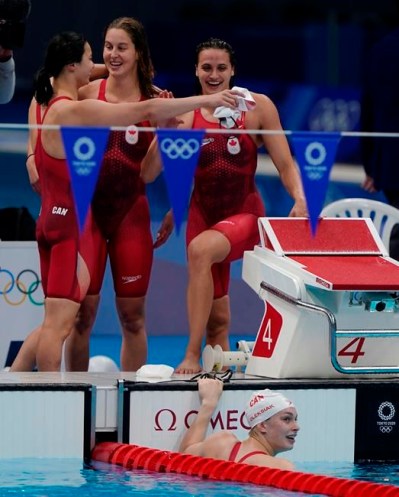
TOKYO - The Canadian women finished their impressive medal haul in the pool – including a record-setting performance from Penny Oleksiak – and Andre De Grasse finally got Canada's men on the board with his second consecutive Olympic bronze in the men's 100 metres.

After finishing third in the medley relay, Maggie Mac Neil draped a bronze medal brimming with significance around Oleksiak's neck as their teammates Kylie Masse and Sydney Pickrem celebrated on the podium.

"Most decorated," they chanted in unison with their arms around each other during post-ceremony interviews with reporters.

On the final day of swimming competition at the Tokyo Olympics, Toronto's Oleksiak took her place at the top among Canada's greatest Olympians. In helping the medley relay team win bronze, she earned her seventh career Olympic medal, and at just 21 became the most decorated Canadian Olympian of all time.

Read
Sunday, Aug. 1, 2021

Second plant-based protein plant planned in Manitoba to meet vegan meat demand

Martin Cash 5 minute read Preview

Second plant-based protein plant planned in Manitoba to meet vegan meat demand

Martin Cash 5 minute read Tuesday, Jul. 16, 2019

Manitoba is about to become a key production centre for plant-based protein with a second pea-protein production plant about to break ground.

Merit Functional Foods Corporation is building a $65-million, 65,000-square-foot facility that will produce both pea and canola protein.

The French company, Roquette, is building a $400-million pea protein plant in Portage la Prairie.

Merit is a 60-40 partnership between an investor group made up of Shaun Crew, Barry Tomiski and Ryan Bracken -- all veteran senior management and founders of Hemp Oil Canada Inc./Manitoba Harvest -- and Burcon NutraScience Corp., a publicly traded Vancouver company with strong links to Winnipeg where it has had a research lab for 20 years.

Read
Tuesday, Jul. 16, 2019