Public health agency trying to find out how many Canadians struggling with long COVID

Advertisement

Advertise with us

OTTAWA - Federal agencies are trying to get a handle on how many Canadians may be suffering from long COVID as researchers learn more about the mysterious after-effects of the virus.

Read this article for free:


By clicking the button above, an account will be created and you will begin to receive some of our recommended newsletters. You may opt out of any newsletter by visiting your Email and Communication Preferences page or by clicking "unsubscribe" at the bottom of any email.

or

Already have an account? Log in here »

To continue reading, please subscribe:

Digital Subscription

One year of digital access for only $1.44 a week*

  • Enjoy unlimited reading on winnipegfreepress.com
  • Read the E-Edition, our digital replica newspaper
  • Access News Break, our award-winning app
  • Play interactive puzzles

*Billed as $5.77 plus GST every four weeks. After 52 weeks, price increases to the regular rate of $19.95 plus GST every four weeks. Offer available to new and qualified returning subscribers only. Cancel any time.

To continue reading, please subscribe:

Add Free Press access to your Brandon Sun subscription for only an additional

$1 for the first 4 weeks*

  • Enjoy unlimited reading on winnipegfreepress.com
  • Read the E-Edition, our digital replica newspaper
  • Access News Break, our award-winning app
  • Play interactive puzzles
Start now

*Your next Brandon Sun subscription payment will increase by $1.00 and you will be charged $17.95 plus GST for four weeks. After four weeks, your payment will increase to $24.95 plus GST every four weeks.

Hey there, time traveller!
This article was published 06/05/2022 (1639 days ago), so information in it may no longer be current.

OTTAWA – Federal agencies are trying to get a handle on how many Canadians may be suffering from long COVID as researchers learn more about the mysterious after-effects of the virus.

The Public Health Agency of Canada and Statistics Canada have launched a survey to try to get a broad idea of how common it is for people to feel lingering effects after COVID-19 infection, which can be difficult to identify and even harder to track.

“We probably anticipate that the impact of long COVID is going to be quite substantial,” chief public health officer Dr. Theresa Tam said at a media briefing Friday.
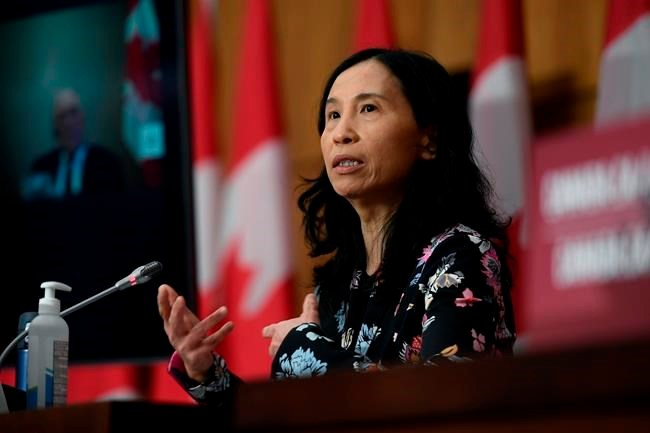
Chief Public Health Officer of Canada Dr. Theresa Tam speaks during a news conference in Ottawa on Tuesday, Dec. 22, 2020. Tam says the government is trying to find out how many Canadians are suffering from long-COVID as researchers try to learn more about the prolonged affects of the virus. THE CANADIAN PRESS/Justin Tang

Relatively little is known about the effects of long COVID, also known as post-COVID-19 condition, including how to diagnose it, how long it lasts or how best to treat it.

It can affect people who were hit hard by their initial COVID-19 symptoms, but it’s also been noted in people who had hardly any COVID-19 symptoms at all.

The public health agency says there have been reports of more than 100 potential symptoms associated with the condition.

The most common ones, according to PHAC, include fatigue, memory problems, anxiety, depression and even post-traumatic stress disorder.

The wide array of symptoms, coupled with the fact that few jurisdictions provide documented COVID-19 tests, make it difficult to know how many people are still suffering the effects of an infection.

Early indications from the World Health Organization showed 10 to 20 per cent of people infected with the virus would go on to have symptoms of long COVID. Tam said more up-to-date research indicates it could actually be as high as 50 per cent.

“Long COVID symptoms can be quite broad and non-specific, and so depending on the questions and the questionnaire, you might elicit different answers,” Tam said of the complexity of nailing down long COVID cases.

The survey will hopefully give public health officials a broad understanding of how many people are dealing with long COVID and could even help nail down whether certain geographic areas or segments of the population are being hit harder, she said.

The federal government will also look at information gathered from provincial health systems as well as clinics that have been established to specifically deal with long COVID cases.

Tam said there’s emerging evidence that COVID-19 vaccines offer some protection against long COVID, but those studies are still ongoing, and the best way to avoid long-COVID is to avoid catching COVID-19 altogether.

The number of new cases appears to be trending down, Tam said, though the number of people hospitalized with COVID-19 remains high in some parts of the country.

The federal government dedicated $20 million over the next five years in its latest budget to support research into the long-term effects of COVID-19 infections, as well as wider impacts of the virus on health and health-care systems.

One of the things researchers are looking for is a better way to diagnose the nebulous condition.

Tam said the survey may give public health officials a better understanding of antibody data, which may even lead to better diagnostic tools for past COVID-19 infection and long COVID.

This report by The Canadian Press was first published May 6, 2022.

Report Error Submit a Tip

More Stories

Human rights museum responds to reopening backlash

Julia-Simone Rutgers 4 minute read Preview

Human rights museum responds to reopening backlash

Julia-Simone Rutgers 4 minute read Thursday, Jul. 29, 2021

The Canadian Museum for Human Rights reopened to fully vaccinated members of the public this week, drawing cries of discrimination from those who have chosen not to get vaccinated against COVID-19.

While the some of the backlash has been “disturbing,” museum CEO Isha Khan said the conflict has opened room for a conversation about human rights during the pandemic.

“We made the decision to open in compliance with that law, really because we’re a public institution and we saw it as our responsibility to open as soon as we could to the public — within the restrictions as they currently are,” Khan said Thursday.

“But it’s really important to us, as the Canadian Museum for Human Rights we have a mandate for human rights education, that we’re trying to ground the conversation in human rights principles.”

Read
Thursday, Jul. 29, 2021

Fact Check

1 minute read Thursday, Nov. 30, 2023

Fact Check

Having problems with the form?Contact Us Directly |

Nobel laureate Toni Morrison dead at 88

Hillel Italie, The Associated Press 18 minute read Preview

Nobel laureate Toni Morrison dead at 88

Hillel Italie, The Associated Press 18 minute read Tuesday, Aug. 6, 2019

NEW YORK - Nobel laureate Toni Morrison, a pioneer and reigning giant of modern literature whose imaginative power in "Beloved," ''Song of Solomon" and other works transformed American letters by dramatizing the pursuit of freedom within the boundaries of race, has died at age 88.

Publisher Alfred A. Knopf announced that Morrison died Monday night at Montefiore Medical Center in New York. Morrison's family issued a statement through Knopf saying she died after a brief illness.

"Toni Morrison passed away peacefully last night surrounded by family and friends," the family announced. "The consummate writer who treasured the written word, whether her own, her students or others, she read voraciously and was most at home when writing."

Few authors rose in such rapid, spectacular style. She was nearly 40 when her first novel, "The Bluest Eye," was published. By her early 60s, after just six novels, she had become the first black woman to receive the Nobel literature prize, praised in 1993 by the Swedish academy for her "visionary force" and for her delving into "language itself, a language she wants to liberate" from categories of black and white. In 2012, Barack Obama awarded her a Presidential Medal of Freedom.

Read
Tuesday, Aug. 6, 2019

PHAC tries to get idea of how many have long COVID

Laura Osman, The Canadian Press 4 minute read Preview

PHAC tries to get idea of how many have long COVID

Laura Osman, The Canadian Press 4 minute read Friday, May. 6, 2022

OTTAWA - Federal agencies are trying to get a handle on how many Canadians may be suffering from long COVID as researchers learn more about the mysterious after-effects of the virus.

The Public Health Agency of Canada and Statistics Canada have launched a survey to try to get a broad idea of how common it is for people to feel lingering effects after COVID-19 infection, which can be difficult to identify and even harder to track.

"We probably anticipate that the impact of long COVID is going to be quite substantial," chief public health officer Dr. Theresa Tam said at a media briefing Friday.

Relatively little is known about the effects of long COVID, also known as post-COVID-19 condition, including how to diagnose it, how long it lasts or how best to treat it.

Read
Friday, May. 6, 2022

Olympics Overnight: Speedskater Blondin wins silver in the mass start, Bowman narrowly misses podium in halfpipe skiing, Jamaica returns to bobsled track

Richie Assaly - Toronto Star, Toronto Star 6 minute read Preview

Olympics Overnight: Speedskater Blondin wins silver in the mass start, Bowman narrowly misses podium in halfpipe skiing, Jamaica returns to bobsled track

Richie Assaly - Toronto Star, Toronto Star 6 minute read Saturday, Feb. 19, 2022

Here’s what you missed overnight at Day 15 of the 2022 Beijing Olympics.

Read
Saturday, Feb. 19, 2022

Letters, Oct. 31

6 minute read 2:01 AM CDT

Civic election a missed opportunity

The outcome of the latest municipal election in Winnipeg is nothing short of baffling. The decline of what was once a proud, beautiful prairie hub is impossible to ignore.

Winnipeg is rapidly sliding into a state of structural and social dilapidation, yet voters have inexplicably chosen to hand incumbent Mayor Scott Gillingham a second term. The decision smells of complacency, and sadly, it represents a massive missed opportunity for real urban renewal.

Walking through downtown Winnipeg today is an exercise in heartbreak. A city centre that should be a bustling economic and cultural core has instead transformed into an absolute eyesore. Encampments and tents are permitted to dot the heart of the city. Streets that used to thrive are now dominated by the tragic, visible reality of severe addiction, with individuals wandering and staggering through public spaces without adequate intervention or care.