Food prices soar to record levels on Ukraine war disruptions

Advertisement

Advertise with us

ROME (AP) — Prices for food commodities like grains and vegetable oils reached their highest levels ever last month largely because of Russia's war in Ukraine and the “massive supply disruptions” it is causing, threatening millions of people in Africa, the Middle East and elsewhere with hunger and malnourishment, the United Nations said Friday.

Read this article for free:


By clicking the button above, an account will be created and you will begin to receive some of our recommended newsletters. You may opt out of any newsletter by visiting your Email and Communication Preferences page or by clicking "unsubscribe" at the bottom of any email.

or

Already have an account? Log in here »

To continue reading, please subscribe:

Digital Subscription

One year of digital access for only $1.44 a week*

  • Enjoy unlimited reading on winnipegfreepress.com
  • Read the E-Edition, our digital replica newspaper
  • Access News Break, our award-winning app
  • Play interactive puzzles

*Billed as $5.77 plus GST every four weeks. After 52 weeks, price increases to the regular rate of $19.95 plus GST every four weeks. Offer available to new and qualified returning subscribers only. Cancel any time.

To continue reading, please subscribe:

Add Free Press access to your Brandon Sun subscription for only an additional

$1 for the first 4 weeks*

  • Enjoy unlimited reading on winnipegfreepress.com
  • Read the E-Edition, our digital replica newspaper
  • Access News Break, our award-winning app
  • Play interactive puzzles
Start now

*Your next Brandon Sun subscription payment will increase by $1.00 and you will be charged $17.95 plus GST for four weeks. After four weeks, your payment will increase to $24.95 plus GST every four weeks.

Hey there, time traveller!
This article was published 08/04/2022 (1667 days ago), so information in it may no longer be current.

ROME (AP) — Prices for food commodities like grains and vegetable oils reached their highest levels ever last month largely because of Russia’s war in Ukraine and the “massive supply disruptions” it is causing, threatening millions of people in Africa, the Middle East and elsewhere with hunger and malnourishment, the United Nations said Friday.

The U.N. Food and Agriculture Organization said its Food Price Index, which tracks monthly changes in international prices for a basket of commodities, averaged 159.3 points last month, up 12.6% from February. As it is, the February index was the highest level since its inception in 1990.

FAO said the war in Ukraine was largely responsible for the 17.1% rise in the price of grains, including wheat and others like oats, barley and corn. Together, Russia and Ukraine account for around 30% and 20% of global wheat and corn exports, respectively.
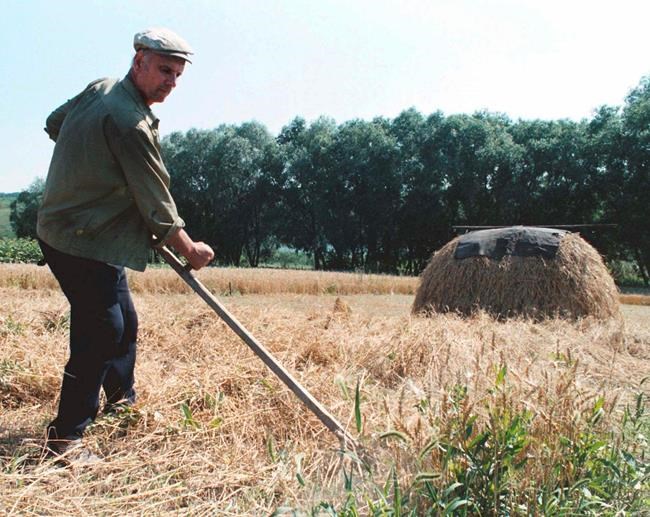
FILE--A private Ukrainian farmer Dmytro Hnatkevitch harvests wheat crop on his farm in the village of Grygorovka, 110 km south of Kiev, in August, 1996. Prices for food commodities like grains and vegetable oils reached their highest levels ever last month because of Russia's war in Ukraine and the “massive supply disruptions” it is causing, the United Nations said Friday, April 8, 2022. (AP Photo/Efrem Lukatsky)

While predictable given February’s steep rise, “this is really remarkable,” said Josef Schmidhuber, deputy director of FAO’s markets and trade division. “Clearly, these very high prices for food require urgent action.”

The biggest price increases were for vegetable oils: that price index rose 23.2%, driven by higher quotations for sunflower seed oil that is used for cooking. Ukraine is the world’s leading exporter of sunflower oil, and Russia is No. 2.

“There is, of course, a massive supply disruption, and that massive supply disruption from the Black Sea region has fueled prices for vegetable oil,” Schmidhuber told reporters in Geneva.

He said he couldn’t calculate how much the war was to blame for the record food prices, noting that poor weather conditions in the United States and China also were blamed for crop concerns. But he said “logistical factors” were playing a big role.

“Essentially, there are no exports through the Black Sea, and exports through the Baltics is practically also coming to an end,” he said.

Soaring food prices and disruption to supplies coming from Russia and Ukraine have threatened food shortages in countries in the Middle East, Africa and parts of Asia where many people already were not getting enough to eat.

Those nations rely on affordable supplies of wheat and other grains from the Black Sea region to feed millions of people who subsist on subsidized bread and bargain noodles, and they now face the possibility of further political instability.

Other large grain producers like the United States, Canada, France, Australia and Argentina are being closely watched to see if they can quickly ramp up production to fill in the gaps, but farmers face issues like climbing fuel and fertilizer costs exacerbated by the war, drought and supply chain disruptions.

In the Sahel region of Central and West Africa, the disruptions from the war have added to an already precarious food situation caused by COVID-19, conflicts, poor weather and other structural problems, said Sib Ollo, senior researcher for the World Food Program for West and Central Africa in Dakar, Senegal.

“There is a sharp deterioration of the food and nutrition security in the region,” he told reporters, saying 6 million children are malnourished and nearly 16 million people in urban areas are at risk of food insecurity.

Farmers, he said, were particularly worried that they would not be able to access fertilizers produced in the Black Sea region. Russia is a leading global exporter.

“The cost of fertilizers has increased by almost 30% in many places of this region due to the supply disruption that we see provoked by a crisis in Ukraine,” he said.

The World Food Program has appealed for $777 million to meet the needs of 22 million people in the Sahel region and Nigeria over six months, he said.

To address the needs of food-importing countries, the FAO was developing a proposal for a mechanism to alleviate the import costs for the poorest countries, Schmidhuber said. The proposal calls for eligible countries to commit to added investments in their own agricultural productivity to obtain import credits to help soften the blow.

Report Error Submit a Tip

More Stories

Transit driver killed in knife attack on U of M campus

8 minute read Preview

Transit driver killed in knife attack on U of M campus

8 minute read Tuesday, Feb. 14, 2017

A Winnipeg Transit driver was killed early this morning after he was stabbed by the only passenger on his bus at the University of Manitoba campus.

Irvine Jubal Fraser, 58, was rushed to hospital in critical condition but later died, police said.

The attack occurred at about 2 a.m. in the area of Dafoe Road West and Gillson Street.

Witnesses pointed officers led by the canine unit in the direction of the Red River, where a 22-year-old suspect trying to cross to the St. Vital side was arrested and taken into custody.

Read
Tuesday, Feb. 14, 2017

RCMP to bolster traffic enforcement after ‘concerning’ spike in deadly collisions

Free Press staff 3 minute read Preview

RCMP to bolster traffic enforcement after ‘concerning’ spike in deadly collisions

Free Press staff 3 minute read 12:46 PM CDT

Manitoba RCMP are boosting traffic enforcement after a spike in fatal collisions.

So far this year, 73 people have been killed in 65 collisions — a 28 per cent increase from the 57 deaths in the same January to October period last year, the Mounties said Friday.

The increase in fatalities is 28 per cent higher than the province’s five-year average.

“It’s concerning to me personally, but it’s also concerning to us, the RCMP, to see this many crashes occurring and this many people losing their lives,” RCMP traffic services enforcement commander Staff Sgt. Jon Greer said.

Read
12:46 PM CDT

Kinew will listen to city request for new taxes — but no promises

Nicole Buffie 5 minute read Preview

Kinew will listen to city request for new taxes — but no promises

Nicole Buffie 5 minute read Friday, Nov. 1, 2024

Premier Wab Kinew remained coy about whether he would support a new municipal tax in Winnipeg as the city struggles to maintain services.

Kinew dodged questions on the matter Friday afternoon.

“We want to see services strong, we want to see roads getting fixed,” Kinew said. “Affordability is really top of mind … we got to keep life affordable for the average person out there.”

Some of the items being considered for a new tax are: alcohol, online deliveries, vehicle registration, vacant homes, commercial parking and land transfers with an exemption for first-time homebuyers.

Read
Friday, Nov. 1, 2024

Security tightens at downtown library

Aldo Santin 5 minute read Preview

Security tightens at downtown library

Aldo Santin 5 minute read Saturday, Feb. 16, 2019

Users of the downtown Millennium Library will be subject to several new security screening measures, more commonly seen at airports and sporting facilities.

City hall announced Friday that effective Feb. 25, all visitors to the Donald Street library will undergo bag checks and be subjected to a hand-held metal detector sweep for alcohol and prohibited weapons. Visitors who refuse to participate will be barred from entering the library.

“The number of incidents (has) increased in the past four to five years, incidences involving violence, threats, alcohol, substance abuse and it was concerning. We met with police and our security contractor. After discussing, we came up with this course of action,” Ed Cuddy, manager of library services, told reporters. “We feel it’s a big change, but we feel it’s justified based on the kind of incidents we’ve been experiencing recently.”

Cuddy wouldn’t elaborate on the nature of the incidents, but did say library workers have not been the victims.

Read
Saturday, Feb. 16, 2019

Just say no (to deficits during good economic times)

Tom Brodbeck 5 minute read Preview

Just say no (to deficits during good economic times)

Tom Brodbeck 5 minute read Wednesday, Oct. 2, 2019

When a political party pledges to run small, “manageable” deficits if elected, it almost always means it will go deeper into the red if it wins government.

It’s human nature.

After all, as a government, if you get the blessing of the public to spend beyond your means, what’s a few billion more a year in overspending?

The problem is, it doesn’t usually end there. When those same politicians seek re-election, they often want permission to post even larger deficits. In some cases, they’ve abandoned the idea of balancing the books altogether, arguing perpetual deficit financing is acceptable, as long as the debt doesn’t exceed a certain percentage of the economy.

Read
Wednesday, Oct. 2, 2019

Meteorologist behind Rob’s Obs is moving weather station to Ontario

Ben Waldman 7 minute read Preview

Meteorologist behind Rob’s Obs is moving weather station to Ontario

Ben Waldman 7 minute read Monday, Jun. 13, 2022

In a Winnipeg winter, there are always at least two certainties: it will be cold, and it will snow. A third certainty: the people will talk endlessly about how frigid the temperature is, and argue about how much snow is cloaking their driveways. Is it colder than it ever has been? Is there more snow today than the same time last year?

Rob Paola likely knows the answers to those questions.

Paola possesses no super powers. He is but a man with a metre stick and 40 years of professional meteorological experience, in the midst of a lifelong love affair with Mother Nature, a most turbulent mistress who rarely, if ever, reciprocates.

Each year when snow begins to fall, Paola heads outside his Charleswood home to figure out how much. He sticks his ruler in the ground, grabs his clipboard, and clicks his pen. In neat script, he records the temperature, what time precipitation began, how deep the powder is stacked. Then, he shares his data and insights online with thousands of followers who want a clear answer to the eternal questions: Why is this happening? When will it stop? How much snow has fallen in the city of Winnipeg?

Read
Monday, Jun. 13, 2022