Germany seeks to boost renewable energy, cut Russian imports

Advertisement

Advertise with us

BERLIN (AP) — The German government unveiled a major package of reforms Wednesday to boost the production of renewable power, meet its climate goals and become independent of energy imports from hostile nations such as Russia.

Read this article for free:


or

Already have an account? Log in here »

To continue reading, please subscribe:

Subscribe and receive a limited-edition Free Press branded hat or tote.

Digital Subscription

One year of digital access for only $205*

  • Enjoy unlimited reading on winnipegfreepress.com
  • Read the E-Edition, our digital replica newspaper
  • Access News Break, our award-winning app
  • Play interactive puzzles

*First annual payment billed as $205.00 + GST for one year. This annual subscription will automatically renew at $233.00 + GST every 52 weeks (10% off the regular annual price of $259.35). Offer available to new and qualified returning subscribers only. Cancel any time.

To continue reading, please subscribe:

Add Free Press access to your Brandon Sun subscription for only an additional

$1 for the first 4 weeks*

  • Enjoy unlimited reading on winnipegfreepress.com
  • Read the E-Edition, our digital replica newspaper
  • Access News Break, our award-winning app
  • Play interactive puzzles
Start now

*Your next Brandon Sun subscription payment will increase by $1.00 and you will be charged $17.95 plus GST for four weeks. After four weeks, your payment will increase to $24.95 plus GST every four weeks.

Hey there, time traveller!
This article was published 06/04/2022 (1639 days ago), so information in it may no longer be current.

BERLIN (AP) — The German government unveiled a major package of reforms Wednesday to boost the production of renewable power, meet its climate goals and become independent of energy imports from hostile nations such as Russia.

The 600-page “Easter package” approved by Cabinet lays out ambitious goals for the expansion of offshore power and declares the installation of renewable energy to be of “overriding public interest” — a trump card meant to cut through Germany’s often lengthy bureaucratic processes.

Europe’s biggest economy aims to generate almost all of its electricity from renewable sources such as wind and solar by 2035 — more than doubling the current rate in 13 years. But the roll-out has slowed sharply in recent years due to complex rules and changes in feed-in subsidies.
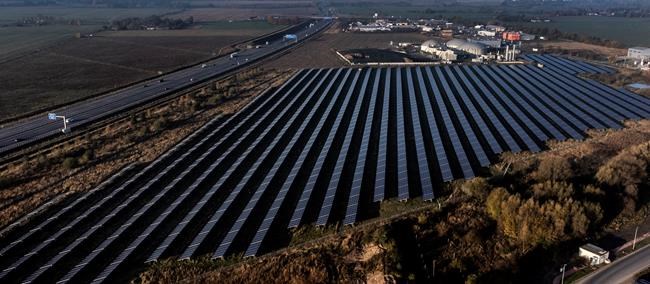
FILE -- A solar farm, front, and a biogas plant, rear, are seen in Oberkraemer, Germany, Thursday, Oct. 28, 2021. The German government presented a major package of reforms Wednesday to boost the construction of renewable power as part of its efforts to meet its climate goals and become independent of energy imports from hostile nations such as Russia. (AP Photo/Michael Sohn, file)

“In sum, this package will lead to a significant increase in renewable energy,” Economy and Energy Minister Robert Habeck told reporters in Berlin.

After adding no offshore wind in 2021, the new center-left government that took power in December said Germany will increase the installed capacity from under 8 Gigawatts currently to 30GW by 2030 and 40GW by 2035. The goal for 2045 — by when Germany aims to achieve “net zero”’ greenhouse gas emissions — is 70 GW of offshore wind capacity.

The government has also set a target of more than doubling onshore wind capacity to 115GW by 2030, including by reducing the minimum distance to certain radio beacons and weather radars. The goal for solar is even more ambitious: almost quadrupling the existing capacity to 215GW by the next decade.

Habeck acknowledged the enormity of the task and said Germany will likely miss its short-term targets for cutting greenhouse gas emissions due to failures of the past.

“It’s the precondition,” he said of the new measures, “not the solution for everything.” Further measures will be agreed in the coming months and many must be approved by parliament before they come into force.

The war in Ukraine would also affect plans, with Germany likely having to use more domestic coal to fill the short-term gap caused by a reduction in Russian energy imports, Habeck said.

Still, the government has already managed to significantly cut its purchase of Russian coal, oil and gas in recent months and aims to stop importing oil and coal from Russia this year, and gas by mid-2024, he said.

“You can see at what speed we are becoming independent of Russian energy,” he added.

Germany’s powerful industry lobby group BDI welcomed the new measures but warned that the targets will be tough to achieve.

Aside from renewables, Germany will also have to expand the use of hydrogen and biomass energy to safeguard the power supply during times when little wind or solar power can be generated, it said.

As Habeck unveiled the new energy package to journalists, about a dozen environmental activists glued themselves to a nearby bridge leading to the German parliament and chancellery.
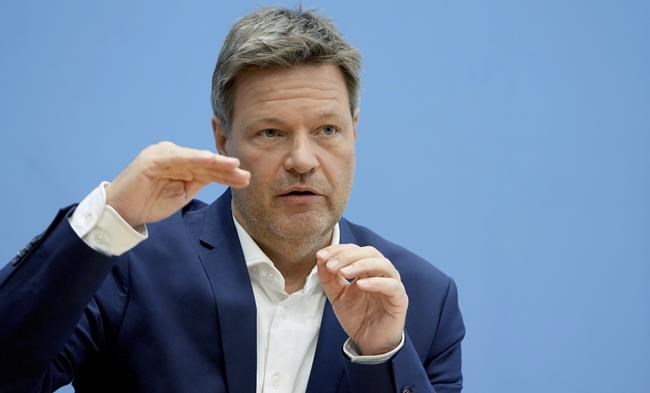
German Economy and Climate Minister Robert Habeck presents the government's so-called 'Easter Package' during a press conference in Berlin, Germany, Wednesday, April 6, 2022. (AP Photo/Michael Sohn)

Protester Cornelia Huth, a biologist and member of the group Scientist Rebellion, said Germany’s targets aren’t enough to meet the goals of the 2015 Paris climate agreement and should be even higher on account of the country’s high historical emissions.

Huth also called on the government to implement a number of measures she described as “no brainers” including a law against food waste and a universal speed limit.

Germany’s transport minister this week dismissed the idea of even a temporary speed limit of 130 kilometers per hour (81 mph) on the Autobahn, saying the country doesn’t have enough signs.

Neighboring Austria announced subsidies worth about 300 million euros ($327 million) Wednesday to install additional renewable energy facilities.

The Alpine nation is even more dependent on Russian gas than Germany, and Environment Minister Leonore Gewessler said every wind turbine or solar power facility “frees us from Vladimir Putin’s grip.”

___

Follow AP’s climate coverage at https://apnews.com/hub/climate

Report Error Submit a Tip

More Stories

Winnipeg Rifles can still secure post-season berth despite starting season 0-4

Joshua Frey-Sam 5 minute read Preview

Winnipeg Rifles can still secure post-season berth despite starting season 0-4

Joshua Frey-Sam 5 minute read 12:47 PM CDT

The Winnipeg Rifles have a seat at the table, something they would’ve certainly taken a few weeks ago.

A solid three-phase performance in a 25-13 win over the Edmonton Huskies on Sunday kept the junior football club’s playoff hopes alive as the team heads into the final week of the regular season in the Prairie Football Conference.

The path to punching their ticket isn’t easy, however. The Rifles must travel to a perennially difficult environment in Saskatoon to face the Hilltops (4-3) on Sunday (1 p.m.), a contest that only matters if the Huskies beat the Edmonton Wildcats on Saturday.

But after starting the season 0-4, it’s a deal that the Rifles will happily take.

Read
12:47 PM CDT

Soldiers battle COVID-19 in Garden Hill

Drew May  3 minute read Thursday, Jan. 28, 2021

BRANDON — Military members from Canadian Forces Base Shilo have returned to northern Manitoba to assist Garden Hill First Nation with a spike in COVID-19 cases.

The approximately 30 soldiers, along with medical personnel from Edmonton, arrived in the community Jan. 20, said Maj. James Cressall of 2nd Battalion, Princess Patricia’s Canadian Light Infantry, Charlie Company.

Members are helping with staffing at the local nursing station, doing wellness checks, and assisting with contact tracing, he said Wednesday.

Local test positivity numbers have stabilized since soldiers arrived, Cressall said, but are still high.

City considers first-come, first-served Transit Plus

Kevin Rollason 5 minute read Preview

City considers first-come, first-served Transit Plus

Kevin Rollason 5 minute read Friday, Sep. 11, 2020

The city's much-maligned Transit Plus, which is for people with disabilities, could soon do away with a system that prioritizes jobs and medical trips over recreation and visits with friends, in favour of first-come, first-served bookings.

While the city says the changes could mean Transit Plus users would no longer be guaranteed to get to work or medical appointments, several disability advocates are in favour of the move. They don't believe any trip should take priority over another.

Natalie Pirson has used Transit Plus, and the former Handi Transit system, for more than 20 years. She is pleased with the proposed changes, which will be discussed by the city's public works committee next week. Pirson was quick to point out the city will have to do more than change the booking system.

"I rely on Transit Plus for every aspect of my life," Pirson said on Thursday.

Read
Friday, Sep. 11, 2020

Port of Churchill signs agreement with Dutch port

Aaron Epp 2 minute read Preview

Port of Churchill signs agreement with Dutch port

Aaron Epp 2 minute read Yesterday at 4:40 PM CDT

Arctic Gateway Group, operator of the Port of Churchill, has signed an agreement with the Port of Rotterdam in the Netherlands to attract business and strengthen supply chains linking Western Canada and Europe.

The agreement enables the two ports to work together to develop new trade in critical minerals and energy products, connect Canadian producers with European buyers, and identify opportunities to improve the supply chain from Western Canadian resource projects through Churchill and into European markets.

The Port of Rotterdam is Europe’s largest port and home to more than 3,000 businesses across its industrial complex, serving as a major gateway for critical raw materials and energy.

Meanwhile, the Port of Churchill has been identified as a transformative national strategy for Canada and is emerging as a northern trade corridor connecting Western Canada’s resources to global markets.

Read
Yesterday at 4:40 PM CDT

Klein vows to freeze water, sewer rate for next two years

Joyanne Pursaga 5 minute read Preview

Klein vows to freeze water, sewer rate for next two years

Joyanne Pursaga 5 minute read Yesterday at 6:09 PM CDT

Mayoral candidate Kevin Klein is promising to cancel a water and sewer rate hike proposed for next year and freeze the fee for two years.

Klein said Winnipeggers are simply paying far too much for the utility.

“I think we have to freeze them right now because we’ve seen (a substantial increase) in the last four years. We are facing some of the most difficult financial times for families right now,” he said.

He would also ask the provincial Public Utilities Board to set Winnipeg’s future water and sewer rates, a power currently held by city council.

Read
Yesterday at 6:09 PM CDT

Night terrors

AV Kitching 7 minute read Preview

Night terrors

AV Kitching 7 minute read Monday, Oct. 20, 2025

Before we go any further, let me just unequivocally state: Six Pines is not for the weak.

I was so terrified my mind has effectively erased the entire experience.

I shall do my best to give you a comprehensive, cohesive review of the night my friend and I visited, but please forgive the lack of detail.

What you are about to read are snatches of memories, dragged kicking and screaming from the depths of my fear-addled brain, which is, even as I type, trying to block all attempts of retrieval.

Read
Monday, Oct. 20, 2025