You may soon be offered a fourth COVID-19 shot. What’s known about second boosters?
Advertisement
Read this article for free:
or
Already have an account? Log in here »
To continue reading, please subscribe:

Digital Subscription
One year of digital access for only $205*
- Enjoy unlimited reading on winnipegfreepress.com
- Read the E-Edition, our digital replica newspaper
- Access News Break, our award-winning app
- Play interactive puzzles
*First annual payment billed as $205.00 + GST for one year. This annual subscription will automatically renew at $233.00 + GST every 52 weeks (10% off the regular annual price of $259.35). Offer available to new and qualified returning subscribers only. Cancel any time.
To continue reading, please subscribe:
Add Free Press access to your Brandon Sun subscription for only an additional
$1 for the first 4 weeks*
- Enjoy unlimited reading on winnipegfreepress.com
- Read the E-Edition, our digital replica newspaper
- Access News Break, our award-winning app
- Play interactive puzzles
*Your next Brandon Sun subscription payment will increase by $1.00 and you will be charged $17.95 plus GST for four weeks. After four weeks, your payment will increase to $24.95 plus GST every four weeks.
Read unlimited articles for free today:
or
Already have an account? Log in here »
Hey there, time traveller!
This article was published 01/04/2022 (1651 days ago), so information in it may no longer be current.
More Canadians may soon be offered a fourth dose of the COVID-19 vaccine, but the extent of the protection it provides remains to be seen.
Canada’s advisory panel on vaccines is expected to update its guidance in coming days as concern mounts that the country could be on the brink of a sixth wave.
U.S. regulators approved additional boosters this week for Americans aged 50 and older if it’s been at least four months since their last dose, as well as certain younger people with severely weakened immune systems.
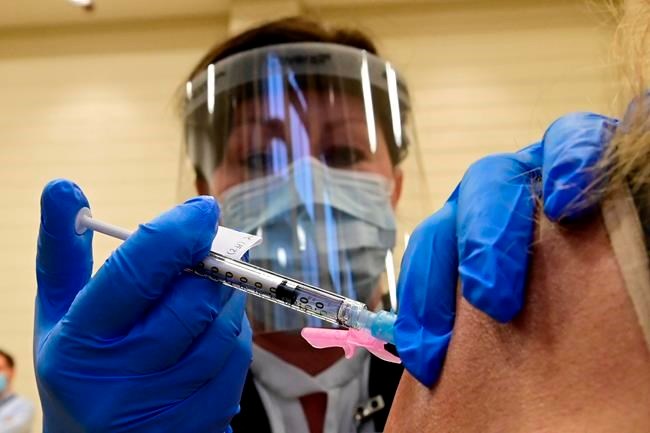
Here’s what scientists say about what could be ahead for Canada’s next stage in the COVID-19 fight.
WHO IS ELIGIBLE FOR A SECOND BOOSTER?
The National Advisory Committee on Immunization suggests anyone “moderately to severely immunocompromised” get a fourth dose six months after their third shot.
Many provinces have already prioritized this population and set their own guidelines on booster timing and eligibility.
As a number of provinces move to expand access to second boosters, a spokeswoman for the Public Health Agency of Canada said Thursday that it plans to publish NACI’s guidance in early April.
“NACI has been asked for advice on the potential use of second booster doses in elderly populations at higher risk of severe disease,” Anna Maddison said in an email.
In addition to immunocompromised people, Ontario offers fourth doses to residents of long-term care homes and other congregate assisted-living settings, while Quebec seniors aged 80 and older became eligible this week.
Meanwhile, B.C. Health Minister Adrian Dix signalled Thursday that the province is looking to extend more boosters to vulnerable groups such as long-term care residents, with details expected Tuesday.
WHAT’S THE POINT OF ANOTHER VACCINE?
Experts warn that current vaccines appear to be a poor match for the more infectious Omicron variant.
The goal of a booster shot is to restore protection that naturally fades over time, says Matthew Miller, an associate professor with McMaster University’s Immunology Research Centre.
A primary vaccine series trains the body to identify a virus and defend itself. Eventually, the immune system’s front-line fighters — antibodies — retreat, but it retains instructions on how to quickly deploy its defences if it encounters the virus, says Miller.
Boosters reactivate this immunological army, he says.
The problem, says Miller, is that these vaccine drills were designed to recognize the original version of the COVID-19 virus andOmicron’s heavy mutations make it better at evading detection.
“We know current vaccines are not a great match for Omicron,” Miller says of infection protection, underscoring that shots still guard well against severe illness and death.
“The current vaccine is really challenging our ability to protect against infection in the long term.”
However, there is evidence to suggest that boosters spur a short-term increase in antibody levels that can help stave off infection, Miller adds.
But those boosters should be reserved for those at highest risk if they get sick, such people with weakened immune systems and seniors.
WHAT DOES THE RESEARCH SAY?
Some scientists say data on second boosters is limited, and it’s unclear how much of a benefit another dose would provide.
Israel began offering people age 60 and older a second booster during its first Omicron surge. Preliminary findings posted online last week reported fewer deaths among those who chose another booster compared to those who skipped the fourth dose.
In a preprint paper that hasn’t been peer reviewed, researchers analyzed the health records of more than 1.1 million older Israelis and found that rates of confirmed infections and severe illness were lower among those who had two boosters compared to those who had just one.
Tim Evans, executive director of the COVID-19 Immunity Task Force, questions how applicable the Israeli findings are for Canada, given the drastic differences between the two countries’ vaccine strategies.
But Dan Gregson, an infectious disease physician and medical microbiologist at the University of Calgary, says while the evidence available may not be that strong, he’s satisfied that there’s enough to show that fourth doses are safe and don’t pose an increased risk of side-effects.
“It’s reasonable to move forward with the idea of protecting those who are at greatest risk,” he says.
WHAT’S NEXT?
Once the highest risk groups are covered, scientists expect that the fourth dose rollout will expand to otherwise healthy older adults, although they disagree on which cohorts should qualify, offering age cutoffs ranging from 50 to 75.
There is consensus, however, that it would be premature to offer younger Canadians a second booster in the near future, particularly when so many of them haven’t received their first.
Evans, the director of McGill’s School of Population and Global Health, says the priority should be to increase third-dose coverage, with federal figures indicating that only 47 per cent of the population has received a booster shot.
Earl Brown, a virologist and professor emeritus at the University of Ottawa, says the time interval between booster doses should be at least three to six months, adding that Canada’s strategy of delaying second doses suggests that waiting longer may give you more “bang for your buck.”
Moreover, there is reason to believe that boosting too often may offer diminishing returns, says Brown: “Some of the early data is showing that you can boost and boost and boost, but you sort of can’t get past a certain point.”
Miller adds that the recommendations on booster timing should be carefully calibrated to reflect the risks that people face, suggesting that it may be prudent to hold off on offering young people boosters until fall, when cases are expected to spike.

“We’re also concerned about apathy and acceptance if we keep telling people that they need to be boosted,” he says.
Going forward, Evans predicts that Canada will have to take a more targeted approach to immunization to reflect the varying protection across the population, particularly as breakthrough Omicron infections give more people “hybrid immunity.”
“Tailoring management of risk is going to have to be very, very sensitive to these different types of groupings within the population,” he says, “and anything but a one size fits all.”
This report by The Canadian Press was first published April 1, 2022.
Note to readers: This is a corrected story. A previous version mischaracterized prevailing expert opinion on the importance of fourth doses.
Related Articles
Second COVID-19 booster recommended for some: NACI
Advertisement Advertise With Us
Advertisement Advertise With Us