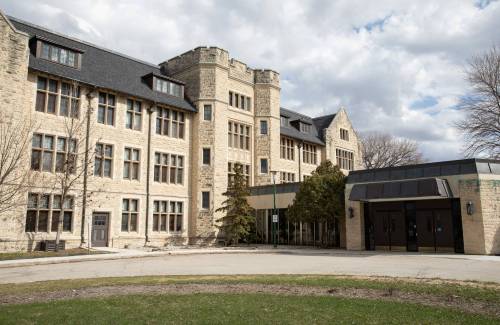
Mennonite programs in Ukraine face unsettled future

Advertisement
Read this article for free:
or
Already have an account? Log in here »
To continue reading, please subscribe:

Digital Subscription
One year of digital access for only $205*
- Enjoy unlimited reading on winnipegfreepress.com
- Read the E-Edition, our digital replica newspaper
- Access News Break, our award-winning app
- Play interactive puzzles
*First annual payment billed as $205.00 + GST for one year. This annual subscription will automatically renew at $233.00 + GST every 52 weeks (10% off the regular annual price of $259.35). Offer available to new and qualified returning subscribers only. Cancel any time.
To continue reading, please subscribe:
Add Free Press access to your Brandon Sun subscription for only an additional
$1 for the first 4 weeks*
- Enjoy unlimited reading on winnipegfreepress.com
- Read the E-Edition, our digital replica newspaper
- Access News Break, our award-winning app
- Play interactive puzzles
*Your next Brandon Sun subscription payment will increase by $1.00 and you will be charged $17.95 plus GST for four weeks. After four weeks, your payment will increase to $24.95 plus GST every four weeks.
Read unlimited articles for free today:
or
Already have an account? Log in here »
Hey there, time traveller!
This article was published 28/02/2022 (1683 days ago), so information in it may no longer be current.
For Winnipeg Mennonites who lead ministries serving seniors and other vulnerable people in southeastern Ukraine, it is an uncertain and troubling time.
“Everyone is in shock now,” Alvin Suderman, chairman of the board of the Friends of the Mennonite Centre in Ukraine, said of local staff members in Molochansk, about 120 kilometres from the region of Donetsk.
Russia has invaded Ukraine under the pretext of “liberating” separatist-held Donetsk and Luhansk.
The Mennonite centre’s director, who is also Ukrainian, has fled to Poland with her family.
“I could see the worry on her face when we talked,” Suderman said of a FaceTime call with her Thursday.
While there had been no fighting in Molochansk before Friday, residents heard explosions in the city of Melitopol, about 25 km away, and saw drones fly overhead.
The centre, which is located in a former Mennonite girl’s school built in 1906, has received a request to use its basement as a bomb shelter if needed, Suderman said.
“It’s very uncertain time,” he said last week, noting local staff members are safe and the centre’s programs to help seniors, orphans, poor families, local schools and people needing medical care are operating on a limited basis.
If the war continues and grows worse, he fears there could be a flood of refugees that will need assistance.
“We might have a new way to help people if that happens,” Suderman said.
But if Russia “decides it wants a land bridge from Crimea back to its own territory, it will go right through where the centre is,” he said.
“I don’t know if Russia will tolerate an outside aid group like ours,” Suderman said, adding he doesn’t know if the most recent transfer of funds from Canada to the centre will go through Ukrainian banks.
A similar story is told by Louie Sawatzky, who is project director for the Mennonite Family Centre operated by the Mennonite Benevolent Society of Manitoba.
“It’s not a good time for people in Ukraine and in the rest of the world,” he said.
Programs operated by the centre, located in Zaporizhzhia, about 100 km north of Molochansk, are closed.
“They will stay closed until we know what is possible,” Sawatzky said, noting local staff members provide programs for seniors, along with home care, respite and other services.
A week ago, Sawatzky asked staff how they were doing, and all said they planned to stay. “They didn’t think anything like this would take place,” he said, noting they have been living with the threat of invasion for years and had almost “become numb to it.”
“Now, anything could happen. We don’t know right now what we are going to do.”
Both centres were founded in the early 2000s after North American Mennonites on heritage tours to the former homeland in Ukraine saw the needs, especially for seniors. Funds for two centres comes from donors in Canada and the United States.
Suderman and Sawatzky called on Canadians to pray for all Ukrainians.
“It’s the only thing we can do as Christians when confronted by something seen to be so evil,” Sawatzky said. “The people we serve are so vulnerable.”
faith@freepress.mb.ca
The Free Press is committed to covering faith in Manitoba through our Religion in the News project. This reporting continues because readers like you step forward to fund it.
Donate now to support our reporting on religion.
Your donation is eligible for a charitable tax receipt.
BECOME A FAITH JOURNALISM SUPPORTER
John Longhurst has been writing for Winnipeg's faith pages since 2003. He also writes for Religion News Service in the U.S., and blogs about the media, marketing and communications at Making the News.
Our newsroom depends on a growing audience of readers to power our journalism. If you are not a paid reader, please consider becoming a subscriber.
Our newsroom depends on its audience of readers to power our journalism. Thank you for your support.
The Free Press is committed to covering faith in Manitoba through our Religion in the News project. This reporting continues because readers like you step forward to fund it.
Donate now to support our reporting on religion.
Your donation is eligible for a charitable tax receipt.
BECOME A FAITH JOURNALISM SUPPORTER
John Longhurst has been writing for Winnipeg's faith pages since 2003. He also writes for Religion News Service in the U.S., and blogs about the media, marketing and communications at Making the News.
Our newsroom depends on a growing audience of readers to power our journalism. If you are not a paid reader, please consider becoming a subscriber.
Our newsroom depends on its audience of readers to power our journalism. Thank you for your support.
Related Articles
‘Hurts to see’: Russians take over Mennonite building

Advertisement Advertise With Us
The Free Press acknowledges the financial support it receives from members of the city’s faith community, which makes our coverage of religion possible.