BEIJING SNAPSHOT: As Olympics ebb, smartphone synchronicity

Advertisement

Advertise with us

BEIJING (AP) — The smartphones glowed. The irony echoed.

Read this article for free:


or

Already have an account? Log in here »

To continue reading, please subscribe:

Subscribe and receive a limited-edition Free Press branded hat or tote.

Digital Subscription

One year of digital access for only $205*

  • Enjoy unlimited reading on winnipegfreepress.com
  • Read the E-Edition, our digital replica newspaper
  • Access News Break, our award-winning app
  • Play interactive puzzles

*First annual payment billed as $205.00 + GST for one year. This annual subscription will automatically renew at $233.00 + GST every 52 weeks (10% off the regular annual price of $259.35). Offer available to new and qualified returning subscribers only. Cancel any time.

To continue reading, please subscribe:

Add Free Press access to your Brandon Sun subscription for only an additional

$1 for the first 4 weeks*

  • Enjoy unlimited reading on winnipegfreepress.com
  • Read the E-Edition, our digital replica newspaper
  • Access News Break, our award-winning app
  • Play interactive puzzles
Start now

*Your next Brandon Sun subscription payment will increase by $1.00 and you will be charged $17.95 plus GST for four weeks. After four weeks, your payment will increase to $24.95 plus GST every four weeks.

Hey there, time traveller!
This article was published 20/02/2022 (1651 days ago), so information in it may no longer be current.

BEIJING (AP) — The smartphones glowed. The irony echoed.

As part of the closing ceremony Sunday night for the most locked-down and sequestered Olympics in human history, a carefully curated crowd packed — well, dotted, really — the famed Bird’s Nest stadium as a warm and humanistic show unfolded.

The show itself, directed by famed Chinese director Zhang Yimou, fairly burst with color and music and energy and even joy. It felt disconnected from a COVID-compartmentalized Winter Games that, despite its insistent theme of “Together for a shared future,” kept people apart by the thousands — both those inside and outside its calibrated bubble.
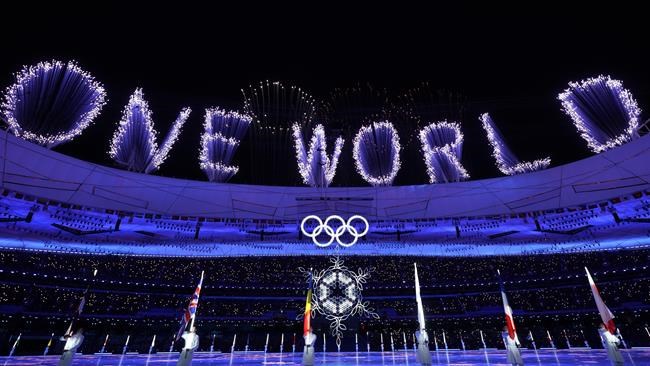
Fireworks explode over the stadium during the closing ceremony of the 2022 Winter Olympics, Sunday, Feb. 20, 2022, in Beijing. (AP Photo/Natacha Pisarenko)

As the closing ceremony reached its denouement, something interesting unfolded. It was the kind of moment that has become common in the post-lighter-at-the-concert era:

Before the ceremony, the official crowd preppers had exhorted those in attendance to, at a certain moment, take out their phones. “When the Olympic flame is about to be extinguished,” the emcee said, “hold up your phone, turn it on and sway to the music.”

And so they did, these carefully screened representatives of a carefully screened Games, these folks who had passed through security screenings and swabbing of their mucous membranes and all sorts of other gates and portals and checkpoints to gather here for the event that’s supposed to symbolize the planet coming together in the spirit of excellence and amiable competition.

In The Era of The Phone, humanity is negotiating a new relationship with itself. But as we clutch our remarkable and terrible devices, be it swaying in unison in an Olympic Stadium or sitting alone and reaching across the ether, are we together but always apart? Or apart but always together?

The smartphone, barely a teenager in 2022, has — like many teenagers — sucked up most of the oxygen in the room. And as these Olympic faithful in the Bird’s Nest held their phones skyward to become totems of warmth and togetherness against cold and COVID, a Chinese song called “You and Me” played and the words “One World” were displayed in fireworks, it was easy to wonder: Is this now the best connection we can hope for?

___

Ted Anthony, AP’s director of new storytelling and newsroom innovation, is the AP’s former director of Asia-Pacific news and former China news editor and is covering his seventh Olympics. Follow him on Twitter at http://twitter.com/anthonyted

Report Error Submit a Tip

More Stories

Of frogs, roses, kings and a Great Lake

Editorial 4 minute read Preview

Of frogs, roses, kings and a Great Lake

Editorial 4 minute read 2:01 AM CDT

A rose by any other name would smell as sweet, as the saying goes. Basically, if you change something’s name, you don’t actually change the nature of the thing.

That being said, if even 15 years ago an American president had called an entire news conference to announce he was renaming one of the Great Lakes by writing on a map with a red pen and issuing an executive order purporting to rename Lake Ontario as “Lake America,” all and sundry would question his mental health.

Maybe, after witnessing so much from Donald Trump, we’ve all just been hardened off and the foolish is now expected daily. Perhaps it’s the political equivalent of the fable of the boiling frog.

As the fable goes, drop a frog into a pot of boiling water and it will jump right out. But put the frog in room temperature water and bring the pot to a boil, the frog will stay until its death. (It’s unlikely the frog would actually wait.)

Read
2:01 AM CDT

Leaked data prompts news backlash in Canada, U.S.

James McCarten, The Canadian Press 5 minute read Preview

Leaked data prompts news backlash in Canada, U.S.

James McCarten, The Canadian Press 5 minute read Friday, Feb. 18, 2022

WASHINGTON - Journalists in Canada and the United States, veterans of a daily grind that entails tracking down and chatting up newsmakers, politicians and ordinary citizens by whatever means necessary, are encountering a very different — and hostile — world as they work to learn more about supporters of the protests in Ottawa.

Reporters are being harassed, spammed, "doxxed" and even threatened for reaching out to donors to an online crowdfunding campaign that was targeted last week by hackers who disclosed the contact details of thousands of pro-trucker contributors.

"I actually had someone come to my door and leave a threatening note," said Bryan Schott, a political reporter with the Salt Lake Tribune who used the list to send emails to donors with Utah zip codes.

In Schott's case, along with countless others, people have been using social media to post screen shots of emails they've received from reporters — usually innocuous queries asking for confirmation that they had donated to the protesters and whether they'd agree to an interview.

Read
Friday, Feb. 18, 2022

One family passes trapping knowledge through three generations

Story and photography by Mikaela Mackenzie / Winnipeg Free Press 5 minute read Preview

One family passes trapping knowledge through three generations

Story and photography by Mikaela Mackenzie / Winnipeg Free Press 5 minute read Tuesday, Mar. 23, 2021

Snow falls softly over a muted landscape of boreal forest, rock ridges, spruce swamps and beaver ponds. This 60-square-kilometre area of land in the southwest corner of Whiteshell Provincial Park is the Imrie family trapline; they are designated to trap and manage the populations of fur-bearing animals.

Right now, three generations of Imries — Murray, 72, Devin, 36, and five-year-old Thomas — are gathered at a beaver house. Devin thumps a 1.5-metre-long ice chisel onto the surface of the pond, looking for the entrance of the lodge (the movement of the beavers swimming back and forth below weakens the surface). Thomas climbs onto the pile of sticks and brush with his grandpa, and the two dig through the snow to find the breathing hole. Hot air and a thick, musky smell means that the beavers are active here this winter.

The scene could have taken place a century earlier. Other than the snowmobiles parked nearby, the process hasn’t changed much over the years. Devin cuts a hole in the ice, chops down a long, thin tree to serve as a pole for holding the traps under the water, and then gets to work setting them. They are wire “conibear” style traps, orange with rust after many seasons of use, designed to snap around the animals’ neck or body, killing them instantly.

Murray explains the beavers have already eaten all of the poplar in the area, which is their preferred food source, and have moved onto birch and spruce. If the going gets really rough, the rodents might even resort to eating cattail tubers to make it through the winter. A twig of poplar, scratched to simulate tooth marks, is stuck into the trap as bait. “We’re going to have a beaver probably in less than two days,” crows Thomas.

Read
Tuesday, Mar. 23, 2021

Parents share special bond with hockey-loving son

Mike McIntyre 7 minute read Preview

Parents share special bond with hockey-loving son

Mike McIntyre 7 minute read Wednesday, Oct. 14, 2020

As parents, we want the best for our children. We wish for them to find something they're passionate about, that brings them joy, and to share in their successes and cheer them on when things go well, and offer a listening ear and shoulder to lean on when they don't.

For our 19-year-old son, Parker, one of those passions has always been hockey. From the first time he hit the ice at the age of two at our local outdoor community rink to his first half-ice Timbits game at the age of five to what I thought was his very last game at the age of 17 in his senior year of high school, it's been an incredible journey.

And now, much to our pleasant surprise, it continues to this day. A funny thing happened on his way to late-night beer league skates with buddies, where Mom and Dad would typically stay far away for fear of completely embarrassing the boy.

Welcome, folks, to the world of junior B hockey.

Read
Wednesday, Oct. 14, 2020

Canada vs. the United States — evenly matched

Gwynne Dyer 5 minute read 2:00 AM CDT

Canada’s “trade war” with the United States, ignited on Aug. 21 when Prime Minister Mark Carney walked out of trade talks with the Trump administration, is not the foredoomed David vs. Goliath struggle it seems.

It’s really about sovereignty, not trade, and Canada stands a fair chance of winning.

“Winning” in this context, of course, can be defined as surviving with as little damage as possible despite the tenfold superiority in population and wealth of its giant neighbour. Canada has had more than two centuries of practice at that. If Carney can keep his nerve, it can do it again.

The tariffs that Trump has imposed on some Canadian products (and the precisely equal tariffs that Canada has slapped on some American imports) will cause some job losses and considerable economic pain in both countries. However, they only affect about five per cent of the US$872 billion of annual trade between the two countries.

Parcel Pizza delivers familiar favourite wrapped up with a saucy twist

Eva Wasney 5 minute read Preview

Parcel Pizza delivers familiar favourite wrapped up with a saucy twist

Eva Wasney 5 minute read Tuesday, May. 31, 2022

Good ideas come to those who wait (for the right location).

Parcel Pizza, a new restaurant from the owners of the Roost and Oxbow, is a case of food inspired by its surroundings. The pizzeria, located on the main floor of a new residential building on Stradbrook Avenue — although it’s equidistant from Osborne Village, downtown and The Forks — is one of the only eateries in the neighbourhood. Choosing a cuisine that would draw people in was the first order of business.

“We thought that something that is universally beloved, like pizza, would be really beneficial for the area,” says co-owner Elsa Taylor. “Another reason, what with the plague and all, is that we wanted something that would be conducive to takeout and delivery.”

In addition to the location, Parcel represents several firsts for Taylor and business partners Caiden Bircham and Isaac Hedenstierna, who make up the Oddlot Collective restaurant group.

Read
Tuesday, May. 31, 2022