Snow struggles and temperature troubles: climate change could impact future Olympics
Advertisement
Read this article for free:
or
Already have an account? Log in here »
To continue reading, please subscribe:

Digital Subscription
One year of digital access for only $205*
- Enjoy unlimited reading on winnipegfreepress.com
- Read the E-Edition, our digital replica newspaper
- Access News Break, our award-winning app
- Play interactive puzzles
*First annual payment billed as $205.00 + GST for one year. This annual subscription will automatically renew at $233.00 + GST every 52 weeks (10% off the regular annual price of $259.35). Offer available to new and qualified returning subscribers only. Cancel any time.
To continue reading, please subscribe:
Add Free Press access to your Brandon Sun subscription for only an additional
$1 for the first 4 weeks*
- Enjoy unlimited reading on winnipegfreepress.com
- Read the E-Edition, our digital replica newspaper
- Access News Break, our award-winning app
- Play interactive puzzles
*Your next Brandon Sun subscription payment will increase by $1.00 and you will be charged $17.95 plus GST for four weeks. After four weeks, your payment will increase to $24.95 plus GST every four weeks.
Read unlimited articles for free today:
or
Already have an account? Log in here »
Hey there, time traveller!
This article was published 01/02/2022 (1690 days ago), so information in it may no longer be current.
Daniel Scott remembers the mild weather that swept through coastal British Columbia in the lead-up to the 2010 Winter Olympics, and the efforts organizers went through to ensure Vancouver’s surrounding mountains had enough snow to host its skiing and snowboarding competitions.
“They were putting hay bales down, helicoptering snow in from other valleys,” Scott recalled. “It was just too warm to even make snow at that time.
“And that sort of got us thinking.”
Scott, a professor of geography and environmental management at the University of Waterloo, said the Vancouver Games — and the similar snow struggles seen in Sochi four years later — were the impetus for a research project aiming to show how climate change might impact future Winter Olympics.
An international research team led by Scott published findings of its study last month, suggesting that if global emissions of greenhouse gases are not dramatically reduced, only one of the 21 previous Winter Games sites — Sapporo, Japan — would be able to safely and viably host another Olympics by the end of this century.
Among those that wouldn’t make the cut: Vancouver, which is eyeing a potential 2030 bid, and Calgary, home of the 1988 Games.
Researchers from Canada, the U.S. and Austria reviewed historical climate data from the 1920s to the present day and looked at future climate-change scenarios for the 2050s and 2080s based on high-emission and low-emission targets.
They found the average February daytime temperature of host cities has steadily increased — from 0.4 degrees C from the 1920s to 1950s; 3.1 C in the 1960s through 1990s; and 6.3 C in Games held in the 21st century, including Beijing.
Researchers say 21st century warming of 2 to 4.4 C is projected, depending on emission pathways.
If emission targets from the Paris Climate Agreement can be achieved, Scott’s team predicts the number of climate-reliable host cities that previously held a Games would jump from one to eight, including both Canadian sites.
“There’s two fundamentally different futures under low- and high-emission scenarios,” he said. “Under high-emission scenario … that really changes the geography to where Games can be held for future generations and that’s something we don’t want to see.”
Researchers also surveyed 339 elite athletes and coaches from 20 countries within North America and Europe, finding that 89 per cent felt changing weather patterns were affecting competition conditions, and 94 per cent feared climate change will impact the future development of their sport.
Natalie Knowles, a PhD student at Waterloo involved in the study and a former elite skier who competed at the University of Denver, said it was important to get the athletes’ perspective.
She noted how weather and snow conditions at a number of regular competition and training sites have changed over the years, which could have implications on an athlete’s ability to practise.
Some often have to travel further distances now to find better training grounds, Knowles said, which carries an economic toll that many can’t afford.
Unideal conditions during training or competitions can also impact an athlete’s safety when snow gets too soft or mushy from rising temperatures, she added.
“Some of the places we go to consistently, like training on glaciers in the summer, we’re seeing those retreat significantly and it’s very visual,” she said.
“World Cup races are often held in the same location at the same time every year and some of them are becoming less consistent. (We’re seeing) more and more cancelled events for sure.”
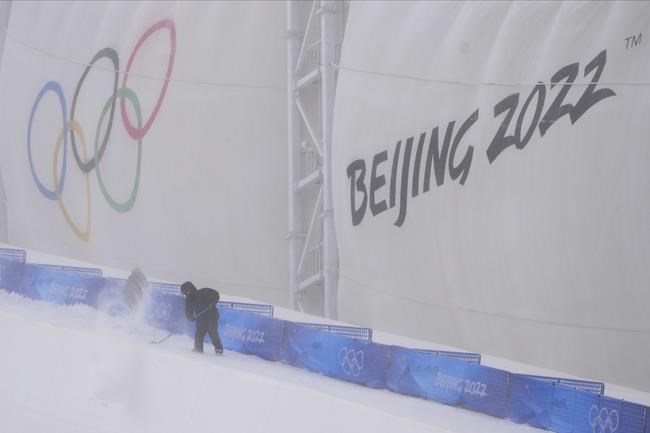
When the Beijing Olympics begin this week, skiing and snowboarding venues will comprise entirely of machine-made snow. Scott said unnatural snow isn’t new to Beijing — the technique has been used in many Olympics since Lake Placid in 1980, and temperate Sochi needed about 90 per cent of its snow made or brought in.
But no other Games has required 100 per cent of its snow be made and preserved prior to competition before Beijing, and it may not be the last.
Machine-made snow can mimic ideal conditions for elite skiers and snowboarders, Scott said, noting that the athletes surveyed said they didn’t mind it. But if the process of creating snow or hauling it in from other sites impacts the environment, Scott said the International Olympic Committee may want to reconsider who it awards Olympics to.

He expects many future winter hosts will continue to have two main sites — a mountainous region for snow-based sports, and a city that can host all indoor events.
Vancouver had that with Whistler, a trend followed by Sochi, Pyeongchang and Beijing. But the distance between the two hubs is getting longer, and Scott thinks that will continue as the IOC searches for spots cold enough to keep snow on the ground for future Games.
Scott said the athletes in the study expressed concern about trickle-down effects of degrading snow conditions, not just at possible Olympic sites but locally too.
“They realize if we lose the ski hills where their kids learned to ski and where they learned to ski, that’s the pipeline to the next generation,” he said. “That’s part of the risk that their sport faces as well.”
This report by The Canadian Press was first published Feb. 1, 2022.
Related Articles
Russians, Belarusians out of Paralympics amid boycott risk







Advertisement Advertise With Us
Advertisement Advertise With Us