Entering Beijing’s Olympics bubble is a surreal experience

Advertisement

Advertise with us

BEIJING (AP) — For the thousands of athletes, journalists and others descending on Beijing for the Winter Olympics, China’s strict pandemic measures are creating a surreal and at times anxious experience.

Read this article for free:


By clicking the button above, an account will be created and you will begin to receive some of our recommended newsletters. You may opt out of any newsletter by visiting your Email and Communication Preferences page or by clicking "unsubscribe" at the bottom of any email.

or

Already have an account? Log in here »

To continue reading, please subscribe:

Digital Subscription

One year of digital access for only $1.44 a week*

  • Enjoy unlimited reading on winnipegfreepress.com
  • Read the E-Edition, our digital replica newspaper
  • Access News Break, our award-winning app
  • Play interactive puzzles

*Billed as $5.77 plus GST every four weeks. After 52 weeks, price increases to the regular rate of $19.95 plus GST every four weeks. Offer available to new and qualified returning subscribers only. Cancel any time.

To continue reading, please subscribe:

Add Free Press access to your Brandon Sun subscription for only an additional

$1 for the first 4 weeks*

  • Enjoy unlimited reading on winnipegfreepress.com
  • Read the E-Edition, our digital replica newspaper
  • Access News Break, our award-winning app
  • Play interactive puzzles
Start now

*Your next Brandon Sun subscription payment will increase by $1.00 and you will be charged $17.95 plus GST for four weeks. After four weeks, your payment will increase to $24.95 plus GST every four weeks.

Hey there, time traveller!
This article was published 27/01/2022 (1739 days ago), so information in it may no longer be current.

BEIJING (AP) — For the thousands of athletes, journalists and others descending on Beijing for the Winter Olympics, China’s strict pandemic measures are creating a surreal and at times anxious experience.

China is isolating everyone coming from abroad from any contact with the general public for the duration of the Games, which open next week. That means being taken from the Beijing airport in special vehicles to a hotel surrounded by temporary barricades that keep participants in and the public out.

“I know the only experience of Beijing I’m going to experience is the Beijing I will see out of my bus window and my hotel window,” said Associated Press photo editor Yirmiyan Arthur, who arrived this week. “I’m not really going to experience China, I’m just going to experience the Olympics within the bubble.”
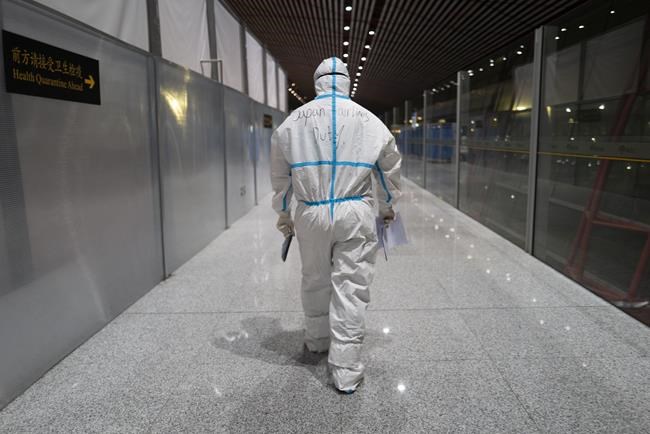
FILE - A member of airport personnel dressed in protective gear leads passengers into the customs area at the Beijing Capital International Airport ahead of the 2022 Winter Olympics in Beijing, Jan. 24, 2022. (AP Photo/Jae C. Hong, File)

The experiences of AP journalists who have arrived or are preparing to depart offers a glimpse into life inside the bubble.

Photographer Jae Hong said he had been warned about the bubble but seeing it in effect in Beijing was still a shock. He described seeing passengers met by workers in white, full-body protective gear. Everyone is tested for COVID-19 at the airport before being transported to their barricaded hotels, the entrances protected by round-the-clock guards.

Organizers want to keep any infections from getting out of the bubble, as well as spreading within the bubble, a heightened concern with the easily transmissible omicron variant. Everyone is tested daily — failing to get tested the previous evening means being stuck in your hotel the next day.

So far, organizers said Thursday there have been 129 positive tests among the 4,046 people who have arrived for the Games. Of those, two are either athletes or team officials. The rest are other participants such as the media. Those who test positive are taken to a hospital if they have symptoms or a quarantine hotel if they do not.

Even getting to China can be worrying, requiring multiple negative COVID-19 tests entered into an app that displays your health status. That kept Arthur on edge during her journey from New Delhi to Beijing via Tokyo. A colleague who had already arrived in Beijing helped her download the app. Then she saw the health workers in biohazard suits after she got off the plane.

“In the airport it’s a bit scary, it’s almost like a hospital that was treating COVID patients in the second wave,” she said, referring to India’s devastating surge in March 2021.
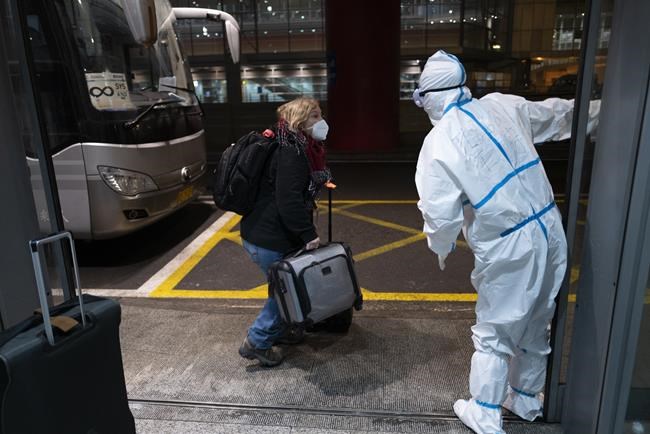
FILE - A passenger is directed to a bus by an Olympic worker wearing protective gear at the Beijing Capital International Airport ahead of the 2022 Winter Olympics in Beijing, Jan. 24, 2022. (AP Photo/Jae C. Hong, File)

Tokyo also had strict rules for the Summer Olympics last year, but participants were allowed outside of the bubble after two weeks.

AP video journalist Johnson Lai, who has yet to depart for the Olympics, is facing stress because China has no formal relations with Taiwan, his self-governing homeland that Beijing claims as its own territory.

That meant he was unable to complete the form in the Olympics app to get a code, which requires a test conducted at a China-approved hospital. “There’s a lot of uncertain matters that we can’t control,” he said.

Outside the bubble, Beijing authorities locked down more neighborhoods in the city’s Fengtai district on Thursday as they try to snuff out a delta variant outbreak that has infected about 70 people.

China has a “zero tolerance” policy under which it quickly locks down affected areas and conducts mass testing of residents to find infections and isolate them. All 2 million residents of Fengtai are undergoing a third round of testing since last weekend.

FILE - Two Olympic workers wearing protective gear work at a loading zone at the Beijing Capital International Airport ahead of the 2022 Winter Olympics in Beijing, Jan. 24, 2022. (AP Photo/Jae C. Hong, File)

The Beijing outbreak has spread to neighboring provinces. After four cases were reported in the city of Langfang, just south of Beijing in Hebei province, authorities suspended travel between the cities to try to prevent further spread.

Arthur, the photo editor, could see other passengers at the airport from a bus, a view of people outside the Olympics bubble. “And you see … oh, there’s life out there,” she said, “and you’re like, oh my God, it’s so near and yet so far.”

Report Error Submit a Tip

More Stories

Listening after decades of hearing

Melissa Martin 7 minute read Preview

Listening after decades of hearing

Melissa Martin 7 minute read Friday, Oct. 1, 2021

It seemed that all of Canada glowed orange, in act or in mind. On the streets of Winnipeg, a sea of people marched in orange shirts, carrying orange signs. On social media, people shared text posts on orange backgrounds, urging more attention to the Truth and Reconciliation Commission's 94 calls to action.

Even city buses — though not orange — marked the day on their digital signs.

If you'd come to me 10 years ago and told me this week would happen, I wouldn't have believed you. If you'd told me that on the last day of September 2021, everything from a cocktail bar to a Botox clinic would close to remember the children and survivors of residential schools, I would have said you were telling me about a dream.

Not the kind we seek to create, but the kind that disintegrates upon waking.

Read
Friday, Oct. 1, 2021

Say What?! Sports guys travel to new destination

Steve Lyons and Paul Wiecek 16 minute read Preview

Say What?! Sports guys travel to new destination

Steve Lyons and Paul Wiecek 16 minute read Thursday, Jan. 30, 2020

Say What?! is an email conversation between sports editor Steve Lyons and sports columnist Paul Wiecek. Look for us regularly but intermittently on the Free Press website.


Steve Lyons: Heya. How you doing? How’s 2020 treating you so far?

Few things to get us started:

Read
Thursday, Jan. 30, 2020

The new normal in Canadian politics

David McLaughlin 5 minute read Preview

The new normal in Canadian politics

David McLaughlin 5 minute read Yesterday at 2:01 AM CDT

“Nothing happening, all at once.”

Welcome to the new normal of Canadian politics, where normality is the new normal. Routine and stable are in; disruptive and excessive are out. Exhibits A and B are the Alberta referendum and the British Columbia election. Voters opted for stability over volatility.

The opposite of being normal is being different from the norm. In politics that means different from where we’ve been and what we’ve come to expect. Two competing trends have dominated our politics for the past decade and a half — progressivism and populism. Think Justin Trudeau and liberal, progressive identity politics in Canada, and Donald Trump and conservative, populist MAGA politics in America. We are now experiencing a swing away from both those trends.

Representing this “new normal” are Prime Minister Mark Carney, for one, and newly elected British Columbia premier, Lorne Doerksen, for another. Both are considered normal because they talk and act like adults in a childish political world. Their political flair is to not have any political flair. They stand out for not standing out.

Read
Yesterday at 2:01 AM CDT

Manitoba’s Top Employers

7 minute read Monday, May. 4, 2026

| Manitoba's Top Employers

Letters, Oct. 31

6 minute read Yesterday at 2:01 AM CDT

Civic election a missed opportunity

The outcome of the latest municipal election in Winnipeg is nothing short of baffling. The decline of what was once a proud, beautiful prairie hub is impossible to ignore.

Winnipeg is rapidly sliding into a state of structural and social dilapidation, yet voters have inexplicably chosen to hand incumbent Mayor Scott Gillingham a second term. The decision smells of complacency, and sadly, it represents a massive missed opportunity for real urban renewal.

Walking through downtown Winnipeg today is an exercise in heartbreak. A city centre that should be a bustling economic and cultural core has instead transformed into an absolute eyesore. Encampments and tents are permitted to dot the heart of the city. Streets that used to thrive are now dominated by the tragic, visible reality of severe addiction, with individuals wandering and staggering through public spaces without adequate intervention or care.

Taxi and ride-hailing services receive 58 complaints since March

Jessica Botelho-Urbanski 5 minute read Preview

Taxi and ride-hailing services receive 58 complaints since March

Jessica Botelho-Urbanski 5 minute read Friday, Aug. 17, 2018

The City of Winnipeg has fielded 58 formal complaints about vehicle-for-hire operations since taking over industry oversight from the province in March.

According to freedom of information request results, the city mostly received complaints about taxi operations, and the two largest companies – Duffy’s Taxi and Unicity Taxi – were the main culprits.

From March 1, 2018 to July 13, 2018, the Winnipeg Parking Authority received 20 complaints about Duffy’s, mostly to do with driver road habits (five complaints), driver conduct (three), service refusal (three) or poor service (three), among other issues.

During the same period, Unicity had 19 complaints, five of them related to poor service and three about driver conduct, plus other misdeeds.

Read
Friday, Aug. 17, 2018