Attitude on carbon tax rebate defined by politics, not facts, survey suggests

Advertisement

Advertise with us

Rebates on carbon taxes haven't helped Canadians warm to them, a new survey suggests.

Read this article for free:


By clicking the button above, an account will be created and you will begin to receive some of our recommended newsletters. You may opt out of any newsletter by visiting your Email and Communication Preferences page or by clicking "unsubscribe" at the bottom of any email.

or

Already have an account? Log in here »

To continue reading, please subscribe:

Digital Subscription

One year of digital access for only $1.44 a week*

  • Enjoy unlimited reading on winnipegfreepress.com
  • Read the E-Edition, our digital replica newspaper
  • Access News Break, our award-winning app
  • Play interactive puzzles

*Billed as $5.77 plus GST every four weeks. After 52 weeks, price increases to the regular rate of $19.95 plus GST every four weeks. Offer available to new and qualified returning subscribers only. Cancel any time.

To continue reading, please subscribe:

Add Free Press access to your Brandon Sun subscription for only an additional

$1 for the first 4 weeks*

  • Enjoy unlimited reading on winnipegfreepress.com
  • Read the E-Edition, our digital replica newspaper
  • Access News Break, our award-winning app
  • Play interactive puzzles
Start now

*Your next Brandon Sun subscription payment will increase by $1.00 and you will be charged $17.95 plus GST for four weeks. After four weeks, your payment will increase to $24.95 plus GST every four weeks.

Hey there, time traveller!
This article was published 25/01/2022 (1739 days ago), so information in it may no longer be current.

Rebates on carbon taxes haven’t helped Canadians warm to them, a new survey suggests.

Results published this week in the journal Nature Climate Change say that not only did rebates fail to make much difference to public opinion, Canadians don’t understand them very well.

And those convinced they were paying more in carbon taxes than they received remained just as convinced even when they were shown the facts.
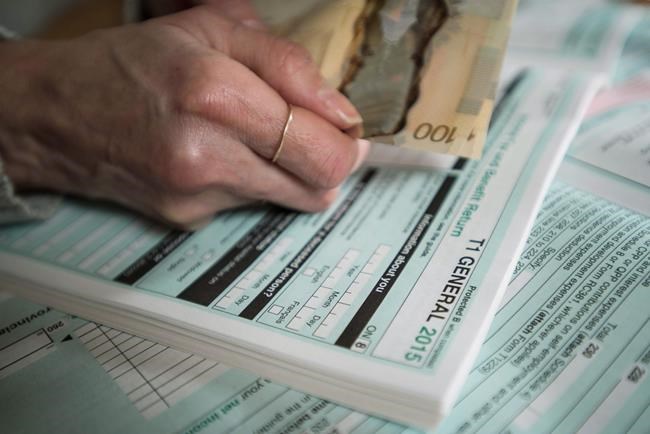
Tax forms and Canadian currency are shown together in this photo illustration taken in Toronto on Sunday, April 3, 2016. A new survey suggests rebates on carbon taxes haven't helped Canadians warm to them. THE CANADIAN PRESS/Graeme Roy

“Partisanship had a big impact — not just on whether people were supportive of the idea of carbon pricing, but on their perception of the facts,” said co-author Kathryn Harrison of the University of British Columbia.

Harrison said she and her colleagues wanted to study whether carbon rebates — returning money to taxpayers to offset or even exceed the amount they’d paid in carbon taxes — would make the policy more palatable.

“Canada was one of the first two countries to do that,” Harrison said. “There was an opportunity to systematically check what was the impact of the policy.”

The team surveyed Canadians between early 2019 and March 2020. They looked at Saskatchewan and Ontario, whose residents get the federal rebate; Quebec, which uses a cap-and-trade system to reduce carbon; British Columbia, which has a provincial carbon tax without rebates; and Alberta, which ended up on the federal program halfway through the study when it cancelled its provincial levy.

Respondents were queried after the rebate plan was announced, after it was implemented, after the first rebates were issued, after the 2019 federal election and a year after the initial announcement. The sample size was 3,313 at the start and 899 by the end of the fifth survey.

“There was no magic,” said Harrison.

The survey found, at most, minor changes in support for carbon pricing over time in all five provinces. British Columbia, which doesn’t offer rebates, showed the biggest increase at about 10 percentage points. No province showed a decrease.

There were wide gaps in support between self-identified Liberal and Conservative respondents.

But the researchers found nearly half the Ontario respondents and about a quarter of those in Saskatchewan didn’t even know they got a rebate. Those who did consistently underestimated the amount by an average of 40 per cent in Ontario and 32 per cent in Saskatchewan.

When researchers showed the respondents the true value of their rebate, a simple calculation that requires no tax data, the results again split over political affiliation.

“After learning how much they were getting back, Conservative voters were more likely to report they were net losers, that they were paying more in taxes than they were getting back,” Harrison said.

“They must have increased their estimate of how much they were paying up front,” she said. “(They) seem to have adjusted their beliefs in order to support their position of opposition to the federal carbon tax.”

When the researchers conducted similar surveys in Switzerland, the other country to have implemented a rebate system, Harrison said the results were similar.

The results are discouraging for those who think of the public as composed of rational actors coolly evaluating information and acting on their best interests, Harrison said.

“Giving people back money doesn’t automatically shift the politics of it.

“Canadians are getting their signals on this type of policy from people they trust, whether it’s interest groups or politicians. In many cases, they are basing those positions on inaccurate information.”

This report by The Canadian Press was first published Jan. 25, 2022.

— Follow Bob Weber on Twitter at @row1960

Report Error Submit a Tip

More Stories

Letters, Oct. 30

7 minute read 2:00 AM CDT

Embarrassed by turnout

I am ashamed by the poor turnout of voters in the recent municipal election in Winnipeg. Just 38 per cent of eligible voters is a disgrace to the thousands of men and women who gave their lives in past wars, where they were defending democracy and the right to vote.

My grandfather was an infantry soldier in the First World War, and my father-in-law flew in Avro Lancasters in the Second World War. For both I am grateful.

Maybe the 62 per cent that had a flimsy excuse for not voting will keep this mind for the next election. People died for our right to vote.

Is Canada headed for time chaos this weekend?

Michelle Bastian 5 minute read 2:00 AM CDT

When Manitoba Premier Wab Kinew declared Sept. 17 that the province would remain on permanent daylight time, he suggested it was a historical moment people would share with their “great-great-grandkids.” But, while Sunday, Nov. 1 has been heralded as the date many Canadians will stop changing their clocks, there are rumblings behind the scenes suggesting this will actually cause more trouble than ever before.

There are, of course, the warnings from chrono-biologists and sleep scientists about the damage permanent daylight time will do. The lighter evenings will mean many more dark mornings. But there is another set of problems in the offing in the critical infrastructure that underpins our digital lives.

While it used to be common to spend the Sunday morning after a time change going around our homes updating the clocks, we now wake up to devices that have already adjusted to the new time. These automatic updates occur regularly for daylight time, as well as when we travel to new time zones.

Our clocks are able to change by themselves owing to the hard work of a group of volunteers who were recently named in a list of the people who hold up the internet. This group, led by Paul Eggert, a computer scientist at UCLA, maintains a little-known tool called the Time Zone Database. Since the 1980s, it has kept track of regional, national and international debates about clock time and provided an up-to-date table of what time it should be on our walls.

Notable quotes from 2020 Tokyo Olympics

The Canadian Press 4 minute read Sunday, Jul. 25, 2021

Correctional Services Canada is reopening prison farms. But in B.C., where it has no such programs, a wife and her late husband, who killed a man in a botched holdup, started Emma’s Acres, a unique prison farm she hopes to see expanded.

A timeline of the WE Charity controversy

The Canadian Press 9 minute read Wednesday, Aug. 19, 2020

OTTAWA - A timeline of events regarding the Canada Student Service Grant program, based on public documents, events and statements from cabinet ministers, government officials, and WE Charity:

March 6, 2020: WE Charity staff prepare a concept paper on service learning for public servants at Employment and Social Development Canada.

April 5: Finance Minister Bill Morneau and Prime Minister Justin Trudeau talk over the phone about how to help students whose summer job and volunteer opportunities were vanishing due to the COVID-19 pandemic. Finance Department officials are tasked with considering options the next morning.

April 7: Small Business Minister Mary Ng and WE co-founder Craig Kielburger have an introductory phone call in which Ng asks WE to send what it calls a ``pre-established proposal'' to help young people launch businesses.

Must-see Folk Fest workshops

16 minute read Preview

Must-see Folk Fest workshops

16 minute read Thursday, Jul. 5, 2018

Workshops have always been an integral part of the Winnipeg Folk Festival.

They are magic-moment makers; a curated group of musicians — sometimes friends, sometimes strangers — on one stage playing together, supporting each other, creating something that will only exist for an hour or two. No one knows what will come out of the collaboration, but usually it’s something special.

When the Free Press spoke to Winnipeg Folk Festival artistic director Chris Frayer ahead of the lineup release in early March, he noted he would be paying some extra attention to workshops this year, as some of the special projects occurring during the past couple of festivals had pulled some of his attention away.

And with 37 workshops on the books, it would seem he followed through on his promise.

Read
Thursday, Jul. 5, 2018

Transit driver killed in knife attack on U of M campus

8 minute read Preview

Transit driver killed in knife attack on U of M campus

8 minute read Tuesday, Feb. 14, 2017

A Winnipeg Transit driver was killed early this morning after he was stabbed by the only passenger on his bus at the University of Manitoba campus.

Irvine Jubal Fraser, 58, was rushed to hospital in critical condition but later died, police said.

The attack occurred at about 2 a.m. in the area of Dafoe Road West and Gillson Street.

Witnesses pointed officers led by the canine unit in the direction of the Red River, where a 22-year-old suspect trying to cross to the St. Vital side was arrested and taken into custody.

Read
Tuesday, Feb. 14, 2017