B.C. long-term care residents are entitled to a designated visitor: seniors advocate

Advertisement

Advertise with us

VICTORIA - British Columbia's seniors advocate is asking the province to designate one person as an essential visitor for every long-term care resident as the facilities move to stem the spread of COVID-19.

Read this article for free:


By clicking the button above, an account will be created and you will begin to receive some of our recommended newsletters. You may opt out of any newsletter by visiting your Email and Communication Preferences page or by clicking "unsubscribe" at the bottom of any email.

or

Already have an account? Log in here »

To continue reading, please subscribe:

Digital Subscription

One year of digital access for only $1.44 a week*

  • Enjoy unlimited reading on winnipegfreepress.com
  • Read the E-Edition, our digital replica newspaper
  • Access News Break, our award-winning app
  • Play interactive puzzles

*Billed as $5.77 plus GST every four weeks. After 52 weeks, price increases to the regular rate of $19.95 plus GST every four weeks. Offer available to new and qualified returning subscribers only. Cancel any time.

To continue reading, please subscribe:

Add Free Press access to your Brandon Sun subscription for only an additional

$1 for the first 4 weeks*

  • Enjoy unlimited reading on winnipegfreepress.com
  • Read the E-Edition, our digital replica newspaper
  • Access News Break, our award-winning app
  • Play interactive puzzles
Start now

*Your next Brandon Sun subscription payment will increase by $1.00 and you will be charged $17.95 plus GST for four weeks. After four weeks, your payment will increase to $24.95 plus GST every four weeks.

Hey there, time traveller!
This article was published 06/01/2022 (1759 days ago), so information in it may no longer be current.

VICTORIA – British Columbia’s seniors advocate is asking the province to designate one person as an essential visitor for every long-term care resident as the facilities move to stem the spread of COVID-19.

Isobel Mackenzie said Thursday the need to limit visitors has left a majority of long-term care residents without visits from loved ones.

The province announced last week that visits to long-term care and assisted living facilities would be limited to essential visitors in response to the fast-spreading Omicron variant and would be re-evaluated Jan. 18.

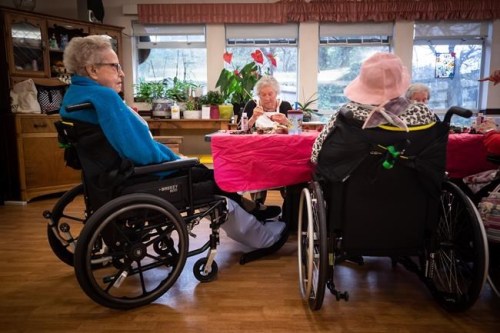
Inglewood Care Centre resident Connie Zweng, back centre, paints a pine cone during arts and crafts recreation time at the long-term care home in West Vancouver, on Thursday, December 16, 2021. Visits to long-term care and assisted living facilities in the province have been limited to essential visitors in response to the fast-spreading Omicron variant of COVID-19.There have been concerns that the need to limit visitors has effectively left a majority of long-term care residents without visits from loved ones.THE CANADIAN PRESS/Darryl Dyck

Mackenzie said in a statement the process for determining if a resident meets the criteria to have a designated essential visitor is made by the administrator of the facility on a case-by-case basis.

Essential visitors often give vital support care to seniors, especially as these places face staff absences of up to 30 per cent because of COVID-19, she said in a news release Thursday.

“They help to feed their loved one, get them dressed, take them for walks, and keep them engaged,” she said.

“For many residents, these visitors are the only people who can motivate them to engage in any activities, and yet they are not formally recognized as essential.”

Provincial health officer Dr. Bonnie Henry agreed during her weekly briefing on Tuesday that visitors in care homes are essential, saying that once rapid tests are deployed in each facility, they’ll go back to allowing every resident to have a designated social visitor and an essential visitor.

The federal government said Wednesday that it would be distributing 140 million rapid tests to provinces and territories this month.

B.C. reported 3,223 new cases of COVID-19 Thursday, along with a rise in hospitalizations.

The Ministry of Health said in a statement there are 324 people in hospital and 90 are in intensive care.

There have been three new deaths to bring the total number since the pandemic began to 2,430.

The ministry also said there have been 16 new health-care facility outbreaks for a total of 37 active outbreaks, many of them in seniors care facilities.

A recommendation made by the Office of the Seniors Advocate in November 2020 said all residents must be provided the opportunity to designate an essential visitor.

Mackenzie said her office has received calls from family members, including spouses, who say they can no longer visit, even though they are helping care for the senior. It is only the resident and their families who truly know who is essential to their health and well-being, she added.

“Care home operators are significantly overburdened,” she said.

“They need the clarity from the province that every resident is entitled to an essential visitor and be relieved of the staff resources required to manage the essential visitor designation process.”

Terry Lake, chief executive officer of the BC Care Providers Association, said one of the difficulties for facilities is interpreting what an essential visitor is when health authorities and home operators have differing views.

Guidance from the Ministry of Health last year defined essential visits as those that are “necessarily linked with an essential need that could not be met in the absence of the essential visit.”

Lake, whose group represents over 400 long-term care and other such facilities in B.C., said it can be argued that feeding and getting someone dressed is something staff can do.

“And that’s where we get into trouble,” he said in an interview on Thursday.

“(The ministry) needs to liberalize the definition and reduce the workload on care home staff to make this possible.”

The seniors advocate should just say that everyone is entitled to a visitor, Lake said.

The mental and physical toll on seniors cut off from their families is “huge,” especially if that person has dementia or Alzheimer’s, he said.

“As wonderful as staff are, they’re not family.”

This report by The Canadian Press was first published Jan. 6, 2022.

Note to readers: This is a corrected story. A previous version said a recommendation on visitors to care homes from the Office of the Seniors Advocate was made last November. In fact, it was made in November 2020.

Report Error Submit a Tip

More Stories

Provincial budget fails to chart new course

Editorial 4 minute read Preview

Provincial budget fails to chart new course

Editorial 4 minute read Wednesday, Apr. 13, 2022

If the 2022 Manitoba budget was intended to provide a lifeline for the Progressive Conservative government, it must surely be considered a failure.

Prior to the budget’s release, Premier Heather Stefanson and her government were teetering on the edge of the political abyss. Manitobans are profoundly unhappy with the government’s performance on most issues, including pandemic management. National polls show Ms. Stefanson is Canada’s least popular premier.

That political context made this budget a high-priority project for the Tories. It was, simply put, their best chance to shed the lingering burden left by former premier Brian Pallister, and rebuild the party brand under a new leader.

Unfortunately, Ms. Stefanson’s first budget remains shackled to the deeply flawed fiscal and political logic that defined the Pallister years. And no single budgetary measure embodies that failure more than the premier’s decision to continue cutting education property taxes.

Read
Wednesday, Apr. 13, 2022

Long-term residents left without visits: advocate

The Canadian Press 5 minute read Preview

Long-term residents left without visits: advocate

The Canadian Press 5 minute read Thursday, Jan. 6, 2022

VICTORIA - British Columbia's seniors advocate is asking the province to designate one person as an essential visitor for every long-term care resident as the facilities move to stem the spread of COVID-19.

Isobel Mackenzie said Thursday the need to limit visitors has left a majority of long-term care residents without visits from loved ones.

The province announced last week that visits to long-term care and assisted living facilities would be limited to essential visitors in response to the fast-spreading Omicron variant and would be re-evaluated Jan. 18.

Mackenzie said in a statement the process for determining if a resident meets the criteria to have a designated essential visitor is made by the administrator of the facility on a case-by-case basis.

Read
Thursday, Jan. 6, 2022

Submit a news tip

1 minute read Monday, Mar. 16, 2026

Submit a news tip

Behind the scenes at circus spectacle Odysseo, it's the horses who hold the reins

Erin Lebar / Photos by Ruth Bonneville 15 minute read Preview

Behind the scenes at circus spectacle Odysseo, it's the horses who hold the reins

Erin Lebar / Photos by Ruth Bonneville 15 minute read Wednesday, Jun. 13, 2018

It’s almost 4 p.m. on a particularly steamy May afternoon and Cavalia Odysseo rider Chelsea Jordan is putting on her makeup in the back corner of the very humid artistic tent.

She’s already spent some time layering on foundation, and is now into the decorative portion of the 30-minute process, placing a pair of small gems on her forehead and enhancing her naturally sharp cheekbones with some extra contouring.

“This is the messy part of the business,” she jokes as she sticks on fake lashes over an eyelid covered in earth-toned shadow.

It’s odd that makeup is considered the messy part of the day when Jordan spends the majority of her time surrounded by horses, but as with most people involved in Odysseo, the glitzy and glamorous aspects of being a member of the largest touring production in the world aren’t nearly as fun as the time she gets to spend with her four-legged cast-mates.

Read
Wednesday, Jun. 13, 2018

Haunted houses aren’t the only places to find jump scares

Jen Zoratti 3 minute read Preview

Haunted houses aren’t the only places to find jump scares

Jen Zoratti 3 minute read 2:01 AM CDT

C’est l’Halloween, to quote the 1981 elementary school French class banger by Matt Maxwell, but you know what’s already plenty scary? Life.

We all have our personal haunted houses, so to speak, hence the popularity of the “a haunted house but it’s just…” meme that pops up every October. Sample: “a haunted house but it’s just a bunch of men telling you you’d be prettier if you smiled.”

In the spirit of the season, I thought I’d offer up a few jump scares of my own.

A haunted house but it’s just Gate E25

Read
2:01 AM CDT

SNC planned U.S. move if no deal: documents

Jordan Press and Christopher Reynolds, The Canadian Press 5 minute read Preview

SNC planned U.S. move if no deal: documents

Jordan Press and Christopher Reynolds, The Canadian Press 5 minute read Thursday, Mar. 28, 2019

OTTAWA - SNC-Lavalin warned federal prosecutors last fall about a possible plan to split the company in two, move its offices to the United States and eliminate its Canadian workforce if it didn't get a deal to avoid criminal prosecution, newly obtained documents show.

The documents, part of a PowerPoint presentation obtained by The Canadian Press, describe something called "Plan B" — what Montreal-based SNC might have to do if it can't convince the government to grant a so-called remediation agreement to avoid criminal proceedings in a fraud and corruption case related to projects in Libya.

Under that plan, SNC would move its Montreal headquarters and corporate offices in Ontario and Quebec to the U.S. within a year, cutting its workforce to just 3,500 from 8,717, before eventually winding up its Canadian operations.

“The government of Canada needs to weigh the public interest impact of the prosecution of SNC-Lavalin," the presentation reads.

Read
Thursday, Mar. 28, 2019