Saskatchewan considers bringing back program that privatized some surgeries

Advertisement

Advertise with us

REGINA - The Saskatchewan government is considering whether to bring back a program that would privatize some surgeries to deal with a growing backlog of people needing an operation.

Read this article for free:


or

Already have an account? Log in here »

To continue reading, please subscribe:

Subscribe and receive a limited-edition Free Press branded hat or tote.

Digital Subscription

One year of digital access for only $205*

  • Enjoy unlimited reading on winnipegfreepress.com
  • Read the E-Edition, our digital replica newspaper
  • Access News Break, our award-winning app
  • Play interactive puzzles

*First annual payment billed as $205.00 + GST for one year. This annual subscription will automatically renew at $233.00 + GST every 52 weeks (10% off the regular annual price of $259.35). Offer available to new and qualified returning subscribers only. Cancel any time.

To continue reading, please subscribe:

Add Free Press access to your Brandon Sun subscription for only an additional

$1 for the first 4 weeks*

  • Enjoy unlimited reading on winnipegfreepress.com
  • Read the E-Edition, our digital replica newspaper
  • Access News Break, our award-winning app
  • Play interactive puzzles
Start now

*Your next Brandon Sun subscription payment will increase by $1.00 and you will be charged $17.95 plus GST for four weeks. After four weeks, your payment will increase to $24.95 plus GST every four weeks.

Hey there, time traveller!
This article was published 04/11/2021 (1796 days ago), so information in it may no longer be current.

REGINA – The Saskatchewan government is considering whether to bring back a program that would privatize some surgeries to deal with a growing backlog of people needing an operation.

There are 35,000 people in the province who are waiting for surgery, a list that continues to grow as COVID-19 continues to overwhelmed the health-care system.

In 2010, the Saskatchewan Party government introduced an initiative to help reduce surgical wait times when the list was 27,500 patients long.
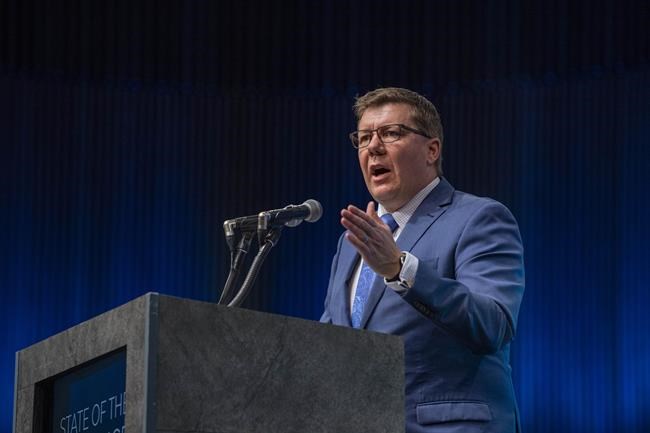
Saskatchewan Premier Scott Moe speaks in Saskatoon, Sask., on Oct. 25, 2021. THE CANADIAN PRESS/Liam Richards

People on the waiting list were allowed to choose either a public or private provider for select surgeries. The goal was that no patient would wait more than three months.

The final report on the initiative said the four-year program helped 11,528 patients get off the waiting list within the three-month period.

“That would be one of the options we would look at to address some of the current challenges that we have,” Premier Scott Moe said Thursday.

Those challenges include a shortage of health-care workers.

Moe said the government is also exploring ways to expand surgical capacity in the public sector to make it sustainable in the long term.

In recent months, the province privatized some testing and contact tracing to allow health-care workers who were redeployed to deal with COVID-19 to go back to their original jobs.

Other than some surgeries, there are no plans to privatize other parts of public health care, Moe said.

NDP Opposition Leader Ryan Meili said he’s deeply concerned that Moe is using the pandemic to “try to take advantage of a crisis to further privatize our system.”

“All smart options should be on the table. Stupid options shouldn’t. Ineffective options shouldn’t,” Meili said.

“We know when you introduce user-pay, private, for-profit surgery, you increase wait times in the public system.”

Dallas Oberik, 70, visited the Saskatchewan legislature on Thursday as the Opposition’s guest, but she also talked to the premier to discuss her three-year wait for a hip surgery.

“This started before the pandemic, but when the virus hit, we all went to hell in a handbasket,” said Oberik, who blamed government policy.

“We’re here because we didn’t step up and do what needed to be done, and listen to the medical professionals.”

Earlier this week, Scott Livingstone, head of the Saskatchewan Health Authority, said it could take 18 months to catch up on hip and knee surgeries alone, not including anyone newly added to the waiting list.

“It’s going to be worse and I’ll live with it simply because I have no choice. If I was independently wealthy, I’d go to a private clinic and get this taken care of right away,” Oberik said.

“I don’t have that kind of money, so I’ll be like everybody else, wait my turn, and do what I can to get through each day.”

This report by The Canadian Press was first published Nov. 4, 2021.

Report Error Submit a Tip

More Stories

Hydro’s planned outages turn out the lights for thousands across province

Nicole Buffie 4 minute read Preview

Hydro’s planned outages turn out the lights for thousands across province

Nicole Buffie 4 minute read Wednesday, Jul. 15, 2026

Business owners in the East Beaches area of Lake Winnipeg hauled out generators Wednesday after a planned Manitoba Hydro outage left thousands of residents and cottagers without power.

Lise Bourassa, who runs several stores in Grand Beach, had to rent generators to accommodate the eight-hour blackout, which affected the area from Beaconia to Victoria Beach as well as Sagkeeng First Nation, while Hydro crews fixed a pole that was damaged by fire in May .

Despite the spare power source, she was only able to open one of her stores during the outage and said it came at a bad time.

“I understand the importance of what Manitoba Hydro is doing, the problem all the businesses in this area are having is that our season is very short and to be shut down for a full day has a fairly big impact, plus they added cost of getting generators,” she wrote in a message to the Free Press. “We also had less than one week to make arrangements, find electricians and generators to be able to keep all the food safe.”

Read
Wednesday, Jul. 15, 2026

Letters, Oct. 5

7 minute read 2:01 AM CDT

Fighting the good fight

Re: Transit, roads and city council’s priorities (Oct. 2)

Many thanks to Erna Buffie for once again speaking up for transit.

When will Winnipeg finally make the shift from a car-dependent culture to a greener and more efficient way?

Ducks Unlimited makes province’s largest-ever conservation-land purchase

Zoe Pierce 4 minute read Preview

Ducks Unlimited makes province’s largest-ever conservation-land purchase

Zoe Pierce 4 minute read Tuesday, Aug. 11, 2026

A Manitoba landscape that helped save the Giant Canada goose from extinction has now been permanently protected in the province’s largest conservation land purchase in history.

Ducks Unlimited Canada announced Tuesday in a virtual press conference that it has acquired a conservation easement for East Meadows Ranch, a more than 8,000-acre property near Lundar in Manitoba’s Interlake region, about 80 kilometres northwest of Winnipeg, that includes wetlands, native prairie and bur oak savannah.

Ducks Unlimited called the property, now known as the Kennedy Field Station at East Meadows, one of Manitoba’s most ecologically diverse landscapes and said protecting it will contribute to the long-term health of Manitoba’s wildlife, biodiversity and natural heritage.

“The sheer size of the property is not that common in private ownership here in Manitoba, and to have that in a complete connected tract is just something that we’re not likely to see again or come available anytime soon,” said Mark Francis, Ducks Unlimited Canada’s manager of provincial operations.

Read
Tuesday, Aug. 11, 2026

Uncanny acting and bittersweet script a fitting tribute to Laurel and Hardy

Randall King  4 minute read Preview

Uncanny acting and bittersweet script a fitting tribute to Laurel and Hardy

Randall King  4 minute read Friday, Feb. 1, 2019

Laurel and Hardy, arguably one of the greatest comedy teams ever to grace the Vaudeville stage and screen, enjoyed a long and fruitful partnership. In fact, it lasted so long, it might as well have been a marriage.

That is the dramatic gist of this film by Jon S. Baird (Filth), who examines the duo in their career twilight, touring the music halls and theatres of England, circa 1953.

The Lancashire-born Stan Laurel (Steve Coogan) has the advantage of being on home turf. Oliver Hardy (John C. Reilly) is hobbled by health issues. While their routines are very much rooted in the English music hall tradition, they are past their prime. Feature films are the medium of choice for comedy duos. Laurel, who has a plaintive moment staring at a freshly installed billboard for the latest Abbott and Costello movie, is trying to cut a deal for a new film based on the legend of Robin Hood. It becomes increasingly obvious that the English producer he’s trying to contact is avoiding him.

Hardy is under different stresses, including failing health and an unhealthy penchant for the vices of drinking and gambling.

Read
Friday, Feb. 1, 2019

Three could prove an awkward crowd

Maureen Scurfield 4 minute read 2:00 AM CDT

DEAR MISS LONELYHEARTS: My girlfriend and I — two women in our late 20s — are finally getting married.

Previously, we were both living with guys and it didn’t ever work for us. She thinks marriage itself was not her problem, but that guys are basically not suited to “loving” in the special ways two women can love.

So, here I am getting ready to give marriage another go — but with her! She’s a woman who’s a wonderful chef, decorator and a mother of two from her previous marriage. The problem we have as partners? I don’t care for the domestic arts myself — but I’d still like to have a child of my own.

That brings up another issue. I also have a male friend who’d be happy to get me pregnant — an old pal of mine who is a bachelor and would like to be a father and continue being platonic friends with me. He’d also help support the child financially.

Thank Manitoba’s teachers by investing in students

Lillian Klausen 5 minute read 2:00 AM CDT

Manitoba’s students are settling into a new school year. Whether you graduated in 1986 or 2006, today’s classrooms look very different from the ones you remember.

Students reflect the changing makeup of our communities — differences in social, emotional, physical and cognitive abilities and socioeconomic stresses are all increasingly present and adding to the complexity of our classrooms.

Meeting these differing individual needs is no easy feat. It requires manageable class sizes, school counsellors, social workers, specialized resource teachers and investment in the systems that can help students thrive. But when those supports aren’t available, students’ needs don’t disappear. Increasingly, it falls to classroom teachers to try to fill the gaps.

When I started working as a teacher more than 30 years ago, we had budgets for resources when we needed them. Today, the needs of students have diversified and increased, but the funding for our public schools is failing to meet them.