Jake Burton alive and bristling in ‘Dear Rider’ documentary

Advertisement

Advertise with us

People who know the sport — really know it — will tell you that the best snowboarding movies are those that never let you get too comfortable.

Read this article for free:


or

Already have an account? Log in here »

To continue reading, please subscribe:

Subscribe and receive a limited-edition Free Press branded hat or tote.

Digital Subscription

One year of digital access for only $205*

  • Enjoy unlimited reading on winnipegfreepress.com
  • Read the E-Edition, our digital replica newspaper
  • Access News Break, our award-winning app
  • Play interactive puzzles

*First annual payment billed as $205.00 + GST for one year. This annual subscription will automatically renew at $233.00 + GST every 52 weeks (10% off the regular annual price of $259.35). Offer available to new and qualified returning subscribers only. Cancel any time.

To continue reading, please subscribe:

Add Free Press access to your Brandon Sun subscription for only an additional

$1 for the first 4 weeks*

  • Enjoy unlimited reading on winnipegfreepress.com
  • Read the E-Edition, our digital replica newspaper
  • Access News Break, our award-winning app
  • Play interactive puzzles
Start now

*Your next Brandon Sun subscription payment will increase by $1.00 and you will be charged $17.95 plus GST for four weeks. After four weeks, your payment will increase to $24.95 plus GST every four weeks.

Hey there, time traveller!
This article was published 26/10/2021 (1787 days ago), so information in it may no longer be current.

People who know the sport — really know it — will tell you that the best snowboarding movies are those that never let you get too comfortable.

That might explain how “Dear Rider” could very well end up in that category, even though nobody dropped out of a helicopter or plunged off a cliff to make this film.

Instead, the best storytelling in the documentary about snowboarding icon Jake Burton, who died in 2019 after a relapse of testicular cancer, comes from the nimble stitching together of decades of home movies and archival media interviews to paint a well-rounded portrait of the man who saw a sport in that undefined slab of fiberglass and forever changed life on the mountain.
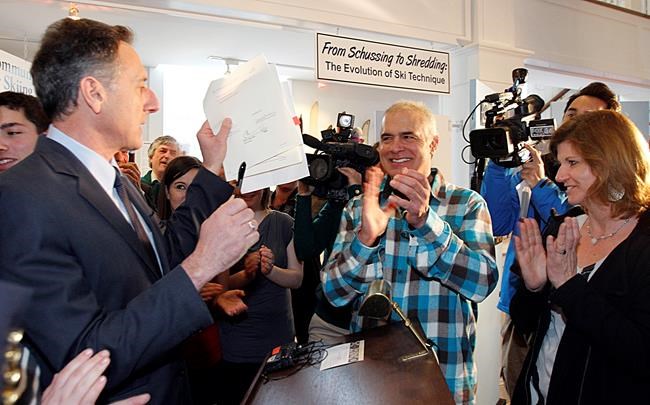
FILE - Jake Burton, the creator of Burton Snowboards, center, and his wife Donna Carpenter, right, applaud Gov. Peter Shumlin after he signed a bill in Stowe, Vt., making skiing and snowboarding the official sports of Vermont, in this March 8, 2012, file photo. A new documentary on the late snowboarding pioneer Jake Burton is more than a glossy retrospective of his life. Jake Burton had been approached about a movie of his life story and had started planning to make it. His wife, Donna, let the project move forward after Burton's death. One of her instructions to director Fernando Villena was that there was no subject that would be out of bounds.(AP Photo/Toby Talbot, File)

Some might argue the wounds from Burton’s death are too fresh to allow for an unflinching narrative about a man whose life and influence on the sport he created are detailed in this 90-minute film, which debuts on HBO on Nov. 9.

But in large part because Burton had been plotting out the movie of his life story well before his death, and knew exactly where he wanted to go with it, much of the fluff that might have accompanied such a project so soon after his passing never makes the cut. A lot of the hard truth of what it took to build a snowboarding empire, then leave it behind too soon, comes to light.

What results is a movie that is, no doubt, an homage to Burton. But it also serves as a history lesson about a pastime that became a sport in the late 1970s when Burton quit his Wall Street job to produce snowboards in his garage in Vermont. It’s a lesson that does not shirk from the uncomfortable realities of his undertaking: Yes, he built it for fun, freedom and who-gives-a-crap rebellion, but no billion-dollar industry sprouts up purely on good vibes and bro hugs.

Some of the most enlightening moments revolve around the sport’s first superstar, Craig Kelly, and his role in the business side’s first major rivalry, between Burton and another snowboard maker, Tom Sims.

It includes backbiting and lawsuits, while also touching on Burton’s potentially career-killing miscalculations at the sport’s outset. The most notable involves prickly issues surrounding the patent for the snowboard that turned Burton, both the man and the company, into something of a pariah within the sport they created. The chapter ends with Kelly’s untimely death in an avalanche in 2003.

It is instructive, not always easy to watch. And while Sims, who died in 2012, would certainly have had a different take on many of these events, the fact this unvarnished portrayal of the main subject makes it into the movie at all is a testament to what Burton, his wife, Donna, and his son, George, were trying to do with this project.

“He was a very resilient man, but the more we could honestly show what his demons were, what his struggles were, and then show how he overcame them, that was always our focus,” said director Fernando Villena, who met several times with Burton before being chosen for the project.

The documentary shows Burton growing as a man while his snowboard becomes both a sport and an industry. He accepts the Olympics and marvels that his invention helped produce a champion such as Shaun White, whose two Rolling Stone magazine covers essentially cemented the sport’s acceptance into the mainstream. Those triumphs also lock in the reality that snowboarding will never return to the days of hand-dug halfpipes and using the legs from overturned park benches as makeshift starting gates.

Being OK with that allowed Burton, and his company, to overcome their rough beginnings and blossom into what they became as the upstart ’80s became the 2010s.

Lest anyone get too comfortable, the last 25 minutes of this movie are mostly sad but partly uplifting. Dozens of family photos and film clips follow Burton as he overcomes cancer, then a paralyzing autoimmune disease, then another bout with cancer that takes him away just as the snow starts falling in the late fall of 2019.
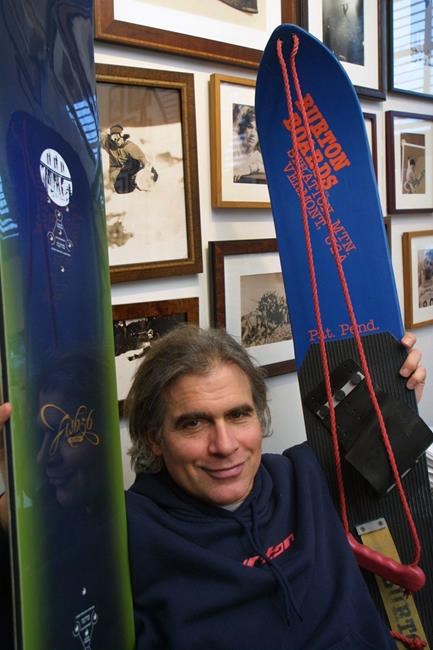
FILE - In this March 8, 2002, file photo, Jake Burton Carpenter, owner of Burton Snowboards, shows an early model, right, and one of the newer snowboards, left, in his office in Burlington, Vt. A new documentary on the late snowboarding pioneer Jake Burton is more than a glossy retrospective of his life. It's a raw, unflinching examination of the trials and tribulations Burton went through over a four-decade career in which he shaped both the snowboard and the the billion-dollar industry that forever changed life on the mountain. The movie: “Dear Rider: The Jake Burton Story,” premieres on HBO on Nov. 9, 2021. (AP Photo/Alden Pellett, File)

“We worked very consciously not to make this too sad, because Jake wasn’t a sad guy,” said his wife, Donna Carpenter. “But it had this certain rawness that maybe it wouldn’t have had” had the movie been completed while Burton was still alive.

For those new (two decades or less) to the snowboarding scene, the old snapshots and film clips of Burton — sometimes sneering, always bristling, never afraid to challenge the snobby ski suits in America and across Europe — are a stark reminder of how much work it took to elbow out room for himself and his baggy-panted diehards on the mountain.

Years passed and Burton Snowboards, always privately owned, branched out and became a behemoth that many in the industry thought was too big. The movie doesn’t flinch from this topic, either.

An interview with a Burton distributor, Andres Erlandsen, about the company’s largesse taps into the main undercurrent of this film — one that’s particularly poignant when viewed through the lens of Burton’s recent death.

“One day I asked him, ‘Have you ever thought about selling Burton?’” Erlandsen said. “And he told me: ‘Anyone who owns Burton Snowboards has to love snowboarding more than me. And I don’t know anyone yet.’”

___

More AP sports: https://apnews.com/hub/apf-sports and https://twitter.com/AP_Sports

Report Error Submit a Tip

More Stories

Winnipeg is one of nearly 40 municipalities to receive a failing grade from the Canadian Federation of Independent Business in the organization’s inaugural “municipal report card.”

The Manitoba capital ranked 33rd amongst the 66 municipalities assessed, earning an F, with an overall score of 4.84 out of 10.

The report, which the CFIB released on Tuesday, evaluated cost burden, regulatory burden and small-business friendliness using 11 indicators and data collected up to Dec. 31, 2025.

Winnipeg’s grade is a starting point and not the final word, said Brianna Solberg, CFIB’s director for the Prairies and northern Canada.

Provincial restrictions against drive-in religious services remain

Steve Lambert 6 minute read Preview

Provincial restrictions against drive-in religious services remain

Steve Lambert 6 minute read Saturday, Dec. 5, 2020

A Manitoba judge rejected a church’s request Saturday to hold drive-in services despite the province’s COVID-19 restrictions on public gatherings and in-person religious events.

“The onus that an applicant must meet to obtain a stay of legislation is extremely high,” Chief Justice Glenn Joyal of the Manitoba Court of Queen’s Bench said in his rare weekend ruling.

“I do not believe that the applicants meet their burden of showing that (they) will suffer irreparable harm if the injunction is not granted.”

Joyal held a special Saturday court hearing in a case brought by Springs Church, which has faced more than $32,000 in fines for drive-in services in recent weeks and wanted a ruling before a planned service later in the day.

Read
Saturday, Dec. 5, 2020

Teenage e-scooter driver in critical condition after crash

Chris Kitching 6 minute read Preview

Teenage e-scooter driver in critical condition after crash

Chris Kitching 6 minute read Updated: 5:50 PM CDT

A teenager riding an e-scooter suffered life-threatening injuries when he was struck by an SUV in southwest Winnipeg on Monday night.

Witnesses provided first aid to the injured rider, who police said is under 18, after the collision happened at Waverley Street and Arbour Meadow Gate/Lake Crest Road at about 9:30 p.m.

“It feels like it happened in slow motion,” said driver Audrey Vanderspek, who was waiting at a red light when she witnessed the incident. “Maybe it’s because you’re helpless, that it just feels like everything slows down in the moment.”

Police said the electric scooter rider was crossing Waverley and was hit by a southbound 2010 Honda CR-V. The posted speed limit on that stretch of Waverley is 70 kilometres per hour.

Read
Updated: 5:50 PM CDT

Plotlines aplenty in pre-season prep

Mike McIntyre and Ken Wiebe 10 minute read Preview

Plotlines aplenty in pre-season prep

Mike McIntyre and Ken Wiebe 10 minute read 2:44 PM CDT

Welcome to a Winnipeg Jets training camp like no other — one where the on-ice storylines and battles threaten to be trumped by what’s happening away from the rink.

Yes, the dark cloud that is the Connor Hellebuyck situation looms over the organization as it prepares to try and turn the page on a terrible 2025-26 campaign which ended with a 26th-overall finish.

It’s not going to be easy, especially in a highly competitive Central Division and Western Conference and with such a major unresolved issue.

But the work starts now, and Free Press hockey writers Mike McIntyre and Ken Wiebe get you set for what to expect ahead of the 84-game regular season, which begins Oct. 2.

Read
2:44 PM CDT

Try growing Salvia and Veronica speedwell in your garden

Colleen Zacharias 7 minute read Preview

Try growing Salvia and Veronica speedwell in your garden

Colleen Zacharias 7 minute read Saturday, Jun. 27, 2026

Salvia and Veronica speedwell are two of the most popular garden plants.

Both include varieties that produce dense, upright spikes of tiny purple or blue flowers and come in a range of colours and forms. Gardeners frequently confuse Salvia and Veronica, but there are distinct differences between the two.

Salvia, which is a member of the Lamiaceae family, has highly aromatic leaves, square stems and tubular two-lipped flowers. Salvia is also a significantly larger and more diverse genus than Veronica, with hundreds of different species of annuals and perennials.

Veronica, formerly classified in Scrophulariaceae, is in the plantain family, Plantaginaceae. The leaves and flowers of Veronica are not known for fragrance. The stems are characteristically round, and the flowers are star-like with four spreading lobes that fuse at the base.

Read
Saturday, Jun. 27, 2026

Payment for plasma a necessary next step

Editorial 4 minute read Preview

Payment for plasma a necessary next step

Editorial 4 minute read Wednesday, Sep. 21, 2022

In an ideal world, enough volunteers would roll up their sleeves to donate blood plasma to meet the needs of Canadian patients. That’s not happening; not even close.

Read
Wednesday, Sep. 21, 2022