Indigenous Tim Hortons owners drive campaign for residential school survivors

Advertisement

Advertise with us

When the remains of 215 missing children were found on the grounds of the former Kamloops Indian Residential School, the local Tim Hortons became more than a pit stop for coffee and doughnuts.

Read this article for free:


or

Already have an account? Log in here »

To continue reading, please subscribe:

Subscribe and receive a limited-edition Free Press branded hat or tote.

Digital Subscription

One year of digital access for only $205*

  • Enjoy unlimited reading on winnipegfreepress.com
  • Read the E-Edition, our digital replica newspaper
  • Access News Break, our award-winning app
  • Play interactive puzzles

*First annual payment billed as $205.00 + GST for one year. This annual subscription will automatically renew at $233.00 + GST every 52 weeks (10% off the regular annual price of $259.35). Offer available to new and qualified returning subscribers only. Cancel any time.

To continue reading, please subscribe:

Add Free Press access to your Brandon Sun subscription for only an additional

$1 for the first 4 weeks*

  • Enjoy unlimited reading on winnipegfreepress.com
  • Read the E-Edition, our digital replica newspaper
  • Access News Break, our award-winning app
  • Play interactive puzzles
Start now

*Your next Brandon Sun subscription payment will increase by $1.00 and you will be charged $17.95 plus GST for four weeks. After four weeks, your payment will increase to $24.95 plus GST every four weeks.

Hey there, time traveller!
This article was published 26/09/2021 (1832 days ago), so information in it may no longer be current.

When the remains of 215 missing children were found on the grounds of the former Kamloops Indian Residential School, the local Tim Hortons became more than a pit stop for coffee and doughnuts.

It turned into an unofficial community gathering place for mourning, reflection and support.

“Where our restaurant is located, it’s pretty much Ground Zero,” franchise co-owner Shane Gottfriedson, former chief of the Tk’emlúps te Secwépemc First Nation, said in an interview.
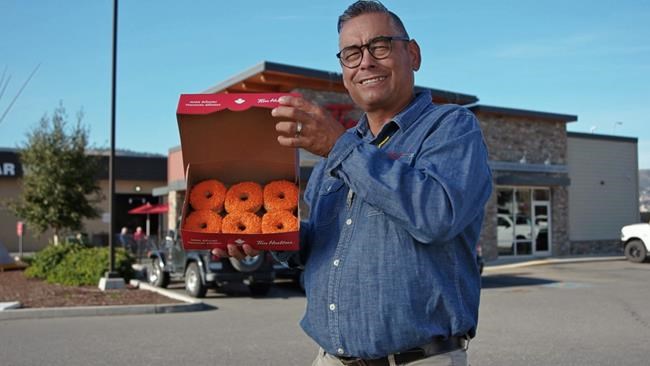
Tim Hortons franchise co-owner, former Tkemlups te Secwepemc First Nation chief and former B.C. regional chief for the Assembly of First Nations Shane Gottfriedson holds a box of orange-sprinkled Tim Hortons doughnuts in this undated handout photo taken from video. The discovery of the unmarked graves of children, some as young as three years old, sent shockwaves across the country last spring. It also propelled a group of Indigenous Tim Hortons owners to come up with fundraising campaign for residential school survivors involving an orange-sprinkled doughnut. THE CANADIAN PRESS/HO, Tim Hortons *MANDATORY CREDIT*

“You can pretty well see the grave sites from here.”

The discovery of the unmarked graves of children, some as young as three years old, sent shock waves across the country last spring.

It also propelled a group of Indigenous Tim Hortons owners to come up with a fundraising campaign for residential school survivors involving an orange-sprinkled doughnut.

Many First Nations people travelled to the British Columbia community this year, stopping in at the nearby Indigenous owned and operated Tim Hortons along the way, said Gottfriedson, also a former B.C. regional chief for the Assembly of First Nations.

“They came and gathered … it was very emotionally charged,” he said. “We have a lot of Indigenous people working for us with family that went to Indian residential schools as well, so it triggered a lot of emotions and opened up a lot of old wounds.”

The restaurant donated food and drinks to those paying their respects, but Indigenous Tim Hortons owners across the country wanted to do more.

They launched a working group and came up with an idea for a national campaign to raise money for Indigenous organizations that support residential school survivors.

For one week starting Sept. 30, Tim Hortons will donate 100 per cent of the retail price of orange-sprinkled doughnuts to the Orange Shirt Society and the Indian Residential School Survivors Society.

“I’m very proud that as a Tim Hortons family we can do something to help,” said Gottfriedson, who co-owns his restaurant with Joe Quewezance and Mitch Shuter.

“There’s a lot of hurt within our communities that still exists, so this is about supporting some great organizations and also raising awareness.”

The federal government announced earlier this year that Sept. 30 would be the National Day for Truth and Reconciliation, a new statutory holiday.

It’s also Orange Shirt Day, an Indigenous-led grassroots commemorative day that has been observed since 2013 when Phyllis Webstad shared her story of her first day of school. It was 1973 when the six-year-old went to St. Joseph’s Mission Residential School in B.C. wearing an orange shirt from her grandmother. The shirt was taken away never to be seen again.

The Orange Shirt Society, and the Every Child Matters movement, raise awareness about Canada’s residential school history and support survivors.

“The truth and legacy of the residential school system are not only Indigenous history, they are Canadian history that every Canadian should learn and know about,” Webstad said in a statement. “I’m humbled and honoured that my story is a vehicle for change across Canada.”

Angela White, executive director of the Indian Residential School Survivors Society, said the organization is offering virtual one-on-one supports including a 24-hour crisis line during the pandemic, and that community contributions enhance the care they provide.

Landon Miller, part of the working group of Tim Hortons owners, launched his own grassroots orange doughnut campaign at his restaurant on Six Nations of the Grand River territory in the days after the Kamloops discovery.

“We were able to quickly raise over $5,000 in our individual campaign and I’m excited for this idea to go national, and grateful for the support of Tim Hortons owners and guests across Canada,” Miller said in a statement.

For decades, the Indian residential school system in Canada forcibly took Indigenous children away from their families. Many never returned.

The Tk’emlúps te Secwépemc First Nation announced in May that ground-penetrating radar identified the remains of 215 children in unmarked graves on the grounds of the Kamloops school.

Other Indigenous nations in Canada have reported finding remains using the same technology. The Cowessess First Nation in Saskatchewan said in June that a search of the Marieval Indian Residential School grounds revealed what are believed to be 751 unmarked graves.

This report by The Canadian Press was first published Sept. 26, 2021.

Report Error Submit a Tip

More Stories

There’s fast and then there’s this

Kelly Taylor 5 minute read Preview

There’s fast and then there’s this

Kelly Taylor 5 minute read 2:00 AM CDT

The advice was not unexpected but it was surprising considering it applied to a vehicle weighing almost 6,000 pounds.

“Before you let off the brake, put your head against the headrest,” the instructor said.

We — myself and a handful of Porsche customers gathered at Red River Exhibition Park — were about to experience launch control on the 2027 Porsche Cayenne Turbo Electric.

Launch control works like this: you put the vehicle in Drive, hold the brake as hard as you can with your left foot and quickly depress the accelerator pedal as far as it goes and hold it.

Read
2:00 AM CDT

Suspension upheld for teen hockey player involved in hazing

Free Press staff 3 minute read Preview

Suspension upheld for teen hockey player involved in hazing

Free Press staff 3 minute read Sunday, Aug. 9, 2026

A high school hockey player who was found to have been involved in sexualized hazing of rookie teammates lost his suspension appeal.

The youth player was barred from Hockey Canada-sanctioned activities. He was handed the four-year and nine-month suspension from sanctioned hockey after an interim ban issued in March 2024.

He appealed his suspension late last year to the Sport Dispute Resolution Centre of Canada, an independent conflict tribunal, but the centre upheld the youth’s suspension, according to a written decision issued earlier this year.

An independent investigator who probed the hockey player’s actions described the youth as a veteran player who both participated in and co-ordinated the “assigning” of rookie team members to veteran players to perform tasks for them. He himself was “assigned” a rookie, the decision said.

Read
Sunday, Aug. 9, 2026

Virus variant from South Africa detected in US for 1st time

Michelle Liu And Mike Stobbe, The Associated Press 3 minute read Thursday, Jan. 28, 2021

COLUMBIA, S.C. - A new coronavirus variant identified in South Africa has been found in the United States for the first time, with two cases diagnosed in South Carolina, state health officials said Thursday.

The arrival of this variant now surging in other countries "is an important reminder to all South Carolinians that the fight against this deadly virus is far from over,” Dr. Brannon Traxler, DHEC Interim Public Health Director, said in a statement. “While more COVID-19 vaccines are on the way, supplies are still limited. Every one of us must recommit to the fight by recognizing that we are all on the front lines now. We are all in this together.”

Viruses are constantly mutating, with coronavirus variants circulating around the globe, but scientists are primarily concerned with the emergence of three of them. Other variants first reported in the United Kingdom and Brazil were previously confirmed in the U.S. Researchers believe these three variants may spread more easily, and predicted it was only a matter of time before they appeared here.

Also, scientists last week reported preliminary but troubling signs that some of the recent mutations may modestly curb the effectiveness of two current vaccines, although they stressed that the shots still protect against the disease. And there are signs that some of the new mutations may undermine tests for the virus and reduce the effectiveness of certain treatments.

Stable incomes, not more weapons, provide security

David Olive - Star Business Columnist, Toronto Star 5 minute read Preview

Stable incomes, not more weapons, provide security

David Olive - Star Business Columnist, Toronto Star 5 minute read Thursday, Apr. 7, 2022

Even amid a global arms race, a hike in Canadian defence spending should be a tough sell, David Olive writes.

Read
Thursday, Apr. 7, 2022

Letters, Oct. 2

6 minute read 2:00 AM CDT

Are clinical psychologists next?

Re: Province hires 17 psychiatrists to work in Winnipeg, Selkirk (Sept. 25)

Manitoba’s government has shown that it knows how to solve a specialist staffing crisis in health care. Clinical psychologists are still left to wonder when it will be their turn.

The Manitoba Psychological Society (MPS) welcomes the recent announcement of 17 new psychiatrists in the public system. Any investment in mental health deserves to be celebrated, especially in light of the Canadian Alliance on Mental Illness and Mental Health’s report card that was released in August 2026. Manitoba received overall grades of F and D for mental health and substance use health, respectively. Although disappointing, this is not surprising given that Manitoba spends five to six per cent of its health budget on mental health and addictions, about half the recommended rate of 12 per cent.

Who protects collegiate athletes?

Brian Ramsay 4 minute read 2:00 AM CDT

College athletes need advocacy, before another life is lost.

They need an independent voice because, as the system stands, athletes speaking out for personal safety would end their positions on their teams. They need an advocate when their voices cannot be heard — and, more importantly, when they are being ignored or silenced.

What happened on Aug. 20 — when Arizona State University hockey player Matthew Mayich collapsed during a high-intensity outdoor workout — was not an accident. Mayich is still in hospital in critical condition.

When established processes and safeguards are alleged not to have been followed, the response cannot begin and end with the institution investigating itself and declaring nothing went wrong. Serious incidents demand transparency, accountability and independent scrutiny.