Ground zero: A selfie stop for some, a cemetery for others

Advertisement

Advertise with us

NEW YORK (AP) — Twenty years after terrorists flew two planes into the World Trade Center, the memorial at ground zero has its own routine, not much different from many city tourist sites.

Read this article for free:

or

Already have an account? Log in here »

To continue reading, please subscribe:

Subscribe and receive a limited-edition Free Press branded hat or tote.

Digital Subscription

One year of digital access for only $205*

  • Enjoy unlimited reading on winnipegfreepress.com
  • Read the E-Edition, our digital replica newspaper
  • Access News Break, our award-winning app
  • Play interactive puzzles

*First annual payment billed as $205.00 + GST for one year. This annual subscription will automatically renew at $233.00 + GST every 52 weeks (10% off the regular annual price of $259.35). Offer available to new and qualified returning subscribers only. Cancel any time.

To continue reading, please subscribe:

Add Free Press access to your Brandon Sun subscription for only an additional

$1 for the first 4 weeks*

  • Enjoy unlimited reading on winnipegfreepress.com
  • Read the E-Edition, our digital replica newspaper
  • Access News Break, our award-winning app
  • Play interactive puzzles
Start now

*Your next Brandon Sun subscription payment will increase by $1.00 and you will be charged $17.95 plus GST for four weeks. After four weeks, your payment will increase to $24.95 plus GST every four weeks.

Hey there, time traveller!
This article was published 10/09/2021 (1784 days ago), so information in it may no longer be current.

NEW YORK (AP) — Twenty years after terrorists flew two planes into the World Trade Center, the memorial at ground zero has its own routine, not much different from many city tourist sites.

Visitors from around the world come and go. They snap selfies as they browse the nearly 3,000 names engraved into the parapets that frame two reflecting pools. Docents give tours. Tourists glance at their watches, decipher subway maps and check off a box. Then they leave.

But for those who live and work close to the memorial, the site is both a part of their daily routine and hallowed ground. The names on the parapets are more than mere engravings on bronze, and the 55,000 gallons of water recycling through the reflecting pools is more than a social media post. It is a constant reminder of that infamous day. It is a cemetery.
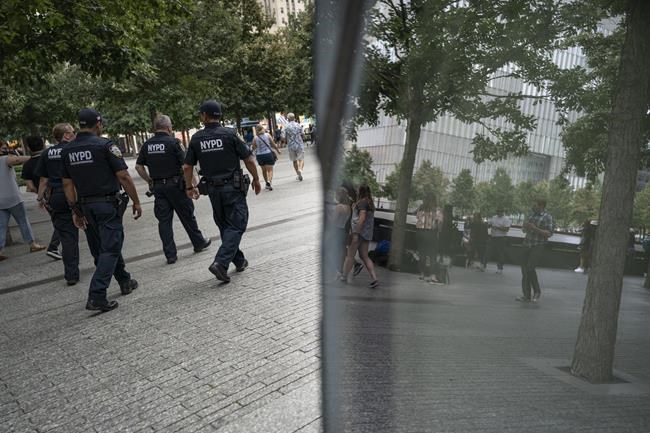
NYPD officer Michael Dougherty, a 25-year veteran, patrols with his colleagues at the National September 11 Memorial & Museum where names of his deceased colleagues and friends are displayed, Monday, Aug. 16, 2021, in New York.
NYPD officer Michael Dougherty, a 25-year veteran, patrols with his colleagues at the National September 11 Memorial & Museum where names of his deceased colleagues and friends are displayed, Monday, Aug. 16, 2021, in New York. "Sometimes something will just hit me, just staring out at the plaza," said Dougherty. "I'll take a couple of minutes to compose myself. But it's still an emotional attachment. You know, I lost many friends that day. Hopefully people never forget that motto, 'Never forget.'" (AP Photo/John Minchillo)

___

After the plaza empties around the reflecting pools each evening, Kevin Hansen pulls on blue work gloves, grabs his torch and begins his nightly work of repairing and maintaining the long, bronze parapets with the names of the dead.

Hansen was 8 and in elementary school on Long Island in 2001.

“You just remember everyone getting phone calls and teachers not knowing what was going on. And then parents were coming to school to pick kids up,” he said.

Of his work, Hansen says, “It’s important to me.”

“This is a sign that we all came together back in 2001. This is my giveback of patriotism and this (event) cannot be forgotten,” he said. “I believe this place brings people to see that there is evil in the world, but it can be overcome.”

___

While patrolling his beat around the World Trade Center, NYPD officer Mike Dougherty keeps an attentive eye on the memorial, often cleaning grime from the parapets and answering questions for tourists.

“If we see something on the panel we’ll make sure to wipe it off, and I see their names and I’ll touch them. I’m here looking over them, basically. Try to relay that to people that don’t understand what this is all about,” he said.
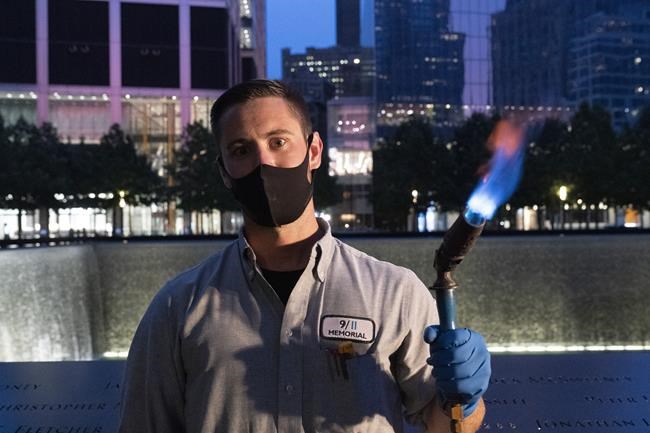
Kevin Hansen, an engineer at the September 11 Memorial, poses with a torch he uses to clean and burnish the names cut into the metal plates that border the south pool, Wednesday, Aug. 4, 2021, in New York. Hansen says of the work he does,
Kevin Hansen, an engineer at the September 11 Memorial, poses with a torch he uses to clean and burnish the names cut into the metal plates that border the south pool, Wednesday, Aug. 4, 2021, in New York. Hansen says of the work he does, "It's important to me. It's a sign that it's something I can do. I can give back and say this is something that cannot be forgotten. This is a sign that we all came together back in 2001. This is my giveback of patriotism and this (event) cannot be forgotten." (AP Photo/Mark Lennihan)

“I get that, a lot of questions sometimes, you know: ‘What is this area?’ And I don’t take offense to it. I like explaining to them where the buildings stood. What this is all about. Just to keep the memory of everyone in your life when you tell somebody who doesn’t have that connection.”

The 25-year NYPD veteran started as an apprentice electrician working inside the World Trade Center before becoming a police officer. He was on patrol in Brooklyn when the planes hit the towers.

When he patrols the memorial plaza now, he sometimes stops in his tracks.

“I’ll just be walking around the side or in one of the particular security pools, and sometimes something will just hit me. I just start staring out at the plaza. So, I’ll take a couple of minutes to compose myself.”

“It’s a privilege to be here. I’m at the end of my career, towards the end of it anyway. And I couldn’t think of a better place for me to finish up,” he said.

___

After moving to Battery Park City in 1998, the World Trade Center was a part of Joan Mastropaolo’s daily life. She not only lived across the street, but also worked two blocks east of the twin towers and shopped in the mall below.

“It was my front lawn. Every time I walked out of my apartment building and I crossed over, I came through the World Trade Center,” she said.

But on the morning of Sept. 11, 2001, “This vibrant community became nothing in a matter of 102 minutes.”
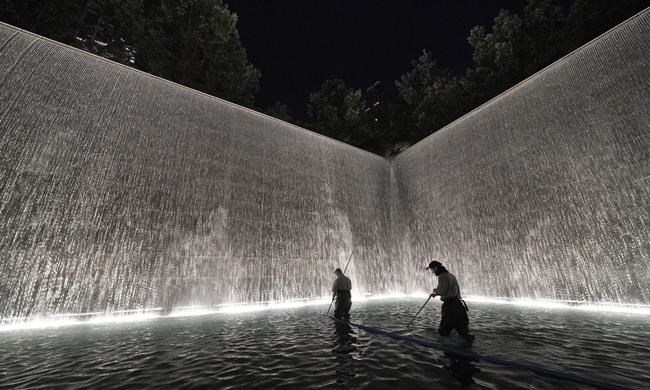
James Maroon, left, cleans the bottom of the south pool of the 9/11 Memorial with a vacuum, Wednesday, Aug. 4, 2021 in New York. On Sept. 11, 2001 he was going to work at the New York Mercantile Exchange, just west of the twin towers.
James Maroon, left, cleans the bottom of the south pool of the 9/11 Memorial with a vacuum, Wednesday, Aug. 4, 2021 in New York. On Sept. 11, 2001 he was going to work at the New York Mercantile Exchange, just west of the twin towers. "I was getting ready to cross the Westside Highway when the first plane hit and people were running up behind me," he said. "I thought a truck or something hit the walkway. I got out, looked up and the first plane was in the building. I thought it was just a small commuter plane because you didn't see a plane, just a hole. I ended going into work and then the second plane hit. I couldn't figure out where to go. Pretty much everything was closed off. I hooked up with a guy I worked with and we started walking up the Westside Highway and I looked back and the tower collapsed. Unbelievable." (AP Photo/Mark Lennihan)

“After everything happened here, I was completely shut out from this situation for a couple of years. I wasn’t a rescue recovery worker or a volunteer. So, I couldn’t get on the site, and I felt like a big part of my life was robbed from me,” she said. “When they started bringing the trees back to this site, for me, that was a symbol of returning life back to the site.”

Mastropaolo now volunteers as a docent at the 9/11 Tribute Museum, where she given more than 800 walking tours.

“I try to explain to them the magnitude of the loss.”

___

Michael Keene has been an owner of O’Hara’s Restaurant and Pub for 35 years. A popular watering hole for firefighters at a station a block away and for area office workers, O’Hara’s shut down for seven months after the attacks.

Its clientele changed when it reopened, becoming popular with crews working at ground zero. Keene now still offers Guinness on tap to the firefighters. Visitors to the memorial also frequent his pub.

“It’s special now, because the people that come over to the site after they’ve gone through the museum, and it’s tough to go through the museum. People that come over here are very respectful. And just to be in a place that was destroyed then and rebuilt, you know, there is something special about that.”

___

When the plaza around the reflecting pools closes, James Maroon dons waders and a headlamp and begins the deliberate task of vacuuming the floors of the giant fountains.
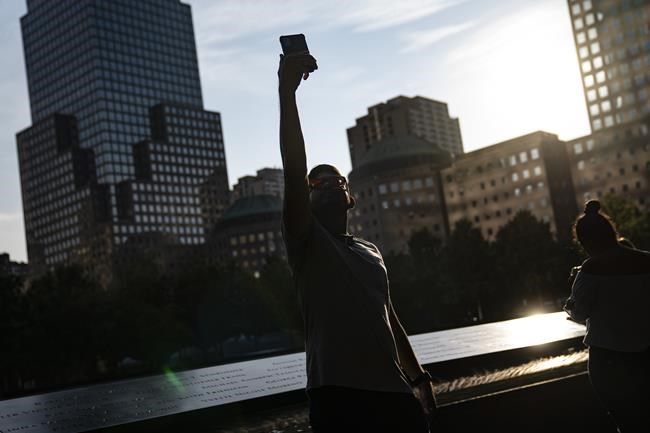
A visitor takes a selfie beside the north pool at the National September 11 Memorial & Museum, Wednesday, Sept. 8, 2021, in New York. (AP Photo/John Minchillo)

“We try and make it a place where people believe their families are being watched and taken care of,” said Maroon, an engineer for the National September 11 Memorial & Museum.

In 2001, Maroon was working at the New York Mercantile Exchange just west of the World Trade Center. He was crossing West Street when the first plane hit. Maroon knew many of the brokers who died in the attacks.

“Sometimes when we’re outside I look at the panel that their names are on. And one of them, Elkin Yuen, his daughter was due to be born. Now she’s going to be 20 years old. And never met her father.”

___

For more AP coverage of the 9/11 anniversary from New York and around the globe, visit our hub at https://apnews.com/hub/9-11-a-world-changed.

Report Error Submit a Tip

More Stories

Vlhova denies Holdener 1st WCup slalom win

The Associated Press 4 minute read Preview

Vlhova denies Holdener 1st WCup slalom win

The Associated Press 4 minute read Sunday, Jan. 9, 2022

KRANJSKA GORA, Slovenia (AP) — Petra Vlhova cemented her status as the leading female slalom skier of the season with her fifth win from six races on Sunday with just a month to go before the Olympic race in Beijing.

The overall World Cup champion from Slovakia won the penultimate slalom before the Games as she denied first-run leader Wendy Holdener of Switzerland a first career win.

Two Canadians cracked the top 10. Toronto's Ali Nullmeyer finished in sixth place and Erin Mielzynski of Collingwood, Ont., was ninth.

Mikaela Shiffrin was third after the opening run but skied out in what seemed a blistering-fast second run until the American straddled a gate.

Read
Sunday, Jan. 9, 2022

It isn’t ‘just the weather’

Erna Buffie 5 minute read 2:00 AM CDT

I was reading The Guardian the other day, which is one of the best, if not the best, newspaper for climate change coverage. I say this, despite the fact that it still silos the subject into a special section called “Climate Crisis and Environment.”

And it continues to publish front page headlines like “May and June heatwave kills about 2,700 in England and Wales, data suggests,” with no reference to climate change, until you hit the body of the story.

Which, quite frankly, is better than most newspapers do.

Indeed, in a recent issue of The Guardian, there’s an article about just that — the fact that an analysis of British newspapers revealed that 72 per cent of articles covering the U.K.’s June heatwave failed to even mention the climate crisis.

Mayor: Officer who put knee on man's neck should be charged

Amy Forliti And Colleen Long, The Associated Press 8 minute read Preview

Mayor: Officer who put knee on man's neck should be charged

Amy Forliti And Colleen Long, The Associated Press 8 minute read Thursday, May. 28, 2020

MINNEAPOLIS - The mayor of Minneapolis called Wednesday for criminal charges against the white police officer seen on video kneeling against the neck of a handcuffed black man who complained that he could not breathe and died in police custody.

Based on the video, Mayor Jacob Frey said officer Derek Chauvin should be charged in the death of George Floyd. The footage recorded by a bystander shows Chauvin with his knee on Floyd's neck as Floyd gasps for breath on the ground with his face against the pavement. The officer does not move for at least eight minutes, even after Floyd stops speaking and moving.

“I've wrestled with, more than anything else over the last 36 hours, one fundamental question: Why is the man who killed George Floyd not in jail?” said Frey, who is white.

He later added: "I saw no threat. I saw nothing that would signal that this kind of force was necessary.”

Read
Thursday, May. 28, 2020

Hydro’s $5-billion deals with Saskatchewan ‘deliberately covered up’

By Dan Lett 8 minute read Preview

Hydro’s $5-billion deals with Saskatchewan ‘deliberately covered up’

By Dan Lett 8 minute read Wednesday, Mar. 24, 2021

A scathing review of Manitoba Hydro failed to disclose the details of two multibillion-dollar power sales to Saskatchewan that are fundamental to the Crown utility's financial future, the Free Press has learned.

The report, by former Saskatchewan premier Brad Wall, into the Keeyask generating station and Bipole III transmission line concluded the former NDP government rushed to build both projects before getting proper regulatory approval, and failed to provide adequate financial oversight once construction started.

Premier Brian Pallister has used the report to buttress his assertion that Keeyask and Bipole III were the worst examples of NDP mismanagement and incompetence.

However, Hydro sources said it was suspicious the Wall report ignored the effect of two recent power sales to Saskatchewan that were completed last year — well before Wall's report was finished.

Read
Wednesday, Mar. 24, 2021

Ground zero: A selfie stop for some, a cemetery for others

Mark Lennihan, John Minchillo And Julie Jacobson, The Associated Press 3 minute read Preview

Ground zero: A selfie stop for some, a cemetery for others

Mark Lennihan, John Minchillo And Julie Jacobson, The Associated Press 3 minute read Friday, Sep. 10, 2021

One political science expert said the incident was ethically “out of line,” though Elections Canada said something of this nature does not appear to contradict regulations in the Canada Elections Act.

Read
Friday, Sep. 10, 2021

Rainbow Stage gamely gives Neil Sedaka's songs another spin

Randall King 4 minute read Preview

Rainbow Stage gamely gives Neil Sedaka's songs another spin

Randall King 4 minute read Friday, Jul. 13, 2018

The Neil Sedaka jukebox musical Breaking Up Is Hard to Do is a nostalgia delivery system in the same way cigarettes are a nicotine delivery system.

It’s not necessarily good for you. But it is an unapologetic indulgence to those of a certain vintage who know... well, who Neil Sedaka is, for starters.

For those of unvintaged vantage: Sedaka was Jewish Brill Building songwriter and pop star whose career peaked in the late 1950s and early ‘60s, one of the reasons this romantic comedy is set in 1960 in a failing holiday resort in New York’s Catskill Mountains.

Esther’s Paradise is operated by Esther Simowitz (Debbie Maslowsky), a widow struggling to keep the place together after paying off the debts left by her late, lamented hubby.

Read
Friday, Jul. 13, 2018