How U.S. citizens can make travelling from U.S. to Canada as painless as possible

Advertisement

Advertise with us

WASHINGTON - Fully vaccinated U.S. citizens and permanent residents can now enter Canada for non-essential purposes for the first time since March 2020, when the COVID-19 pandemic forced the two countries to severely curtail travel.

Read this article for free:


or

Already have an account? Log in here »

To continue reading, please subscribe:

Subscribe and receive a limited-edition Free Press branded hat or tote.

Digital Subscription

One year of digital access for only $205*

  • Enjoy unlimited reading on winnipegfreepress.com
  • Read the E-Edition, our digital replica newspaper
  • Access News Break, our award-winning app
  • Play interactive puzzles

*First annual payment billed as $205.00 + GST for one year. This annual subscription will automatically renew at $233.00 + GST every 52 weeks (10% off the regular annual price of $259.35). Offer available to new and qualified returning subscribers only. Cancel any time.

To continue reading, please subscribe:

Add Free Press access to your Brandon Sun subscription for only an additional

$1 for the first 4 weeks*

  • Enjoy unlimited reading on winnipegfreepress.com
  • Read the E-Edition, our digital replica newspaper
  • Access News Break, our award-winning app
  • Play interactive puzzles
Start now

*Your next Brandon Sun subscription payment will increase by $1.00 and you will be charged $17.95 plus GST for four weeks. After four weeks, your payment will increase to $24.95 plus GST every four weeks.

Hey there, time traveller!
This article was published 09/08/2021 (1864 days ago), so information in it may no longer be current.

WASHINGTON – Fully vaccinated U.S. citizens and permanent residents can now enter Canada for non-essential purposes for the first time since March 2020, when the COVID-19 pandemic forced the two countries to severely curtail travel.

Still, there are stringent requirements and rules in place that need to be followed to ensure crossing into Canada goes smoothly. Here are five key questions to consider before making a run for the (northern) border:

1. What constitutes being “fully vaccinated,” as far as the Canada Border Services Agency is concerned?
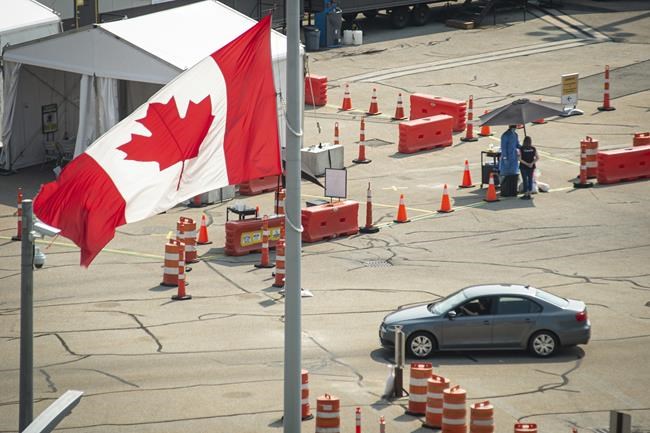
A car crosses the border into Canada, in Niagara Falls, Ont., on Monday, August 9, 2021. American citizens and permanent residents are now allowed to enter Canada for non-essential purposes if they can provide proof that they’ve been fully vaccinated for at least 14 days.THE CANADIAN PRESS/Eduardo Lima

Several things. First, eligible travellers must have completed a full course of one of the four COVID-19 vaccines approved by Health Canada: Pfizer-BioNTech, Moderna, Oxford-AstraZeneca (also known as Covishield) or the single-dose Johnson & Johnson shot. No other vaccines are allowed. Secondly, and this is critical: 14 full days must have elapsed since the last dose, otherwise a person is not considered fully vaccinated.

2. Can I just show my vaccination card to the border agent?

No. Vaccination details must be uploaded to the agency by way of ArriveCAN, an online system that can be accessed either through the iPhone or Android app or via computer at the following web address: www.canada.ca/en/public-health/services/diseases/coronavirus-disease-covid-19/arrivecan.html. Access to the system is not available until 72 hours before a traveller is scheduled to cross the border. When using the app, be sure to update it first; a new version is made available every time the regulations change. And don’t even try to fake your way in; a pair of travellers who uploaded phoney vaccination cards and lied about their test results last month were each hit with nearly $20,000 in fines.

3. What else do I need?

Proof that you are a U.S. citizen or permanent resident who lives full-time in the States, as well as a negative result from a molecular test for COVID-19, administered no more than 72 hours prior to reaching a border crossing point. So-called “antigen” tests are not permitted. Visitors are also required to keep the proof of their test results for a full 14 days upon entering Canada. Test documents, be they paper or electronic, must show:

— The traveller’s name and date of birth;

— The name and address of the facility that administered the test;

— The date the test was conducted, the type of test and, of course, the test result.

Incidentally, fully vaccinated Canadian citizens and permanent residents are also eligible to enter Canada without having to quarantine, provided they meet all the same conditions and requirements.

4. Anything else I should know?

Yes. Canadian border agents are randomly selecting otherwise eligible travellers for spot pre-entry COVID-19 testing, so be prepared to submit to a test before being allowed in. You should also have a quarantine plan ready and available to show the agent in the event that you develop symptoms of COVID-19, test positive at the border or otherwise don’t fully qualify for the exemption. Also, expect to wait awhile: the additional screening measures are slowing things down a lot at certain entry points (a full seven hours Monday at the Fort Frances bridge between Minnesota and northern Ontario). If you’re driving, check out CBSA’s wait-times website at www.cbsa-asfc.gc.ca/bwt-taf/menu-eng.html to see if there’s a better route to take.

5. I’m otherwise eligible to enter Canada, but I’ve already had COVID-19 and I’m still testing positive. What can I do?

Provided you are currently symptom-free, you can show proof of a positive COVID-19 molecular test that was conducted between 14 and 90 days prior to trying to enter Canada. However, you will still need to show the results of a molecular test that’s less than 72 hours old, even if the result is positive.

This report by The Canadian Press was first published Aug. 9, 2021.

Report Error Submit a Tip

More Stories

Manitoba Ag Days takes flight with focus on drone tech advancements

Abiola Odutola 5 minute read Preview

Manitoba Ag Days takes flight with focus on drone tech advancements

Abiola Odutola 5 minute read Wednesday, Jan. 21, 2026

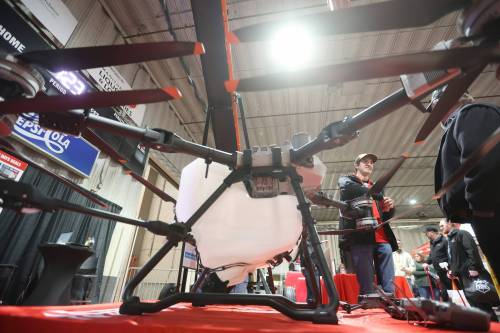
BRANDON — Manitoba Ag Days kicked off its annual event on Tuesday with a strong spotlight on innovation as the large-scale drones showcased on the trade show floor drew plenty of attention.

The Spider-i M400 agricultural spray drone marks a shift in how producers should think about the technology, Ag Drone Canada president Travis Karle said.

Karle, who has been a pilot for 35 years, said he has spent the last four years working with manufacturers to develop a proper high-capacity, high-volume, aerial spray drone. Karle described the M400 as “by far the biggest drone in the industry,” featuring a tank capacity of up to 210 litres, three batteries and extended flight time.

“Instead of thinking of that as a drone, now we’re looking at a piece of farm equipment,” he said. “We’re 100 acres per hour-plus with that drone of that size.”

Read
Wednesday, Jan. 21, 2026

Residents relocated to hotels after fatal fire at Manitoba Housing downtown high-rise

Tyler Searle 6 minute read Preview

Residents relocated to hotels after fatal fire at Manitoba Housing downtown high-rise

Tyler Searle 6 minute read Wednesday, Apr. 22, 2026

Two days after she fled from her Manitoba Housing unit owing to a fire, Norma Bushie manoeuvred her wheelchair to the door of the Kennedy Street building on Wednesday afternoon, desperate to retrieve her identification cards and a charging cable for her cellphone.

Staff told the 37-year-old she could not return to her eighth-floor suite, which is one of dozens damaged by a blaze that killed one person on Monday and shuttered six of the building’s 16 storeys.

“I couldn’t take anything out of there,” Bushie said. “I’m not sure when we can get back in. We’re staying at a hotel right now.”

She is among the many people who are indefinitely displaced as the provincial government scrambles to restore access to the 58 units affected by the blaze.

Read
Wednesday, Apr. 22, 2026

BRANDON — The Manitoba government is seeking to build a soybean crushing plant and is looking for investment to make it happen.

The proposed facility is one of several projects the NDP government pitched at the international investment summit in Toronto this week.

“We’re in a new world of opportunities that I think provinces or the country of Canada needs to apprehend,” Manitoba Agriculture Minister Ron Kostyshyn said Monday.

The MLA for Dauphin said soybeans were a “very popular discussion” during recent trade missions in certain parts of Asia.

Media Literacy & Learning

0 minute read Tuesday, Oct. 28, 2025

Wind and batteries the best bet

James Wilt 5 minute read Preview

Wind and batteries the best bet

James Wilt 5 minute read 2:01 AM CDT

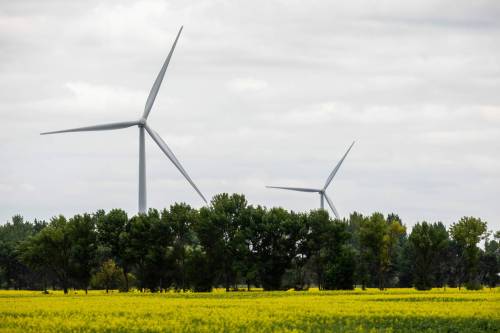
For years, Manitoba Hydro has claimed that we can’t rely on wind turbines during multi-day or even multi-week cold snaps. Although turbines can be equipped with cold-weather packages to operate down to –30 C, as at the St. Leon and St. Joseph wind farms, Hydro routinely warns of the possibility of a lengthy winter wind drought at the same time as electricity use peaks due to high heating demand.

This concern is largely why Hydro is pushing to build a 750 MW fossil gas-fired power plant in Brandon, rather than building more wind farms.

But new analysis by Alexander Hogeveen Rutter, a former energy modeller for Manitoba Hydro, shows that wind-generation reliability well exceeds assumptions and that, if combined with battery energy storage, it could meet even the most bullish load growth forecasts. (These findings were presented to the Public Utilities Board on Aug. 31, and the full report can be found on Climate Action Team Manitoba’s website.)

Hydro’s low estimate of wind generation stems from its erroneous assumption that all new wind farms will be built in the same locations as Manitoba’s two existing wind farms (St. Leon and St. Joseph). Because these two wind farms are only 100 kilometres apart, they have highly correlated wind speeds; when wind conditions are low at one site, they likely are at the other as well. This is not how new wind farms will be built in Manitoba. Instead, they will be located in different areas and use much taller turbines with higher generation potential than the existing wind farms.

Read
2:01 AM CDT

Premier touts Port of Churchill opportunities at Canadian investment summit

Free Press staff 5 minute read Preview

Premier touts Port of Churchill opportunities at Canadian investment summit

Free Press staff 5 minute read Monday, Sep. 14, 2026

Premier Wab Kinew announced Monday that major capital investments in the Port of Churchill Plus project will receive an exemption from Manitoba’s seven per cent retail sales tax.

Kinew made the announcement at the start of the two-day Canada investment summit in Toronto. The premier made the pitch to a room of 250 Canadian and global investors representing more than US$13 trillion in assets.

“We are here in Toronto to tell global investors that the Port of Churchill is open and ready to expand,” Kinew told the Canadian Global Growth Forum, a provincial government news release said.

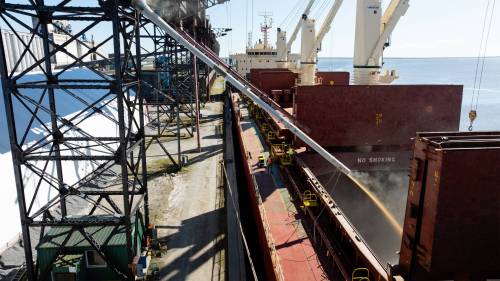
“These new capital incentives make it easier for investors to get in on the ground floor of the largest project featured at the Canada investment summit. The grain and critical minerals we are already shipping out of the port are reaching Europe faster than the Port of Vancouver. With the right investments we can ship commodities year-round, strengthening trade between reliable partners and creating good jobs,” the premier, who was not made available for an interview, said in the release.

Read
Monday, Sep. 14, 2026