‘Still a ways to go in Alberta:’ Top doctors weigh in on plan to end isolation

Advertisement

Advertise with us

Canada’s top doctors say Alberta’s decision to end isolation requirements for those who test positive for COVID-19, or who have been in close contact with someone who has, could have ripple effects across the country.

Read this article for free:


or

Already have an account? Log in here »

To continue reading, please subscribe:

Subscribe and receive a limited-edition Free Press branded hat or tote.

Digital Subscription

One year of digital access for only $205*

  • Enjoy unlimited reading on winnipegfreepress.com
  • Read the E-Edition, our digital replica newspaper
  • Access News Break, our award-winning app
  • Play interactive puzzles

*First annual payment billed as $205.00 + GST for one year. This annual subscription will automatically renew at $233.00 + GST every 52 weeks (10% off the regular annual price of $259.35). Offer available to new and qualified returning subscribers only. Cancel any time.

To continue reading, please subscribe:

Add Free Press access to your Brandon Sun subscription for only an additional

$1 for the first 4 weeks*

  • Enjoy unlimited reading on winnipegfreepress.com
  • Read the E-Edition, our digital replica newspaper
  • Access News Break, our award-winning app
  • Play interactive puzzles
Start now

*Your next Brandon Sun subscription payment will increase by $1.00 and you will be charged $17.95 plus GST for four weeks. After four weeks, your payment will increase to $24.95 plus GST every four weeks.

Hey there, time traveller!
This article was published 30/07/2021 (1896 days ago), so information in it may no longer be current.

Canada’s top doctors say Alberta’s decision to end isolation requirements for those who test positive for COVID-19, or who have been in close contact with someone who has, could have ripple effects across the country.

“I firmly believe that quarantine and isolation can help prevent the spread of COVID-19, especially in light of the spread of the Delta variant,” Theresa Tam, the country’s chief public health officer, said Friday during a news briefing in Ottawa.

She urged people to continue isolating, get tested for COVID-19 and inform their close contacts even if it is no longer required.
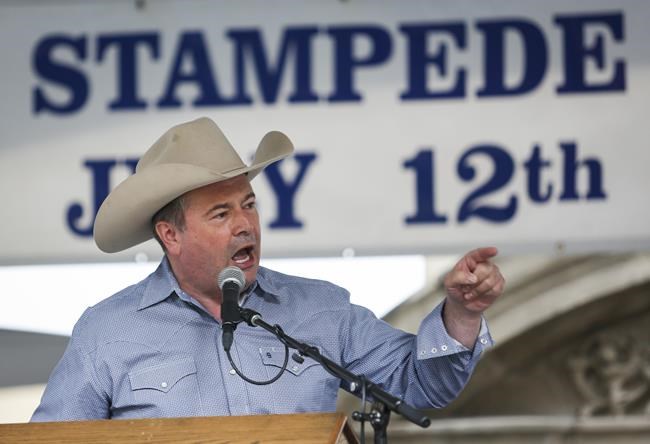
Alberta Premier Jason Kenney speaks at the Premier's annual Stampede breakfast in Calgary on Monday, July 12, 2021. The Canadian Paediatric Society has written an open letter to Alberta's top doctor urging her to reconsider lifting isolation and testing requirements to curb the spread of COVID-19. THE CANADIAN PRESS/Jeff McIntosh

Alberta announced earlier this week that close contacts of positive cases are no longer being notified of exposure by contact tracers, nor are they required to isolate. The government has also ended asymptomatic testing.

As of Aug. 16, individuals who test positive won’t be legally required to isolate either, although it will still be recommended. Isolation hotels will close and quarantine supports will end.

During the height of the third wave, Alberta led Canada and the United States in per capita COVID-19 cases. Infections are now rising again in the province with the Delta variant, first identified in India, dominating.

Vaccination rates are also lagging. About 75 per cent of eligible Albertans have received at least one dose of vaccine and 65 per cent are fully immunized.

That means there are hundreds of thousands of unvaccinated people in Alberta, Tam said, creating the potential for large COVID-19 clusters and outbreaks.

“The bottom line is get vaccinated. There’s still a ways to go in Alberta.”

The consequences of Alberta’s decision could spread beyond provincial boundaries, added Dr. Howard Njoo, Canada’s deputy chief public health officer.

“Everyone is alive to the fact that there could be, as they say, ‘knock-on effects’ to the other provinces and territories with travel within Canada,” he said.

Local leaders and health-care providers across Canada have been highly critical ofAlberta’s decision.

Dr. Andrew Boozary of the University of Toronto said Alberta’s decision to drop public health measures while it faces lower vaccination rates, growing cases and a mutating virus sets the entire country behind.

“It just really appears as a cruel policy experiment for far too many Albertans and a cruel policy experiment that has far-reaching effects across the country,” said Bozary.

“This is a pandemic that requires a global response and, in our own country, it’s going to require provinces working in concert, co-ordinating their responses.”

Saskatchewan’s requirement that positive cases must self-isolate expired July 11 when other restrictions there were lifted. But the government says people who are infected are asked to isolate and can still be ordered to do so by a medical health officer.

Lisa Glover, a spokeswoman for Alberta Health, said in a statement that health officers also have the authority to act in Alberta if “an unacceptable or significant risk” is posed.

She said the province is enhancing how it monitors COVID-19 and it will review its approach if there is too much pressure on hospitals.

Also Friday, protesters in Calgary and Edmonton called for public health measures based in evidence. Many expressed concern for children returning to school in the fall, especially those under 12 who are not eligible for vaccinations.

In an open letter to Alberta’s chief medical officer of health, Dr. Deena Hinshaw, the Canadian Paediatric Society also spoke to the vulnerability of that age group and urged herto think twice about lifting isolation and testing requirements.

The letter called the move an “unnecessary and risky gamble.”

“Dropping these public health measures, especially when we are in such a delicate phase of recovery, has the potential to worsen the spread of the virus and could jeopardize future recovery plans and supports,” the letter said.

This report by The Canadian Press was first published July 30, 2021.

—With files from Julia Peterson in Regina

Report Error Submit a Tip

More Stories

Alzheimer’s has sent my mother back in time

Pam Frampton 5 minute read Preview

Alzheimer’s has sent my mother back in time

Pam Frampton 5 minute read 2:01 AM CDT

My mother does a lot of time-travelling — time-shifting, the Alzheimer’s Society calls it.

I wonder how it feels to be in the present at one moment and then suddenly catapulted deep into the past. Is it a jolting experience or a smooth transition to go back and forth in time?

Mom will never be able to tell me. There is so much she can never tell me now.

She can still recite her children’s names when prompted, but she doesn’t ask us about our lives. Instead, she talks about her younger siblings, their grandfather who was hard of hearing, the isolated place where they used to live whose inhabitants were resettled nearly 60 years ago.

Read
2:01 AM CDT

Messing credits teammates for support

Lori Ewing, The Canadian Press 6 minute read Preview

Messing credits teammates for support

Lori Ewing, The Canadian Press 6 minute read Friday, Jan. 17, 2020

MISSISSAUGA, Ont. - The rink had always felt like home for Keegan Messing. But in the days and weeks after his brother's death, the Canadian figure skater struggled to find solace on the ice.

In a sport that requires steely nerves to reel off big jumps, and the ability to dig deep to push through searing pain, Messing had lost his will.

"It was the question of: why am I doing this?" Messing said. "In the grand scheme of life, it was: should I still do this? Can I still do this?"

Less than four months after his younger brother Paxon died in a motorcycle crash in Anchorage, Messing is aiming for his first national title at the Canadian figure skating championships, and a spot on the world championship team. He credits fellow Canadian skaters Nam Nguyen and Piper Gilles for getting him to the start gate.

Read
Friday, Jan. 17, 2020

RRC Polytech tallies pair of tech programs

Aaron Epp 4 minute read 7:00 PM CDT

Red River College Polytechnic has announced two new degree programs aimed at preparing students to meet workforce demands in Manitoba industries such as engineering and manufacturing.

The first cohorts working toward bachelor of technology degrees in advanced manufacturing and mechatronics will enter the classroom in January at the Winnipeg college’s Notre Dame Avenue campus.

The two programs include a foundation in research methods, Indigenous worldviews and Industry 4.0 technologies to equip graduates with the skills and confidence to take on increasing responsibility in the workplace, RRC Polytech announced earlier this week.

They offer more options for existing students, graduates and mid-career professionals, the school said.

Climate change a clear and present danger to the already-shrinking polar bear population

Sarah Lawrynuik 18 minute read Preview

Climate change a clear and present danger to the already-shrinking polar bear population

Sarah Lawrynuik 18 minute read Friday, Oct. 30, 2020

The rocks fly out from beneath the tires of Angela Mak’s Ford F-150 as she cruises down the gravel road along the coast of Hudson Bay just east of Churchill.

It’s a routine. Every day from July until November she comes out here looking for polar bears.

Mak and her husband Bill Fong are originally from Hong Kong, but moved to Vancouver in the early ‘90s. In 2017 they travelled to Churchill during bear season — October and November, when the bears move out onto the sea ice.

After that one trip, their hearts were set on Churchill. First they bought a house in town to host friends and other guests, then they bought a small hotel when it went on the market in 2019.

Read
Friday, Oct. 30, 2020

Hammer attack on cabbie has industry on edge

Morgan Modjeski 3 minute read Preview

Hammer attack on cabbie has industry on edge

Morgan Modjeski 3 minute read 8:04 PM CDT

A leader in Winnipeg’s taxi industry is calling for people to come forward with information after one of his drivers was attacked by a man with a hammer.

The 26-year-old cabbie was taken to hospital in unstable condition after the incident Saturday morning, Unicity Taxi’s general manager said Wednesday.

“It was a very serious incident,” said Abhishek Tara, adding the driver remains in hospital.

“He lost a lot of blood.”

Read
8:04 PM CDT

Kinew, two NDP caucus members file lawsuit defence, deny defaming former party MLA Wasyliw to expel him

Erik Pindera 5 minute read Preview

Kinew, two NDP caucus members file lawsuit defence, deny defaming former party MLA Wasyliw to expel him

Erik Pindera 5 minute read 5:22 PM CDT

The premier and two New Democrat caucus members have denied they conspired to defame another politician as an excuse to oust him from the party.

Mark Wasyliw, now an independent Member of the Legislative Assembly representing Fort Garry, was booted from the NDP in September 2024, which the party claimed was due to Wasyliw’s former law partner representing convicted sex offender and disgraced fashion mogul Peter Nygard.

The independent MLA, who’s a defence lawyer, claims statements his former colleagues made in September 2024 linking him to Nygard or accusing him of lying, harmed him and his reputation.

Wasyliw filed his lawsuit in December last year, naming Premier Wab Kinew, Natural Resources Minister Ian Bushie and Seine River MLA Billie Cross as defendants. The claim was later amended to remove Bushie as a defendant and add Environment Minister Mike Moyes, who was at the time chair of the NDP caucus, in his place.

Read
5:22 PM CDT