Canada’s justice minister considers legal protection of residential school burial sites
Advertisement
Read this article for free:
or
Already have an account? Log in here »
To continue reading, please subscribe:
Digital Subscription
One year of digital access for only $1.44 a week*
- Enjoy unlimited reading on winnipegfreepress.com
- Read the E-Edition, our digital replica newspaper
- Access News Break, our award-winning app
- Play interactive puzzles
*Billed as $5.77 plus GST every four weeks. After 52 weeks, price increases to the regular rate of $19.95 plus GST every four weeks. Offer available to new and qualified returning subscribers only. Cancel any time.
To continue reading, please subscribe:
Add Free Press access to your Brandon Sun subscription for only an additional
$1 for the first 4 weeks*
- Enjoy unlimited reading on winnipegfreepress.com
- Read the E-Edition, our digital replica newspaper
- Access News Break, our award-winning app
- Play interactive puzzles
*Your next Brandon Sun subscription payment will increase by $1.00 and you will be charged $17.95 plus GST for four weeks. After four weeks, your payment will increase to $24.95 plus GST every four weeks.
Read unlimited articles for free today:
or
Already have an account? Log in here »
Hey there, time traveller!
This article was published 02/06/2021 (1975 days ago), so information in it may no longer be current.
OTTAWA – Federal Justice Minister David Lametti says he is open to considering different legal avenues when it comes to residential schools with burial grounds — in particular the possibility of protecting these sites and criminalizing anyone who might try to damage them or hide evidence.
In an interview with The Canadian Press, Lametti said he has received a request to look at what legal levers may exist to ensure these sites are protected.
All levels of government want to take their lead from Indigenous communities and leaders about what they would like to do with the individual school buildings, grounds and burial sites, Lametti said.
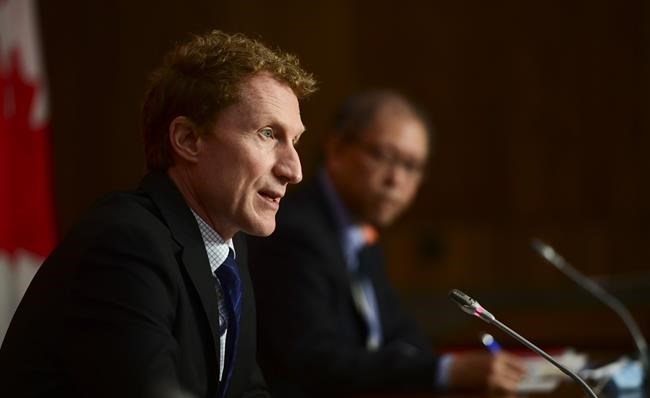
For those looking for some level of legal accountability, the justice minister said he is willing to look into the idea of protecting these sites for the future.
“I’m certainly open to looking at the possibilities here and what the current laws are, but is there potential for — in terms of protecting the sites themselves from tampering — protecting them really as sacred ground where people are buried?” he said.
“Or, again, looking at taking our cues from Indigenous people, is there a way to criminalize the behaviour of people who go against it? So, if a developer went in indiscriminately and dug something up where people might have been buried, for example, or trying to hide facts or that sort of thing.
“I’m willing to look at that. That certainly would come within the bailiwick of the justice minister and the criminal law power and I’m certainly open to that,” he said.
The Tk’emlups te Secwepemc First Nation announced last week that ground-penetrating radar had located what are believed to be the unmarked graves of 215 children at a former residential school in Kamloops, B.C. The discovery has sparked national outrage and grief, and has led to mounting calls for Canada to hold someone or some authority to account.
Even from within Prime Minister Justin Trudeau’s own caucus, calls for action are piercing through the usual partisan din in the nation’s capital.
Liberal MP and parliamentary secretary of foreign affairs Rob Oliphant expressed “outrage” in a tweet Tuesday, adding his belief the “perpetrators of this crime against humanity must be brought to account.”
But Lametti said it would be difficult to go back in time and criminalize behaviours or actions taken as far back as 150 years ago. However, he appeared open to looking at the possibilities.
“I realize some of it was much more recent than that, and to the extent that people are still alive, that’s always a possibility,” Lametti said of finding and prosecuting the perpetrators of crimes against Indigenous children.
“Is there a role that we can play in terms of gathering evidence? Maybe,” he said.
“Our Public Prosecution Service and police services are getting better, they have a lot of work to do, but they’re getting much better at understanding the challenges of looking at these kinds of crimes that were committed against Indigenous people in the past.”
As for growing requests from Indigenous leaders and nations looking for federal help to search grounds of other former residential schools for unmarked graves — including from the Federation of Sovereign Indigenous Nations in Saskatchewan and Six Nations of the Grand River in Ontario —Ottawa says it will be there to help, if requested.
The United Nations Human Rights Office also called Wednesday on all levels of Canadian governments to investigate the deaths of Indigenous children at residential schools and to intensify efforts to find those who are missing.
“We will be there to support the work in all the communities affected by this … we will make sure they have access to whatever expertise they need, but over the past engagement it was very clear they don’t want a top-down approach to this,” said Crown-Indigenous Relations Minister Carolyn Bennett.
She said $27 million — originally earmarked in the 2019 budget — will now be urgently made available to uncover unmarked graves at former residential schools across the country.
As for why this money was not made available to communities for these efforts sooner, Bennett said it was a matter of having to explain to Treasury Board exactly how the money would be distributed.
“That approval has come and we are now able to urgently distribute it.”
At a committee meeting later Wednesday, Public Safety Minister Bill Blair acknowledged “the clear and unavoidable RCMP role” in the Kamloops tragedy, as well as that of the government. He said RCMP Commissioner Brenda Lucki has assured him that the police force “will offer its full support as we seek to learn more about the events in Kamloops.”
Meanwhile, the Catholic Church’s role in the government-funded, church-operated institutions has renewed calls for the Vatican to apologize and contribute financially to Indigenous healing programs.
Indigenous Services Minister Marc Miller said Wednesday the Pope needs to issue an apology for the role the church played in the system.
A papal apology was one of the 94 recommendations made by the Truth and Reconciliation Commission and Prime Minister Justin Trudeau personally asked the Pope to consider such a gesture during a visit to the Vatican in 2017.
The Canadian Conference of Catholic Bishops announced in 2018 that the Pope could not personally apologize for residential schools, even though he has not shied away from recognizing injustices faced by Indigenous people around the world.

Miller said it’s “shameful” that an apology hasn’t been issued to date.
“There is a responsibility that lies squarely on the shoulders of the council of bishops in Canada.”
The institutions operated in Canada for more than 120 years and the Truth and Reconciliation Commission ruled they constituted a cultural genocide.
Tuesday marked the sixth anniversary of the release of the commission’s report, which made recommendations on work governments, justice systems and church officials should do to locate, name and commemorate the children who died in these institutions.
This report by The Canadian Press was first published June 2, 2021.
Related Articles
Long Plain searches for graves before building
Advertisement Advertise With Us
Advertisement Advertise With Us
The Free Press acknowledges the financial support it receives from members of the city’s faith community, which makes our coverage of religion possible.