Other provinces looking at Saskatchewan’s plan to tie COVID-19 vaccines to reopening

Advertisement

Advertise with us

CALGARY - Neighbouring provinces are eyeing Saskatchewan's plan to ease COVID-19 restrictions in tandem with vaccination rates, but experts are warning the approach could lead some to a false sense of security.

Read this article for free:


or

Already have an account? Log in here »

To continue reading, please subscribe:

Subscribe and receive a limited-edition Free Press branded hat or tote.

Digital Subscription

One year of digital access for only $205*

  • Enjoy unlimited reading on winnipegfreepress.com
  • Read the E-Edition, our digital replica newspaper
  • Access News Break, our award-winning app
  • Play interactive puzzles

*First annual payment billed as $205.00 + GST for one year. This annual subscription will automatically renew at $233.00 + GST every 52 weeks (10% off the regular annual price of $259.35). Offer available to new and qualified returning subscribers only. Cancel any time.

To continue reading, please subscribe:

Add Free Press access to your Brandon Sun subscription for only an additional

$1 for the first 4 weeks*

  • Enjoy unlimited reading on winnipegfreepress.com
  • Read the E-Edition, our digital replica newspaper
  • Access News Break, our award-winning app
  • Play interactive puzzles
Start now

*Your next Brandon Sun subscription payment will increase by $1.00 and you will be charged $17.95 plus GST for four weeks. After four weeks, your payment will increase to $24.95 plus GST every four weeks.

Hey there, time traveller!
This article was published 11/05/2021 (1976 days ago), so information in it may no longer be current.

CALGARY – Neighbouring provinces are eyeing Saskatchewan’s plan to ease COVID-19 restrictions in tandem with vaccination rates, but experts are warning the approach could lead some to a false sense of security.

Saskatchewan’s “reopening road map” outlined last week says public health measures are to start to relax three weeks after 70 per cent of residents 40 and older have received their first shot and all adults are eligible.

Step 1, which could take effect as soon as month’s end, would allow restaurants and bars to seat six at a table, fitness classes to resume with three metres between participants and gathering limits to ease.
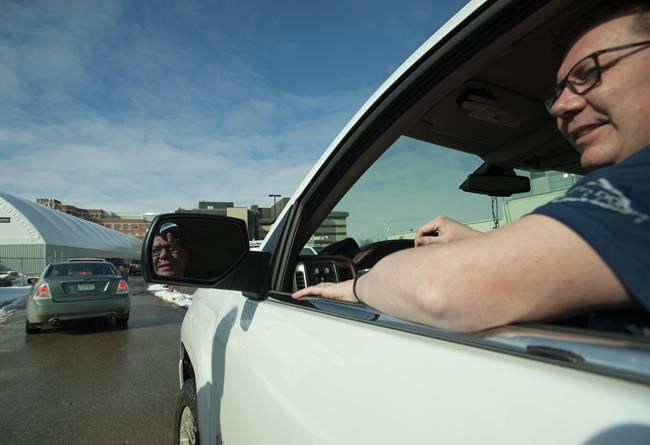
Saskatchewan Premier Scott Moe waits in line at a COVID-19 vaccination drive-thru clinic at Evraz Place in Regina on Thursday, April 15, 2021. THE CANADIAN PRESS/Mark Taylor

Restrictions are to further loosen three weeks after 70 per cent of those 30 and over are vaccinated once, and then again three weeks after the same percentage of anyone 18 and over has had a first shot.

“This has worked in other jurisdictions and we firmly believe that it will work here in Saskatchewan,” said Premier Scott Moe, citing the United Kingdom and Israel as examples.

Nazeem Muhajarine, a professor of community health and epidemiology at the University of Saskatchewan, points out that more than 20 per cent of the U.K.’s population has received a second vaccination, which affords greater protection against the virus than just one shot. The country is also reopening after having imposed much more severe restrictions.

In Israel, more than half the population has received two shots.

Muhajarine said Saskatchewan’s dual-dose coverage is likely to be closer to 10 per cent.

“One dose of a vaccine is not enough to give the population full protection, particularly against the variants,” he said.

“The variants are unpredictable, unknown and the dark horse in all of this.”

Manitoba Premier Brian Pallister has said his Progressive Conservative government is working on a plan he hopes will provide hope and help people comply with health orders.

Health officials have said Manitoba’s plan will be connected to vaccine rates, but will also consider hospital capacity and case numbers.

Alberta recently eased restrictions on visits to long-term care facilities because almost all residents have received both doses.

Premier Jason Kenney has said Saskatchewan has a “thoughtful” framework that his province is exploring.

“We’ve seen some governments, some public health experts, say that even if you’ve received the double dose, it makes no difference. You’ve got to stay shut down at home indefinitely,” Kenney said.

“That I think disincentivizes people from getting the vaccine, especially the people who are vaccine hesitant.”

Muhajarine said dangling vaccines as a carrot could have the opposite effect. “People could actually get a false sense of security.”

He said he understands that people need to see a path toward ending restrictions.

“Canadian summer is what we live through the winter for,” he said.

“We also have to make sure that we don’t put our lives and our loved ones lives at risk unnecessarily or too hastily.”

Dr. Daniel Gregson, an associate professor with the University of Calgary’s Cumming School of Medicine, said Saskatchewan has a “wise” plan overall.

“(Moe’s) not just saying when (the vaccination rate) hits 70 per cent, we’re going to flap open the doors,” he said.

“We’re going to do it in a stepwise manner with a combination of vaccination and restrictions.”

Gregson noted a segment of the population would still remain unprotected.

“If you are in an age group where you’re at really high risk of dying and death, and you’re not vaccinated, this plan will help protect the health-care system, but it’s not going to protect you as an individual,” said Gregson.

Outbreaks will still occur as “birds of a feather flock together” and like-minded unvaccinated people gather, said Gregson. But, he adds, it’s less likely those would grow into super-spreader events in the broader community.

“This virus is not going away, no matter what percentage of the population we get immunized,” said Gregson.

“And if you think herd immunity is going to work for you, you are wrong.”

This report by The Canadian Press was first published May 11, 2021.

Report Error Submit a Tip

More Stories

Federal COVID-19 aid bill passes into law

Mia Rabson and Joan Bryden, The Canadian Press 6 minute read Preview

Federal COVID-19 aid bill passes into law

Mia Rabson and Joan Bryden, The Canadian Press 6 minute read Wednesday, Mar. 25, 2020

OTTAWA - An emergency federal bill to give the government billions of dollars to spend to help anxious workers, families and employers cope with COVID-19 is now law.

Gov. Gen. Julie Payette signed the bill at 12:18 p.m. Eastern time Wednesday, after both the House of Commons and Senate issued speedy approvals earlier in the day.

The bill allows the federal government up to $52 billion in funds to directly help Canadians, including a repackaged aid program for workers who can't work for almost any reason connected to the virus.

That Canada Emergency Response Benefit will offer $2,000 a month in direct support through the Canada Revenue Agency, and is the main reason the cost of direct COVID-19 aid nearly doubled from an estimated $27 billion last week to $52 billion now.

Read
Wednesday, Mar. 25, 2020

Kids deserve better

Jordan Laidlaw 4 minute read 2:00 AM CDT

As much as I cling to hope, I recognize the ominous circumstances and questionable future that our young people stand to inherit.

Youth are navigating a world plagued with the existential dangers of climate change, artificial intelligence, political polarization and rising military armament, among other disconcerting trends. While schools cannot entirely ameliorate these issues, I am inspired by the words of Amina Mohammed, the United Nations deputy secretary-general, who declared teachers to be the “guardians of our future.”

Our future integrally depends on the learning, healthy development and empowerment of young people. With the upcoming Manitoba school board elections, I invite readers, voters and prospective candidates to consider how to support the practices of these guardians so we may ensure a brighter tomorrow.

First, I believe we are in — or entering — a community mental-health crisis. There is a resounding body of peer-reviewed research outlining the declining trends in the mental health of youth, parents and teachers. In May 2026, Doctors Manitoba stated its concern that the technology consumption habits of youth rivalled the health detriments of drinking and smoking. Many parents are stressed, economically struggling and need assistance. How might schools mitigate these precarious developments?

Canadian Mennonite University students, staff victims of cyberattack

Free Press staff 3 minute read Preview

Canadian Mennonite University students, staff victims of cyberattack

Free Press staff 3 minute read Updated: Yesterday at 6:26 PM CDT

Canadian Mennonite University fell victim to a cyberattack that compromised the data of current and former students and employees last month.

School officials became aware of the cybersecurity incident, in which an “unknown third party” accessed its information technology systems without authorization, on Sept. 18, university president Cheryl Pauls said in a recent statement.

The university has since confirmed the third party used that access to steal information from its systems.

“We immediately initiated our incident response plan, retained expert assistance, and informed the university community whose workflows were affected as soon as we became aware of the incident,” Pauls said. “We also reported this incident to law enforcement and will be filing a report with the Office of the Privacy Commissioner of Canada.”

Read
Updated: Yesterday at 6:26 PM CDT

Massive challenges in the media landscape have not altered the enduring Free Press mission

Melissa Martin  6 minute read Preview

Massive challenges in the media landscape have not altered the enduring Free Press mission

Melissa Martin  6 minute read Thursday, Oct. 4, 2018

You never forget the first time you see the newspaper presses, these vast mechanical maws roaring like jet engines, gobbling up raw newsprint and transforming it into something to be held and opened and savoured. 

The sound seems to fill up your ears, your lungs, your bones. A working song, mechanical, magnificent. 

The sadness is that one day, those presses will probably fall silent. There’s no telling exactly when. Only that the march to digitize our culture is not slowing, and someday all the news there is to read will wink out from a screen.

When the presses fall silent, so too will the small pleasures of many consecutive generations. The mingling smells of ink and coffee; the sound of sparrow song, accompanied by the rustle of a morning paper; and the feel of it all. 

Read
Thursday, Oct. 4, 2018

War veteran helped build Rivercrest

Bill Redekop 6 minute read Saturday, Mar. 30, 2019

As one of the original homeowners in Rivercrest, a subdivision north of Winnipeg set aside for war veterans in 1946, and the very last of them to leave at age 101, Art Christensen embodied neighbourhood-building.

He volunteered with the construction of the Rivercrest United Church, Rivercrest Community Club, West St. Paul Curling Club, and West St. Paul Fire Hall.

He went on to serve as West St. Paul councillor for 10 years, and then as reeve for 11.

Christensen was even a bit of a social convener.

Letters, Oct. 7

6 minute read Yesterday at 2:01 AM CDT

On diet and humanity

Re: “Maybe ASI will need us” (Letters, Oct. 5)

Mr. Martin, humans eating animals is not part of the circle of life. Many cultures with abundant plant resources, or for religious beliefs, have historically subsisted on largely or strictly vegetarian diets. Likewise, in extreme environments such as the Arctic, Inuit rely heavily on animal products due to the near-absence of arable land. Humans adapt locally to their environments and do not have a single ancestral diet.

Clearly vegetarian or vegan diets are not fringe, as evidenced by plant-based products on main-stream grocery store shelves. To suggest the Free Press is morally endorsing a fringe diet is rubbish, (the newspaper) merely gives the public a platform for diverse opinions, thus generating individual, thought-provoking ideas and conversations — a practice that is desperately needed these days.