Schools in four more Ontario public health units to reopen for in-person learning

Advertisement

Advertise with us

TORONTO - Schools in four more public health units in southern Ontario will reopen for in-person learning on Monday, but students in several other regions will continue to learn online.

Read this article for free:


or

Already have an account? Log in here »

To continue reading, please subscribe:

Subscribe and receive a limited-edition Free Press branded hat or tote.

Digital Subscription

One year of digital access for only $205*

  • Enjoy unlimited reading on winnipegfreepress.com
  • Read the E-Edition, our digital replica newspaper
  • Access News Break, our award-winning app
  • Play interactive puzzles

*First annual payment billed as $205.00 + GST for one year. This annual subscription will automatically renew at $233.00 + GST every 52 weeks (10% off the regular annual price of $259.35). Offer available to new and qualified returning subscribers only. Cancel any time.

To continue reading, please subscribe:

Add Free Press access to your Brandon Sun subscription for only an additional

$1 for the first 4 weeks*

  • Enjoy unlimited reading on winnipegfreepress.com
  • Read the E-Edition, our digital replica newspaper
  • Access News Break, our award-winning app
  • Play interactive puzzles
Start now

*Your next Brandon Sun subscription payment will increase by $1.00 and you will be charged $17.95 plus GST for four weeks. After four weeks, your payment will increase to $24.95 plus GST every four weeks.

Hey there, time traveller!
This article was published 28/01/2021 (2074 days ago), so information in it may no longer be current.

TORONTO – Schools in four more public health units in southern Ontario will reopen for in-person learning on Monday, but students in several other regions will continue to learn online.

Education Minister Stephen Lecce said Thursday that students will be able to return to physical classrooms in the Ottawa, Eastern Ontario, Southwestern, and Middlesex-London public health units.

He said the government made the decision based on recommendations from the province’s chief medical officer of health.
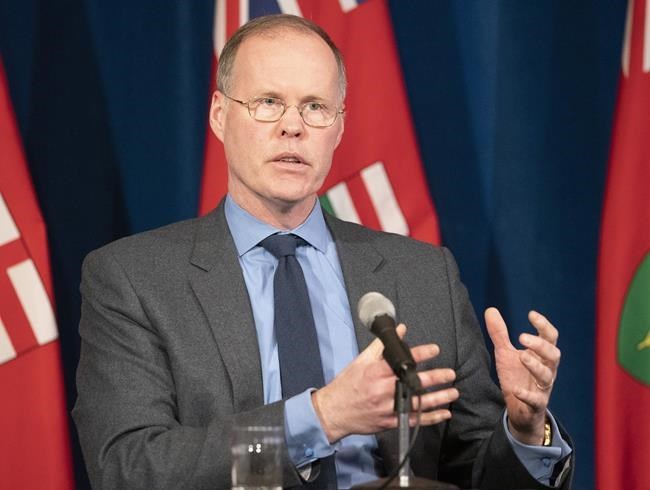
Adalsteinn Brown, dean of the University of Toronto's Public Health Department, answers questions during a news conference at Queen's Park in Toronto on Monday, April 20, 2020. Ontario will provide an update on COVID-19 modelling projections today. The province says Dr. Adalsteinn Brown, the co-chairman of Ontario's COVID-19 Science Advisory Table, will present the update this afternoon. THE CANADIAN PRESS/Frank Gunn

“The government agrees with the growing consensus in the medical community that returning students to in-person learning is essential to the wellbeing, development and mental health of children,” Lecce said in a statement.

All students began their winter term online as part of a provincial lockdown and the government extended remote learning for many as Ontario continues to fight COVID-19.

Thursday’s announcement came after the government allowed schools in seven other public health units to resume in-person learning this week. Schools in Northern Ontario, where virus rates are lower, returned to in-person learning on Jan. 11.

Students in all other public health units in southern Ontario – including those in Toronto, Peel and Windsor – continue to learn online.

The government said Thursday that the province’s top doctor will continue to review public health trends and advise when in-person learning can resume in other public health units.

It also said that local public health units continue to have the authority to close schools based on their own circumstances. Parents can also continue to have their children enrolled in remote learning.

Schools in five hot spots – including those in the Greater Toronto Area – are set to remain online until Feb. 10.

Others in southern Ontario that are teaching students remotely do not yet have a specified date for when they can resume in-person learning.

On Thursday, the province’s top doctor said the government hopes to be able to reopen the rest of Ontario’s schools to in-person learning by Feb. 10.

But Dr. David Williams said much will depend on COVID-19 case rates in each community, and protections that are put in place to keep the virus out of schools.

“Can we put in place all the screening tools and methods we need to say, even if there is the presence of high transmission in the community, do you have a wall or protection around there,” he said.

Lecce has said that as part of an effort to get students back in physical classrooms safely, the province will conduct asymptomatic testing at schools, enhance screening and require students from Grades 1 and up to wear masks.

NDP education critic Marit Stiles said the province needs to cap class sizes at 15, ensure school ventilation is improved and provide paid sick days for all workers to make schools safer.

“Many parents and students are eager to see a return to in-person learning, but without proper safety measures from (Premier) Doug Ford, we’re at risk of more illness and future school closures,” she said in a statement.

Ontario reported 2,093 new cases of COVID-19 on Thursday and 56 more deaths linked to the virus.

This report by The Canadian Press was first published Jan. 28, 2021.
Report Error Submit a Tip

More Stories

U of W Collegiate students thank residential school survivors with the lessons they’ve learned

Maggie Macintosh 6 minute read Preview

U of W Collegiate students thank residential school survivors with the lessons they’ve learned

Maggie Macintosh 6 minute read 6:49 PM CDT

It’s become a back-to-school tradition for teachers to invite Indigenous elders to their classrooms to share first-hand accounts about the ongoing impacts of Canada’s residential school system.

This fall, the University of Winnipeg Collegiate was among the schools that sent an invitation — but its purpose wasn’t to educate students about the system’s horrors.

“Truth and Reconciliation week is so emotional and draining for residential school survivors,” said Christine M’Lot, a longtime instructor of the school’s Grade 9 truth and reconciliation course.

“I wanted to do something a little bit different and offer a thank you.”

Read
6:49 PM CDT

Cops handcuffed by bail issues, lack of mental-health options, WPS chief tells residents in crime-ridden North End neighbourhood

Nicole Buffie 6 minute read Preview

Cops handcuffed by bail issues, lack of mental-health options, WPS chief tells residents in crime-ridden North End neighbourhood

Nicole Buffie 6 minute read 5:30 PM CDT

Weak bail reform and a lack of mental-health resources and addictions treatment beds are making it more difficult to tackle crime in inner-city neighbourhoods such as William Whyte, where there has been a significant increase in criminal behaviour compared to last year, the city’s top police officer says.

Winnipeg Police Services Chief Gene Bowers made the remarks Thursday night at an event hosted by the William Whyte Neighbourhood Association, where about two dozen residents gathered to share their concerns about crime in the North End community.

“Fentanyl and meth, that’s caused a strain on all our front lines and and all these agencies that are trying to help people,” Bowers told the room of people at Inner City Youth Alive on Aberdeen Avenue Thursday night.

“What really is the problem is there’s no treatment. That’s the gap, because (police and agencies) are all churning the same people through, and we’re all seeing them. We’re all frustrated that there’s no help.”

Read
5:30 PM CDT

Stable incomes, not more weapons, provide security

David Olive - Star Business Columnist, Toronto Star 5 minute read Preview

Stable incomes, not more weapons, provide security

David Olive - Star Business Columnist, Toronto Star 5 minute read Thursday, Apr. 7, 2022

Even amid a global arms race, a hike in Canadian defence spending should be a tough sell, David Olive writes.

Read
Thursday, Apr. 7, 2022

Americanizing education is pure folly

John R. Wiens 5 minute read Thursday, Apr. 8, 2021

BILL 64, if passed, would succeed in cutting some of the last strands tying education to democracy in the English-speaking western world, a movement which had its beginnings in the post-war European continent.

Friedrich von Hayek, the founder of neoclassical economic theory, persuaded the political elite of the day that their future lay in a deregulated capitalistic marketplace, and in the reduction of government investment in public services. But even he would be shocked by the latest developments in Manitoba.

A rough timeline would have had Hayek meeting the newly elected Tory leader, Margaret Thatcher, in 1975. Immediately upon her election as prime minister in 1979, she began to implement his economic theory of mass privatization of state assets. The oil and gas industry and the national British Airways were privatized. The powerful miners’ unions were relentlessly pilloried as enemies of the state.

Public services such as health and education were methodically dismantled, systematically privatized in the name of personal choice, while taxes for the wealthy were reduced. In the name of creativity, entrepreneurship and innovation, among other public goods, airlines, telecommunications, banking, trucking and environmental protections were deregulated. Is this starting to sound familiar?

Software glitch caused multi-provincial 911 outage: Bell

Chris Kitching 5 minute read Preview

Software glitch caused multi-provincial 911 outage: Bell

Chris Kitching 5 minute read Updated: 5:25 PM CDT

A 911 outage that affected Manitoba and four other provinces for about 90 minutes last month was caused by a software failure, according to Bell Canada’s report to a federal regulator.

An abridged version of the report, which was made public Friday, did not say how many callers were affected when Bell’s next-generation 911 platform stopped receiving new calls and transferring new calls to local 911 communications centres, putting backup systems into use.

The outage, which lasted from 2:13 a.m. to 3:40 a.m. central time on Sept. 17, was not caused by a cyberattack or any change activity, Bell said.

“Rather, the outage was caused by a latent software issue that triggered an unexpected condition in certain network components within the (next-generation 911) network,” Philippe Gauvin, Bell’s assistant general counsel, wrote in the report, which was published on the Canadian Radio-television and Telecommunications Commission’s website.

Read
Updated: 5:25 PM CDT

Suspension upheld for teen hockey player involved in hazing

Free Press staff 3 minute read Preview

Suspension upheld for teen hockey player involved in hazing

Free Press staff 3 minute read Sunday, Aug. 9, 2026

A high school hockey player who was found to have been involved in sexualized hazing of rookie teammates lost his suspension appeal.

The youth player was barred from Hockey Canada-sanctioned activities. He was handed the four-year and nine-month suspension from sanctioned hockey after an interim ban issued in March 2024.

He appealed his suspension late last year to the Sport Dispute Resolution Centre of Canada, an independent conflict tribunal, but the centre upheld the youth’s suspension, according to a written decision issued earlier this year.

An independent investigator who probed the hockey player’s actions described the youth as a veteran player who both participated in and co-ordinated the “assigning” of rookie team members to veteran players to perform tasks for them. He himself was “assigned” a rookie, the decision said.

Read
Sunday, Aug. 9, 2026