WEATHER ALERT

Indigenous performer was a musical trailblazer

Local singer, producer a tireless promoter of Aboriginal acts

Advertisement

Advertise with us

Shingoose, a Indigenous musician from Winnipeg who was part of the 1960s folk movement in New York and would later become a producer and mentor to others in entertainment in Winnipeg, died Tuesday morning of COVID-19 complications. He was 74.

Read this article for free:

or

Already have an account? Log in here »

To continue reading, please subscribe:

Subscribe and receive a limited-edition Free Press branded hat or tote.

Digital Subscription

One year of digital access for only $205*

  • Enjoy unlimited reading on winnipegfreepress.com
  • Read the E-Edition, our digital replica newspaper
  • Access News Break, our award-winning app
  • Play interactive puzzles

*First annual payment billed as $205.00 + GST for one year. This annual subscription will automatically renew at $233.00 + GST every 52 weeks (10% off the regular annual price of $259.35). Offer available to new and qualified returning subscribers only. Cancel any time.

To continue reading, please subscribe:

Add Free Press access to your Brandon Sun subscription for only an additional

$1 for the first 4 weeks*

  • Enjoy unlimited reading on winnipegfreepress.com
  • Read the E-Edition, our digital replica newspaper
  • Access News Break, our award-winning app
  • Play interactive puzzles
Start now

*Your next Brandon Sun subscription payment will increase by $1.00 and you will be charged $17.95 plus GST for four weeks. After four weeks, your payment will increase to $24.95 plus GST every four weeks.

Hey there, time traveller!
This article was published 13/01/2021 (2007 days ago), so information in it may no longer be current.

Shingoose, a Indigenous musician from Winnipeg who was part of the 1960s folk movement in New York and would later become a producer and mentor to others in entertainment in Winnipeg, died Tuesday morning of COVID-19 complications. He was 74.

He had contracted COVID-19 at the Southeast Personal Care Home, said his daughter, Nahanni Shingoose, but he told her in a phone conversation Jan. 7 that he thought he was getting over it.

“He was supposed to be getting better. He had a fever for three days, he said, and he called and said he had COVID and was feeling better,” Nahanni Shingoose said from Toronto. “On Saturday, he didn’t answer his phone.”
David McLeod photo
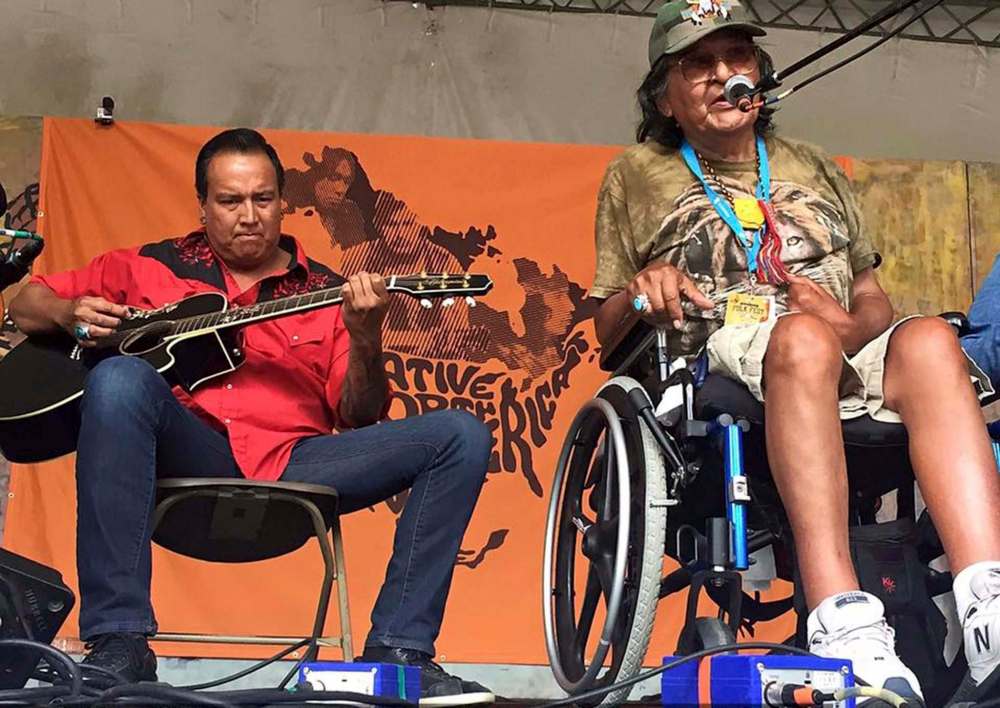
Shingoose performs with Jesse Green on guitar at the Winnipeg Folk Festival in 2016.
David McLeod photo Shingoose performs with Jesse Green on guitar at the Winnipeg Folk Festival in 2016.

The performer was born Curtis Jonnie in 1946 at Roseau River First Nation. By 1965 he’d made his way to Washington, D.C., where he joined a band called Puzzle that landed a deal with ABC Records. It was during this time, when the band moved to New York, when he would brush shoulders with rock legends such as Jimi Hendrix and John Lennon during recording sessions and gatherings of friends and fellow musicians.

Puzzle broke up and eventually Jonnie made his way to Toronto, where he began performing as a solo act at coffee houses. It was there he took on the name Shingoose, his grandfather’s name before Indian agents changed their family members’ names, Nahanni Shingoose said.

In 1973 he met Duke Redbird, an Aboriginal artist from Ontario, and in 1976 they recorded the EP Native Country, accompanied by a young Bruce Cockburn.

Shingoose returned to Winnipeg in 1981 and began focusing on promoting Aboriginal performers. That would lead to Indian Time, a series of variety television specials he produced and starred in that highlighted Indigenous acts and won a Gemini Award.

In 1994, he would join with Canadian folksinger Buffy Sainte-Marie and songwriter Elaine Bomberry to create the Juno Awards’ Aboriginal Music Committee in 1994, which led to the creation of the Junos’ Indigenous Album of the Year category.

His music with Redbird returned to prominence in 2016 after one of their songs, Silver River, was included in Native North America Vol. 1Aboriginal Folk, Rock, and Country 1966-1985, a Grammy Award-nominated anthology of songs by Indigenous artists. That same year, he performed the song at the Winnipeg Folk Festival, an event he loved, his family says, as part of a workshop that showcased songs from the record.

Shingoose suffered a stroke in 2012 that paralyzed the left side of his body, but that didn’t stop him from coming up with ideas to promote Indigenous artists, said David McLeod, general manager of NCI and a vice-chair of APTN.

Clay Hage, Shingoose’s half-brother, who grew up in North Dakota, crossed paths with Shingoose countless times when the singer was on tour. He remembered how determined Shingoose was to have a musical career, and later to promote other entertainment ideas.

“What a great talent Curt was, to have done so many things with that talent, travelling to the United States and Europe, but never getting that one big break,” he said in a telephone call from Moreno Valley, Calif. “He was always pursuing that one big break. He was the eternal optimist, always.”

alan.small@freepress.mb.ca

Twitter:@AlanDSmall

Alan Small

Alan Small
Reporter

Alan Small has been a journalist at the Free Press for more than 22 years in a variety of roles, the latest being a reporter in the Arts and Life section.

Our newsroom depends on a growing audience of readers to power our journalism. If you are not a paid reader, please consider becoming a subscriber.

Our newsroom depends on its audience of readers to power our journalism. Thank you for your support.

Report Error Submit a Tip

More Stories

Havin’ a heat wave — forever

Judy Waytiuk 5 minute read 2:00 AM CDT

When I acquired my seaside home years ago on Mexico’s Yucatan Gulf Coast, I learned instantly that the Yucatan routinely broils for most of the year with temperatures in the mid-40s; by mid-afternoon, the house interior soared to 35 C or so, in 90 per cent humidity, and stepping outside was like entering a blast furnace. The heat is punctuated periodically by wild thunderstorms that flood sand streets and turn roads into lakes for days.

Similar, in fact, to the summer we’ve had here so far this year.

I needed my air conditioning. But electricity in Mexico is devilishly costly, generated by burning diesel fuel, so I installed solar panels. My energy bills plummeted from around 6,000 pesos to 50 pesos — the Comisión Federal de Electricidad’s minuscule administration fee. I was no longer contributing to the world’s soaring carbon emissions and because I generated more energy than I used, and returned that power to the grid, CFE was burning a few less gallons of diesel. While lowering electricity bills, I was also doing the ‘right thing’, planet-wise.

Too little. Too late.

Painter honed art of volunteering at Lower Fort Garry historic site

AV Kitching 5 minute read Preview

Painter honed art of volunteering at Lower Fort Garry historic site

AV Kitching 5 minute read 2:00 AM CDT

When visitors wandered around Lower Fort Garry National Historic Site in the summer of 2023, they encountered a rather unusual volunteer: artist JD Hawk at his easel, busily working on his live paintings.

Hawk engaged with visitors as he painted, encouraging them to come and ask questions about what he was working on.

The paintings he produced during his tenure were never intended for exhibition, however. They were rough drafts for him to reference later in the year when creating his final paintings.

“There’s no fine detail, they’re not masterpieces. I consider them like a scrapbook, exploring the colours I would need to use for my master paintings,” he explains, adding that when he wasn’t painting he would walk around taking photographs for further reference material.

Read
2:00 AM CDT

Trudeau courts progressive voters in B.C.

Joanna Smith, The Canadian Press 6 minute read Preview

Trudeau courts progressive voters in B.C.

Joanna Smith, The Canadian Press 6 minute read Sunday, Oct. 20, 2019

VANCOUVER - Jack Raymond had only just made up his mind.

Standing at the edge of crowd at an atrium in downtown Vancouver on Sunday afternoon, Raymond and a few hundred people were waiting to hear from Liberal Leader Justin Trudeau, who was making his final pitch to voters on a whirlwind trip through British Columbia.

"I was waiting till the last minute to decide," said Raymond, who was there with his wife, Sarah Robertson, and had their infant daughter, Bria, in a baby carrier.

The New Democrats earned his vote in the 2015 federal election, but this time he is voting for Taleeb Noormohamed, the Liberal candidate in Vancouver Granville, where ex-cabinet minister Jody Wilson-Raybould is seeking re-election as an Independent.

Read
Sunday, Oct. 20, 2019

St. Boniface CEO’s commute from COVID-19 hot spot ‘career-limiting move’

Larry Kusch 5 minute read Preview

St. Boniface CEO’s commute from COVID-19 hot spot ‘career-limiting move’

Larry Kusch 5 minute read Friday, Aug. 14, 2020

Because of COVID-19, Manitobans face many restrictions when visiting loved ones in hospitals and personal care homes.

An adult who seeks care in a hospital emergency room cannot take someone with them for support unless they have cognitive issues or require a translator.

Restrictions apply to hospital visitors who have recently travelled outside Manitoba to Eastern Canada.

So, when the president and CEO of St. Boniface Hospital, Martine Bouchard, travelled to Manitoba from Montreal this week without self-isolating for two weeks, it stunned observers.

Read
Friday, Aug. 14, 2020

Today’s horoscope

Georgia Nicols 4 minute read 2:00 AM CDT

Moon Alert: There are no restrictions to shopping or important decisions today. The Moon is in Cancer.

Aries (March 21-April 19)

This might be a challenging day dealing with issues related to home and family, including parents. Obstacles might arise in addition to some confusion. Mixed-up conversations or incorrect assumptions might get in the way of things. Fortunately, a work-related surprise might please.

Taurus (April 20-May 20)

Throne speech offers glimpse of PCs’ priorities

Shannon Sampert 5 minute read Preview

Throne speech offers glimpse of PCs’ priorities

Shannon Sampert 5 minute read Thursday, Nov. 22, 2018

Throne speeches are more than just pomp and circumstance and the opportunity for selfies between political rivals on the beautiful marble floors of the Manitoba legislature building on Broadway. They set the agenda for the legislative session and set the tone for the government as it moves into its new session. Looked at carefully, they also reveal the priorities of the government by what is said, and also what is not said.

But they are also highly symbolic. They are delivered by the lieutenant-governor of the province, who acts as the symbol of the head of state, the Queen, but they are written by speechwriters for the government of the day.

Political scientists have studied the throne speeches delivered at the federal level to understand the thematic commonalities and what they say about nationalism over the past 30 years. Janine Brodie of the University of Alberta, for example, determined that Canadian throne speeches delivered before the 2000s embraced a more neo-liberal tone that was tied to the global economy.

After 2000, an analysis by Tim Nieguth (Laurentian University) and Tracey Raney (Ryerson University) found that Conservative throne speeches tended to focus on neo-conservative themes — emphasizing the family, the military and threats to security — while Liberals’ speeches talked about health care and Indigenous issues.

Read
Thursday, Nov. 22, 2018