“Science is working:” Canadian experts say evolving mask guidance to be expected
Advertisement
Read this article for free:
or
Already have an account? Log in here »
To continue reading, please subscribe:

Digital Subscription
One year of digital access for only $205*
- Enjoy unlimited reading on winnipegfreepress.com
- Read the E-Edition, our digital replica newspaper
- Access News Break, our award-winning app
- Play interactive puzzles
*First annual payment billed as $205.00 + GST for one year. This annual subscription will automatically renew at $233.00 + GST every 52 weeks (10% off the regular annual price of $259.35). Offer available to new and qualified returning subscribers only. Cancel any time.
To continue reading, please subscribe:
Add Free Press access to your Brandon Sun subscription for only an additional
$1 for the first 4 weeks*
- Enjoy unlimited reading on winnipegfreepress.com
- Read the E-Edition, our digital replica newspaper
- Access News Break, our award-winning app
- Play interactive puzzles
*Your next Brandon Sun subscription payment will increase by $1.00 and you will be charged $17.95 plus GST for four weeks. After four weeks, your payment will increase to $24.95 plus GST every four weeks.
Read unlimited articles for free today:
or
Already have an account? Log in here »
Hey there, time traveller!
This article was published 12/11/2020 (2125 days ago), so information in it may no longer be current.
Public health messaging over face masks changed again this week when the U.S.-based Centers for Disease Control and Prevention (CDC) updated its guidance to say face coverings can help protect the wearer as well as those around them.
The new guidance, which landed on the CDC website on Tuesday, cited recent studies suggesting multi-layer cloth masks can “reduce inhalation of … droplets by the wearer.” Previous guidance said masks were useful primarily in blocking the wearer’s droplets from reaching others.
The CDC’s update now matches recommendations from both Health Canada and the World Health Organization (WHO). The Public Health Agency of Canada (PHAC) said in an emailed statement on Wednesday that “wearing a mask can help protect the wearer and others.”
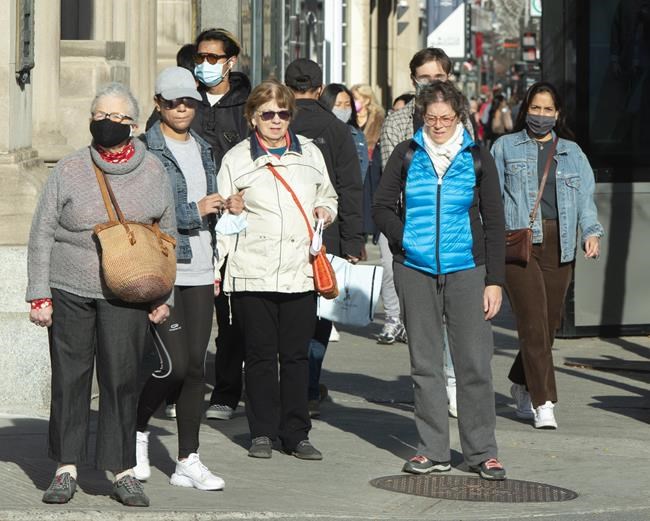
However, this message seems to have been muddled due to previous conflicting guidance, which has mostly emphasized masks as a way to protect those around you.
Canadian health experts are also divided on whether the updated CDC guidance is helpful — some hope it can convince reluctant people to start wearing face masks, while others worry the messagemay be misinterpreted.
Dr. Amy Tan, a clinical assistant professor at the University of Calgary and member of the physician group Masks4Canada, says the “evidence has been there since August” to show that cloth masks, provided they fit well and are made of three layers with a polypropylene filter, do protect the wearer.
And if that can persuade people to wear one, so be it.
“If the small inconvenience of wearing your mask isn’t enough to appeal to the collective good, then now we can say: ‘it can protect you too, so wear it,'” Tan said.
Colin Furness, an assistant professor at the University of Toronto’s School of Public Health, isn’t convinced the updated guidelines are accurate.
While he isn’t ruling out the possibility that cloth face masks might help protect those wearing them, he says people need to remember the caveats — three layers plus a good fit — to that claim.
“If (the CDC) is trying to appeal to peoples’ sense of self-preservation by saying: ‘masks could protect the wearer, therefore you should wear a mask,’ that could be a way to motivate people.
“But on the other hand, I don’t endorse that because it could make people think ‘OK, I can put on a mask and it’s substitutable for physical distancing.'”
The CDC update is the latest in what’s been an evolving policy on mask-wearing over the last eight months.
Face masks were discouraged by many public health officials in Canada back in March, with some saying a home-made covering could actually lead to further spread if it meant constantly touching the face to make adjustments. The discourse then shifted to say masks were useful in protecting others, but not ourselves.
Tan says changes in guidance show “science is working.” And advancements are made in all facets of medicine on a daily basis.
“We’ve never lived in a time where we had a global pandemic,” she said. “In eight months there’s been a lot more science generated…. We’re just seeing this happening publicly and in a very compressed time.”
PHAC also acknowledged that, saying “the government is continually reviewing new evidence and research” and that new evidence guides its recommendations.
Furness agrees that public health policy was expected to change as we learned more about the virus and how it’s transmitted.
He said every expert — himself included — could point to things they got wrong about COVID back in March, when a mask’s ability to “disrupt the ejection of droplets” wasn’t really taken into consideration.
“It was just a giant blind spot,” he said.
“I mean, think about our knowledge back then. Everyone was afraid and we didn’t know much.”
Dr. Christopher Labos, a Montreal-based physician, says COVID-19 was looked at in the same way as SARS or the flu in the early stages of the pandemic. With both of those viruses, people tend to be very symptomatic and infectious when showing symptoms.
“The original messaging was if you have no symptoms, there’s no point in wearing a mask because you’re probably not sick,” he said.
“But what’s changed is the growing realization that a lot of people have coronavirus and don’t know it. So guidelines shifted to suggest a universal masking policy, because you don’t know if you’re walking around with the virus.”
Labos also believes there may have been reluctance to promote face masks in the early stages of the pandemic out of fear people would confuse “the different mask categories, and what their roles are.”

N-95 respirators, worn by medical professionals in high-risk situations, offer “almost complete protection,” because of their tight seal around the face. But a surgical mask or home-made cloth face covering won’t protect the wearer to that degree.
“It probably does protect you a little bit … but in terms of quantifying it, in terms of saying it with any degree of certainty, that becomes a lot more complicated,” Labos said.
The experts say it’s important to remember that mask-wearing should be viewed as just one component of the public health strategy.
“A mask doesn’t prevent infection, but it drastically reduces the chance of infection,” Labos said. “And that certainly helps.”
This report by The Canadian Press was first published Nov. 12, 2020.

Advertisement Advertise With Us
Advertisement Advertise With Us