Key events in development of Pfizer’s COVID-19 vaccine

Advertisement

Advertise with us

Key events in the development of a COVID-19 vaccine by partners Pfizer Inc. and Germany's BioNTech:

Read this article for free:


or

Already have an account? Log in here »

To continue reading, please subscribe:

Subscribe and receive a limited-edition Free Press branded hat or tote.

Digital Subscription

One year of digital access for only $205*

  • Enjoy unlimited reading on winnipegfreepress.com
  • Read the E-Edition, our digital replica newspaper
  • Access News Break, our award-winning app
  • Play interactive puzzles

*First annual payment billed as $205.00 + GST for one year. This annual subscription will automatically renew at $233.00 + GST every 52 weeks (10% off the regular annual price of $259.35). Offer available to new and qualified returning subscribers only. Cancel any time.

To continue reading, please subscribe:

Add Free Press access to your Brandon Sun subscription for only an additional

$1 for the first 4 weeks*

  • Enjoy unlimited reading on winnipegfreepress.com
  • Read the E-Edition, our digital replica newspaper
  • Access News Break, our award-winning app
  • Play interactive puzzles
Start now

*Your next Brandon Sun subscription payment will increase by $1.00 and you will be charged $17.95 plus GST for four weeks. After four weeks, your payment will increase to $24.95 plus GST every four weeks.

Hey there, time traveller!
This article was published 09/11/2020 (2135 days ago), so information in it may no longer be current.

Key events in the development of a COVID-19 vaccine by partners Pfizer Inc. and Germany’s BioNTech:

March 17 — Pfizer and BioNTech announce plans to jointly develop a COVID-19 vaccine using BioNTech’s technology.

April 29 — Testing of four vaccine candidates begins with volunteers in Germany, one of six countries in the testing plan.
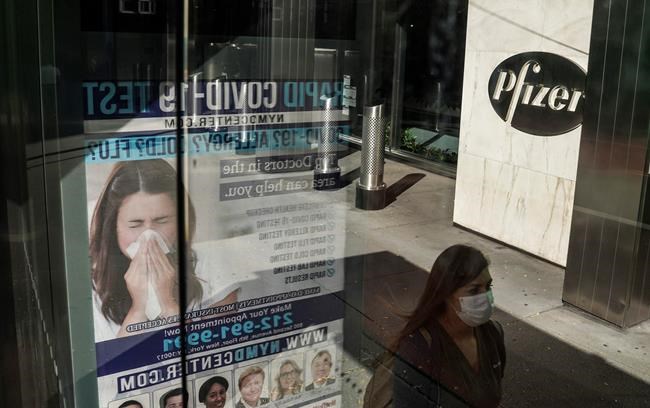
An ad for COVID-19 testing reflects on glass at a bus stop, as pedestrians walk past Pfizer world headquarters in New York on Monday Nov. 9, 2020. Pfizer says an early peek at its vaccine data suggests the shots may be 90% effective at preventing COVID-19, but it doesn't mean a vaccine is imminent. (AP Photo/Bebeto Matthews)

May 5 — Testing expands to the United States.

July 1 — Preliminary data shows one of four candidates appears to stimulate the immune system, is well tolerated.

July 22 — U.S. government agrees to buy 100 million vaccine doses for $1.95 billion, with an option for 500 million more. Several other countries also sign agreements for vaccines.

July 27 — Late-stage tests begin for 30,000 volunteers; companies could seek U.S. regulatory approval as early as October if all goes well.

Aug. 20 — The partners announce promising early data from testing of their lead vaccine candidate.

Sept. 8 — With pressure mounting for a vaccine before the U.S. election, CEOs of Pfizer, BioNTech and seven other major drugmakers pledge to stand with the science and not be rushed.

Sept. 12 — Proposal made to expand study enrolment to 44,000 volunteers to include teenagers and people with certain chronic illnesses; regulators later agree.

Oct. 16 — Pfizer says it can’t request emergency use of vaccine before the third week of November, when safety information due.

Nov. 8 — Independent board analyzes test results so far and notifies Pfizer.

Nov. 9 — Pfizer announces the vaccine appears to be about 90% effective, based on 94 infections so far in study volunteers.

Late November — Pfizer expects to have more data on effectiveness, along with information on safety and manufacturing quality. Soon after that, Pfizer expects to apply for emergency use authorization in the U.S.

End of year: Pfizer expects to have up to 50 million doses available.

___

The Associated Press Health and Science Department receives support from the Howard Hughes Medical Institute’s Department of Science Education. The AP is solely responsible for all content.

Report Error Submit a Tip

More Stories

Convicted mail bomber loses parole-denial appeal

Tyler Searle 4 minute read Preview

Convicted mail bomber loses parole-denial appeal

Tyler Searle 4 minute read Thursday, Apr. 2, 2026

Convicted mail bomber Guido Amsel has lost his fight for full parole, after his appeal for release was shot down by the Parole Board of Canada.

In 2018, Amsel received a life sentence with no chance of parole for 10 years for the attempted murders of his ex-wife Iris Amsel and lawyers Maria Mitousis and George Orle in 2015 by mailing explosives to them. One of the bombs, placed inside a hand-held tape recorder with instructions to press the “play” button, exploded in Mitousis’s office, resulting in the loss of her right hand.

He was also sentenced to 12 years minus time served for an earlier attempt to murder his ex-wife in 2013.

He was 59 years old in August, when he appeared before the board to argue for full parole. Had it been granted, he would have been released from federal custody and deported to Germany, where he was born and lived for decades.

Read
Thursday, Apr. 2, 2026

250 years ago Thomas Jefferson and the American Declaration of Independence

Allan Levine 5 minute read Preview

250 years ago Thomas Jefferson and the American Declaration of Independence

Allan Levine 5 minute read Saturday, Jul. 4, 2026

In the 16th and 17th centuries, countries and territories such as the Netherlands and Portugal boldly declared their independence from Spain. But 250 years ago, on July 4, 1776, the American Declaration of Independence — marked in the U.S. by the semiquincentennial celebrations — was the first time an overseas colony (the 13 colonies, in this case) had set out in an official document its reasons for breaking away from its mother country.

Because the Declaration ultimately gave birth to the United States, it is considered one of the greatest of historical treatises. Thomas Jefferson, its primary author, later explained that his main aim was “not to find out new principles, or new arguments, never before thought of … but to place before mankind the common sense of the subject; in terms so plain and firm as to command their assent.”

He did so brilliantly, creating, in theory at least, an enlightened argument for American independence based on the political, economic, social and philosophical thinking of the era.

Influenced by such philosophers as John Locke and Montesquieu, Jefferson, then 33 years old, a lawyer, landowner, Virginia politician and a delegate to the Second Continental Congress which met in Philadelphia, passionately believed in natural law — that all human beings were born free and equal and that no king or ruler could abolish these rights. It was a key point he made in the Declaration’s well-known preamble.

Read
Saturday, Jul. 4, 2026

Dark money drags democracy toward the abyss

Russell Wangersky 6 minute read Saturday, Sep. 12, 2026

There’s an object lesson playing out to the south of us, and not exactly the one you may be thinking about.

It’s not the obvious one of “don’t elect a federal leader who has a clear history of caring about his own grievances before he thinks about the needs of his citizens,” or more simply, “don’t elect someone who is less an agent of change than he is an agent of chaos.”

No, the lesson playing out to the south of us — one likely to have an impact on U.S. midterm elections later this fall as well as the last U.S. presidential election — is that there is a clear danger in allowing dark money to fuel political campaigns.

There are estimates that political action campaigns — or PACs — will once again dump billions of U.S. dollars into the mix, funding advertising campaigns and other political campaign efforts, and steamrolling less-funded efforts.

Mayoral candidate denounced for online comments

Morgan Modjeski 3 minute read Preview

Mayoral candidate denounced for online comments

Morgan Modjeski 3 minute read Updated: Yesterday at 2:34 PM CDT

A Winnipeg mayoral candidate is facing criticism after he posted derogatory comments about immigrants and used the word “gay” as an insult online.

Sydney Adams said the response she got from Zac Uminski, who is seeking the city’s top office alongside 12 other individuals, left her baffled. She recently criticized Uminski over his use of artificial intelligence to produce campaign material, to which he replied he can’t afford to hire people to make art or “do whatever gay s—- you think is better than AI.”

“What was going through my head was that this is just unacceptable,” she said.

Adams said Uminski also posted other disparaging remarks about newcomers.

Read
Updated: Yesterday at 2:34 PM CDT

Bond yields are rising, reflecting fear, loathing about state of world

Joel Schlesinger 6 minute read Preview

Bond yields are rising, reflecting fear, loathing about state of world

Joel Schlesinger 6 minute read Saturday, Sep. 12, 2026

It can seem counter-intuitive, but rising bond yields reflect investor worry. (After all, aren’t higher yields attractive?)

At the same time, investors’ bagful of anxieties is running headlong into greater demand for borrowing than at any time in human history.

It’s a full-course meal of mayhem: trade wars, unending real wars, accelerating government budgets and big tech companies borrowing as much as they can to achieve artificial intelligence supremacy.

Don’t forget the orange zest of economic unrest: an unpredictable, often incomprehensible president of the United States.

Read
Saturday, Sep. 12, 2026

Why is Cuba embracing freer markets?

Peter McKenna 5 minute read Preview

Why is Cuba embracing freer markets?

Peter McKenna 5 minute read Friday, Jul. 24, 2026

As long as Donald Trump is entangled in a war with Iran, Cuba is probably safe from being next on his hit list.

But if the mercurial U.S. president can somehow extricate himself from the Persian Gulf trap, then all bets are off. One thing is certain: Trump is not going to give up the idea of getting his greedy hands on the Caribbean island.

In response to Trump’s threats of military invasion, the beleaguered Cuban government is understandably in full panic mode. Right now, it is just trying desperately to keep its head above water as the situation on the ground in Cuba deteriorates further with each passing day.

Not all of the blame for the country’s current humanitarian crisis can be laid at the feet of the Trump White House. The Cuban political leadership deserves its fair share of blame for poor economic and financial management, for too much emphasis on expanding the tourism market, and for not enough attention on modernizing the electrical grid and attracting much-needed foreign investment.

Read
Friday, Jul. 24, 2026