Peter Mansbridge says U.S. election shows media has “more work to do” to build trust

Advertisement

Advertise with us

TORONTO - Veteran journalist Peter Mansbridge says media organizations will have to "really look hard" at the way they do their jobs, after another U.S. presidential election that caught many newsrooms off-guard.

Read this article for free:


or

Already have an account? Log in here »

To continue reading, please subscribe:

Subscribe and receive a limited-edition Free Press branded hat or tote.

Digital Subscription

One year of digital access for only $205*

  • Enjoy unlimited reading on winnipegfreepress.com
  • Read the E-Edition, our digital replica newspaper
  • Access News Break, our award-winning app
  • Play interactive puzzles

*First annual payment billed as $205.00 + GST for one year. This annual subscription will automatically renew at $233.00 + GST every 52 weeks (10% off the regular annual price of $259.35). Offer available to new and qualified returning subscribers only. Cancel any time.

To continue reading, please subscribe:

Add Free Press access to your Brandon Sun subscription for only an additional

$1 for the first 4 weeks*

  • Enjoy unlimited reading on winnipegfreepress.com
  • Read the E-Edition, our digital replica newspaper
  • Access News Break, our award-winning app
  • Play interactive puzzles
Start now

*Your next Brandon Sun subscription payment will increase by $1.00 and you will be charged $17.95 plus GST for four weeks. After four weeks, your payment will increase to $24.95 plus GST every four weeks.

Hey there, time traveller!
This article was published 04/11/2020 (2158 days ago), so information in it may no longer be current.

TORONTO – Veteran journalist Peter Mansbridge says media organizations will have to “really look hard” at the way they do their jobs, after another U.S. presidential election that caught many newsrooms off-guard.

The retired CBC News anchor and chief correspondent says there’s been a decline in trust in the media, especially since the 2016 vote, which many news outlets didn’t accurately predict.

And he feels the lack of understanding and coverage of voter thinking in the current race between President Donald Trump and Democratic challenger Joe Biden is going to further hurt that trend.

Peter Mansbridge poses backstage at the Canadian Screen Awards in Toronto on Sunday, March 11, 2018. Mansbridge says the  U.S. election shows that the media has
Peter Mansbridge poses backstage at the Canadian Screen Awards in Toronto on Sunday, March 11, 2018. Mansbridge says the  U.S. election shows that the media has "more work to do" to build trust. THE CANADIAN PRESS/Peter Power

Mansbridge notes the latest election “was a lot closer than we thought, and there seems to have been a basic, once again, misread of the American public and the American voter.”

He says in order for media organizations to restore faith and trust with the people who depend on them for information, they’re going to have to be much more transparent in the way they report, whether it’s on polls or political stories or governments in general.

“I think we have to bring our viewers and readers and listeners into the mix much more than we have in the past — in explaining how we do what we do, why we choose the stories we do, why we choose the partnerships we do,” Mansbridge said Wednesday in an interview with The Canadian Press for his new book, “Extraordinary Canadians: Stories from the Heart of Our Nation.”

Tuesday’s election outcome remained up in the air Wednesday afternoon, as it was still too close to call races in several battleground states.

While voters decide for themselves how they are going to cast their ballots, the media influences those decisions with the kind of information they give and stories they tell, said Mansbridge.

“That’s what I mean when I say we really have to re-evaluate what we we’re doing,” he said, noting the media also missed the mark on the 2016 election, partly because many outlets focused more on cities and didn’t fully explore rural areas and the level of dissatisfaction within them.

“Those same levels of dissatisfaction clearly still exist,” said the former award-winning anchor of “The National,” who stepped down from his role in July 2017 after nearly three decades with the program.

“You’ve got a major urban-rural split, when you look at the maps, as we’re witnessing them now — where big cities tend to vote, in the States, Democratic, as they tend to vote Liberal in Canada. And large swaths of the rest of the country, in smaller towns and smaller communities, certainly in rural areas, the vote is much different. Part of the reason for that vote is that people are really unhappy with the way they areseen, and how their concerns and their interests are confronted by governments and by the media, and by the way their stories are told. We’ve got to give it more than just word value when we look at it again now.”

Mansbridge said he watched the election unfold from his home in Stratford, Ont., flipping between various channels, both American and Canadian. He noted that while Canadian channels can’t compete with the American ones “on a glitz level,” they can compete “in the quality of the journalism and the quality of the discussion that you put forward in trying to understand the unfolding story.”

Mansbridge also said he was happy to see some of the major news organizations in the U.S. be more transparent than usual in the past week or so, in terms of explaining how they would cover the election and make decisions on that night.

However, he said he thought there would be more distance between the contenders on election night and was surprised how well Trump was doing.

And if many others feel the same, it may further erode trust in news coverage.

“We’re going to pay a price for this,” Mansbridge said.

“Those who already didn’t trust the media are going to trust them less. Those who are wavering on the media are going to now seriously consider not trusting us. And those who have been our greatest fans are going to become our greatest critics demanding a better service, in general. Now, I know the media is not a monolith, we all operate kind of differently. But I think there is there are some general issues here that we’ve all got to face.”

“Extraordinary Canadians: Stories from the Heart of Our Nation” (Simon and Schuster), by Mansbridge with Mark Bulgutch,is on sale Nov. 10.

This report by The Canadian Press was first published Nov. 4, 2020.

Report Error Submit a Tip

More Stories

Suspension upheld for teen hockey player involved in hazing

Free Press staff 3 minute read Preview

Suspension upheld for teen hockey player involved in hazing

Free Press staff 3 minute read Sunday, Aug. 9, 2026

A high school hockey player who was found to have been involved in sexualized hazing of rookie teammates lost his suspension appeal.

The youth player was barred from Hockey Canada-sanctioned activities. He was handed the four-year and nine-month suspension from sanctioned hockey after an interim ban issued in March 2024.

He appealed his suspension late last year to the Sport Dispute Resolution Centre of Canada, an independent conflict tribunal, but the centre upheld the youth’s suspension, according to a written decision issued earlier this year.

An independent investigator who probed the hockey player’s actions described the youth as a veteran player who both participated in and co-ordinated the “assigning” of rookie team members to veteran players to perform tasks for them. He himself was “assigned” a rookie, the decision said.

Read
Sunday, Aug. 9, 2026

Americanizing education is pure folly

John R. Wiens 5 minute read Thursday, Apr. 8, 2021

BILL 64, if passed, would succeed in cutting some of the last strands tying education to democracy in the English-speaking western world, a movement which had its beginnings in the post-war European continent.

Friedrich von Hayek, the founder of neoclassical economic theory, persuaded the political elite of the day that their future lay in a deregulated capitalistic marketplace, and in the reduction of government investment in public services. But even he would be shocked by the latest developments in Manitoba.

A rough timeline would have had Hayek meeting the newly elected Tory leader, Margaret Thatcher, in 1975. Immediately upon her election as prime minister in 1979, she began to implement his economic theory of mass privatization of state assets. The oil and gas industry and the national British Airways were privatized. The powerful miners’ unions were relentlessly pilloried as enemies of the state.

Public services such as health and education were methodically dismantled, systematically privatized in the name of personal choice, while taxes for the wealthy were reduced. In the name of creativity, entrepreneurship and innovation, among other public goods, airlines, telecommunications, banking, trucking and environmental protections were deregulated. Is this starting to sound familiar?

Gillingham talks trash, pledges big bin boost

Joyanne Pursaga 4 minute read Preview

Gillingham talks trash, pledges big bin boost

Joyanne Pursaga 4 minute read 2:01 AM CDT

Scott Gillingham says he would add hundreds of locked garbage bins downtown to prevent unsightly trash piles if re-elected as mayor.

Gillingham led a program that added about 120 locked garbage bins along Portage Avenue and Main Street last fall, after trash was repeatedly strewn around the area. If he wins a second term, he plans to add at least 200 more of the receptacles.

A look at how one locked Main Street recycle/garbage bin in front of city hall fared offers an example of the bins’ success so far, he said.

“Every day, you would see the lids up, and people had been rifling through it, or someone left the lid up and the wind picked up the garbage and (spread) it everywhere. It’s much more difficult now. Once the garbage is in, the garbage stays in,” said Gillingham.

Read
2:01 AM CDT

Neighbours concerned shed used as home on city land

Malak Abas 6 minute read Preview

Neighbours concerned shed used as home on city land

Malak Abas 6 minute read Wednesday, Sep. 14, 2022

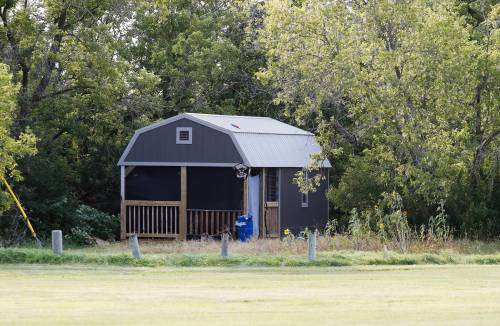
An unassuming tiny home suddenly appeared one day in August, tucked between a park and community garden in St. James.

Read
Wednesday, Sep. 14, 2022

Transit, roads and city council’s priorities

Erna Buffie 5 minute read Preview

Transit, roads and city council’s priorities

Erna Buffie 5 minute read 2:00 AM CDT

Did any of you happen to notice that the week of Sept. 14 marked an interesting confluence of events in Winnipeg? First up was the mayoral debate on public transit. Second was an announcement that the city would be undertaking a survey to determine whether their citizens’ “transportation needs” are being met.

The debate on our public bus system, from which our current Mayor Scott Gillingham was tellingly absent, focused primarily on safety rather than the efficiency of the system.

Which, on one level, is no great surprise.

After all unlawful incidents on buses and at transit stops have increased by 280 per cent compared to levels recorded around 2016. Moreover, the candidates were primarily speaking to the bus drivers’ union that organized the event, and bus drivers are often the victims of violent episodes.

Read
2:00 AM CDT

Teacher barred for ‘repeated boundary-crossing conduct’

Maggie Macintosh 3 minute read Monday, Sep. 28, 2026

A disciplinary panel has ordered the cancellation of a Chinese-Canadian teacher’s certificate because of her “repeated boundary-crossing with a student” during her tenure at an international school with local ties.

Janice Wen Ying Ma is permanently barred from teaching on Manitoba soil or at a Manitoba-accredited institution as of Sept. 14.

The new ruling concludes that Ma engaged in inappropriate physical interaction and “emotionally intimate online messages” with a girl who attended Clifford International School in Guangzhou, China in 2024-25.

“This conduct represents a fundamental departure from the standards expected of a teacher,” the panel, chaired by public representative Gordon Schumacher, wrote in its 22-page decision.