Parents in court demanding Quebec offer remote learning option for all who want it

Advertisement

Advertise with us

MONTREAL - A lawyer representing a group of Quebec parents was in court Thursday trying to compel the province's Education Department to provide an online learning option for all families who want it.

Read this article for free:


By clicking the button above, an account will be created and you will begin to receive some of our recommended newsletters. You may opt out of any newsletter by visiting your Email and Communication Preferences page or by clicking "unsubscribe" at the bottom of any email.

or

Already have an account? Log in here »

To continue reading, please subscribe:

Digital Subscription

One year of digital access for only $1.44 a week*

  • Enjoy unlimited reading on winnipegfreepress.com
  • Read the E-Edition, our digital replica newspaper
  • Access News Break, our award-winning app
  • Play interactive puzzles

*Billed as $5.77 plus GST every four weeks. After 52 weeks, price increases to the regular rate of $19.95 plus GST every four weeks. Offer available to new and qualified returning subscribers only. Cancel any time.

To continue reading, please subscribe:

Add Free Press access to your Brandon Sun subscription for only an additional

$1 for the first 4 weeks*

  • Enjoy unlimited reading on winnipegfreepress.com
  • Read the E-Edition, our digital replica newspaper
  • Access News Break, our award-winning app
  • Play interactive puzzles
Start now

*Your next Brandon Sun subscription payment will increase by $1.00 and you will be charged $17.95 plus GST for four weeks. After four weeks, your payment will increase to $24.95 plus GST every four weeks.

Hey there, time traveller!
This article was published 03/09/2020 (2248 days ago), so information in it may no longer be current.

MONTREAL – A lawyer representing a group of Quebec parents was in court Thursday trying to compel the province’s Education Department to provide an online learning option for all families who want it.

Only children with serious medical conditions or who live with someone at risk of severe complications from COVID-19 are able to get an exemption from physically attending elementary and high school classes. Most other provinces in Canada offer a remote learning option for families who request it.

Human rights lawyer Julius Grey told Quebec Superior Court Justice Frederic Bachand on Thursday the decision to send one’s child to class during the COVID-19 pandemic is an extremely private and personal one.
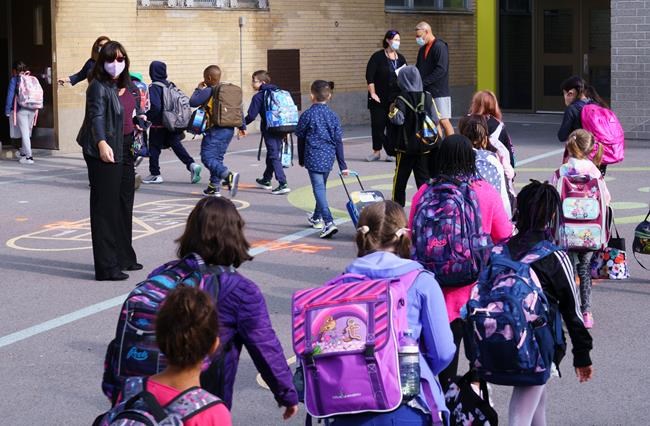
Students enter the Philippe-Labarre Elementary School in Montreal, on Thursday, August 27, 2020. Thousands of Quebec students return to class in the shadow of the COVID-19 pandemic. THE CANADIAN PRESS/Paul Chiasson

He asked the court for a safeguard order allowing parents access to online courses for their children immediately, before the case is argued on its merits at a later date. To obtain this temporary measure, Grey has to convince the judge that the inconveniences of maintaining the status quo outweigh the consequences of changing the current policy.

Grey told the court the consequences of Quebec’s back-to-school plan could be irreversible if someone falls sick or dies from COVID-19.

Granting a safeguard order would not be difficult, Grey said, because the government is already offering online courses for students with a medical exemption. The criteria for obtaining an exemption, he argued, are too narrow. “The government has decided to micromanage who goes to school or not.”

Marisa Fernandez, one of the mothers involved in the lawsuit, has two elementary-aged children, including one with respiratory problems. Fernandez, who has lupus, told reporters outside the courtroom she was unable to get a medical note requesting an exemption for her daughter. The school board, however, granted her daughter an exemption based on a previous medical note.

“The exemptions are arbitrary, and difficult to get,” Fernandez said. “We believe the parents, in Quebec, have the right to decide for the safety and security of our children.”

Quebec Premier Francois Legault responded to the lawsuit Thursday, saying the province is facing a teacher shortage and doesn’t have enough educators to offer online learning for all those who want that service.

“We are missing a couple of hundred teachers in Quebec,” the premier told reporters in St-Raymond, Que., west of Quebec City. “It takes four years to train teachers. Of course, we can’t at the same time have teachers teaching in classrooms and have the same teachers teaching children of parents who decided to keep kids home.

“We can’t do both.”

The lawyer representing the Quebec government argued that the province’s back-to-school rules are valid. Stephanie Garon said the policy covers all children and its goal is to protect the most vulnerable. It is precisely the latter, she said, who would not be going to class if their parents had the choice.

The policy was created in the best interest of all children and based on recommendations by public health authorities, she said. Garon tabled expert opinions with the court, which claimed that in-person classes have benefits for children that outweigh the risk of contagion — which they say is low.

Garon said parents’ freedom is already limited when it comes to schooling their children. Quebec law requires kids go to school.

Grey countered that the law hadn’t foreseen a pandemic. If the government’s decision to force everyone to school — except the most vulnerable — is good for the majority of children, he said, it’s not the right decision for all students.

In the end, Grey said, the question is simple: “Who gets to decide?”

Bachand said he would deliver a ruling by Tuesday.

This report by The Canadian Press was first published Sept. 3, 2020.

Note to readers: This is a corrected story. A previous version said 8 Fernandez’s daughter did not receive an exemption from school

Report Error Submit a Tip

More Stories

‘Women were shortchanged.’ Why bobsledding’s idea of equality doesn’t add up

Kerry Gillespie - Sports Reporter, Toronto Star 7 minute read Preview

‘Women were shortchanged.’ Why bobsledding’s idea of equality doesn’t add up

Kerry Gillespie - Sports Reporter, Toronto Star 7 minute read Saturday, Dec. 4, 2021

When female bobsledders pushed for an Olympic four-woman event, they got a solo discipline instead: monobob. Now they’ll race for the same number of medals as men, but with fewer sledders. Not the progress they were looking for.

Read
Saturday, Dec. 4, 2021

Indigenous-, newcomer-focused job fair puts opportunity in spotlight

Gabrielle Piché 3 minute read Tuesday, Oct. 27, 2026

Canadian Armed Forces pamphlets grazed the side of Serena Valiquette’s ribbon skirt, as the Grade 9 student clutched the handouts tight.

“When I get to age, I’ll probably apply,” said Serena, 14, joining pockets of students hopping from booth to booth — City of Winnipeg here, Manitoba Public Insurance there — at a job fair in Winnipeg on Tuesday.

The job seekers, present and future, were largely Indigenous and newcomers. It was the demographic organizer Clayton Sandy aimed to attract.

“We have the ability to open doors for young people,” Sandy said. “This is one of the ways we use.”

Multi-year budget to force councillors, bureaucrats to focus on the big picture

Aldo Santin 12 minute read Preview

Multi-year budget to force councillors, bureaucrats to focus on the big picture

Aldo Santin 12 minute read Tuesday, Feb. 26, 2019

City hall is putting the final touches on the 2019 preliminary budget -- but the real tough job will start after that.

The city is committed to developing a four-year budget beginning with 2020, and having it in place by the end of this year.

It's a process that is filled with uncertainties, trying to balance four successive annual budgets at the same time, using assumptions on revenues and expenses that can change without notice: a provincial government that has frozen funding to city hall at 2016 levels and is reluctant to disclose annual funding commitments or share in unexpected revenues; erratic fuel prices; a possible change in government in Ottawa, which could bring new spending priorities. And in the middle of that four-year span, another civic election where new members of council may have other priorities than those laid out by the current crop of office holders.

Municipal governments across Manitoba are required to approve their annual operating and capital budgets by the end of March each year. But the criticism of decision-making at city hall has been that all the decisions are made on a year-to-year basis, keeping voters happy with an eye on the next election.

Read
Tuesday, Feb. 26, 2019

Pair preps for weekend test in Kelowna

Laurie Nealin 5 minute read Preview

Pair preps for weekend test in Kelowna

Laurie Nealin 5 minute read 6:40 PM CDT

KELOWNA, B.C. — Their first spin around the ice at Skate Canada International on Thursday was a mix of business and pleasure for Winnipeg pair skaters Ava Kemp and Yohnatan Elizarov.

Job one for the practice session was to get accustomed to the size and feel of the ice surface at Propsera Place while test-driving the lifts, throws and jumps they’ll perform Friday in their senior ISU Grand Prix competition debut.

“The big thing is the patterns (skating into elements) because these boards are very narrow but very long — it’s NHL size — so when you’re setting up elements you need to make sure you’re using the full length or else you’re going to run into the boards,” Elizarov explained in a post-skate chat with media.

“The second thing is the ice which is sometimes really soft or really hard. This ice is really soft.”

Read
6:40 PM CDT

Three’s company for new netminder Daws

Mike McIntyre 6 minute read Preview

Three’s company for new netminder Daws

Mike McIntyre 6 minute read 5:09 PM CDT

TAMPA — Nico Daws is still trying to catch his breath.

An unexpected piece of the Connor Hellebuyck blockbuster. A chaotic crash course in his latest hockey home. Joining a fragile club mired in a prolonged losing streak. And now, hitting the road for four tough tests, including one where he will find himself as the last line of defence.

It’s been quite the ride for the newest Winnipeg Jets netminder, who took some time Thursday morning to reflect on the experience.

“A whirlwind of a week. I haven’t even really had time to sit down and digest it,” said Daws.

Read
5:09 PM CDT

Two government bills left on table as NDP ends third year of term

Carol Sanders 4 minute read Preview

Two government bills left on table as NDP ends third year of term

Carol Sanders 4 minute read 6:59 PM CDT

Year 3 of the NDP government’s four-year mandate ended Thursday with more than 50 bills expected to become law and two that didn’t make it to the finish line.

“We’re on the final stages of passing 52 amazing bills,” government house leader Nahanni Fontaine said after the final question period of the 43rd legislature.

Most were passed before the house rose for the summer break, including getting rid of the provincial sales tax on pop, chips and packaged foods that took effect July 1. A handful of health-care bills that aim to restrict mandatory overtime, create a patient safety charter, establish nurse-to-patient ratios and do away with sick-note requirements for employees — unless they miss more than seven consecutive days or 10 in a year — were also passed.

Under rules of the legislature, the Progressive Conservatives held back three government bills until the fall session to allow for further debate before passage by the NDP majority Thursday. The most contentious was Bill 13, the Residential Tenancies Amendment Act, that aims to strengthen renter protections and increase maximum fines for landlords in breach of the act.

Read
6:59 PM CDT