Younger students now required to wear non-medical masks in Nova Scotia schools

Advertisement

Advertise with us

HALIFAX - Nova Scotia has changed its rules for the use of non-medical masks in schools, announcing Friday that new federal guidelines require younger students to wear them when classes resume Sept. 8.

Read this article for free:


By clicking the button above, an account will be created and you will begin to receive some of our recommended newsletters. You may opt out of any newsletter by visiting your Email and Communication Preferences page or by clicking "unsubscribe" at the bottom of any email.

or

Already have an account? Log in here »

To continue reading, please subscribe:

Digital Subscription

One year of digital access for only $1.44 a week*

  • Enjoy unlimited reading on winnipegfreepress.com
  • Read the E-Edition, our digital replica newspaper
  • Access News Break, our award-winning app
  • Play interactive puzzles

*Billed as $5.77 plus GST every four weeks. After 52 weeks, price increases to the regular rate of $19.95 plus GST every four weeks. Offer available to new and qualified returning subscribers only. Cancel any time.

To continue reading, please subscribe:

Add Free Press access to your Brandon Sun subscription for only an additional

$1 for the first 4 weeks*

  • Enjoy unlimited reading on winnipegfreepress.com
  • Read the E-Edition, our digital replica newspaper
  • Access News Break, our award-winning app
  • Play interactive puzzles
Start now

*Your next Brandon Sun subscription payment will increase by $1.00 and you will be charged $17.95 plus GST for four weeks. After four weeks, your payment will increase to $24.95 plus GST every four weeks.

Hey there, time traveller!
This article was published 14/08/2020 (2268 days ago), so information in it may no longer be current.

HALIFAX – Nova Scotia has changed its rules for the use of non-medical masks in schools, announcing Friday that new federal guidelines require younger students to wear them when classes resume Sept. 8.

When the province unveiled its back-to-school plan July 22, the mask requirement was limited to high school students.

Education Minister Zach Churchill, however, said all students in Grades 4 to 12 will now be required to wear a mask while inside school — except when they are seated at desks that face the same direction and are two metres apart. Masks must also be worn in hallways and other common areas if a two-metre distance cannot be maintained.
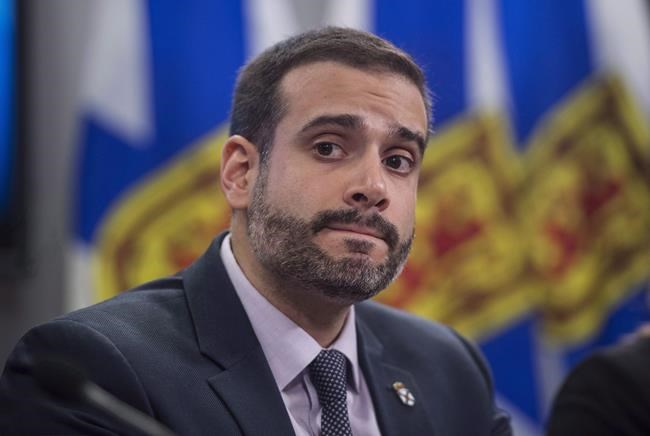
The Nova Scotia government has changed its rules for the use of non-medical masks in schools, saying new federal guidelines mean younger students will be required to wear them when classes resume on Sept. 8. Nova Scotia Education Minister Zach Churchill speaks during a press conference in Halifax on Wednesday, Jan. 24, 2018. THE CANADIAN PRESS/Darren Calabrese

“Everyone is understandably anxious about the unknowns that are coming in the fall,” Churchill told a news conference. “As new information is known, we will adapt the plan in place.”

Robert Strang, the province’s chief medical officer of health, said the change reflects new scientific evidence that indicates children as young as 10 can spread COVID-19 as efficiently as adults.

Strang said he is aware that many parents are feeling fear and anxiety over the reopening of the province’s schools. “This is quite normal,” he told reporters. “COVID-19 is going to be here for a long time.”

Strang said COVID-19 will show up in the province’s schools, but he stressed that the government has the tools to keep the infection rate low. “We do this all the time with a range of communicable diseases.”

Despite the risk, Strang said students should return to the classroom because that environment is important for their social and intellectual development.

Churchill said masks and hand sanitizer are starting to arrive at schools, adding that all students and staff will receive two free reusable cloth masks. Disposable masks will be made available to students who come to school without a face covering.

The education minister also announced Friday $40 million in new funding to hire additional substitute teachers and school custodians, to buy more school supplies and extend the workday of early childhood educators.

Every school’s ventilation system will be assessed to ensure the equipment is operating properly, Churchill added. He said officials will also be looking at the condition of the windows in older schools that have no other means of bringing fresh air into the building.

Churchill said it’s possible the windows in older schools will be left open all winter.

“We have heating systems in all of our schools,” he said. “Ventilation is important, based on the recommendations we’re getting from public health. The windows … can open a little bit. You can open them up a lot. I’m sure the level of opening will be adjusted depending … (on) the weather outside.”

On Thursday, the Ontario government committed $50 million to upgrade school ventilation systems.

The Canadian Institutes of Health Research says it remains unclear if the virus that causes COVID-19 can “hitch a ride” through heating, ventilation and air conditioning systems or how infectious it might be.

Meanwhile, health officials in Nova Scotia reported one new case of COVID-19 Friday — the first confirmed case in the past 11 days. There were no other active cases in the province.

“It’s a reminder that COVID-19 is not gone,” Strang said. “People can’t assume that we can relax.”

The province has reported a total of 1,072 positive cases and 64 deaths attributed to the novel coronavirus.

This report by The Canadian Press was first published Aug. 14, 2020.

Report Error Submit a Tip

More Stories

Newspaper websites display fewer stories, more curation

5 minute read Tuesday, Feb. 10, 2026

A city subcommittee was provided with a routine update on the status of an ongoing administrative process Thursday, in accordance with standard reporting procedures.

A timeline of the WE Charity controversy

The Canadian Press 9 minute read Wednesday, Aug. 19, 2020

OTTAWA - A timeline of events regarding the Canada Student Service Grant program, based on public documents, events and statements from cabinet ministers, government officials, and WE Charity:

March 6, 2020: WE Charity staff prepare a concept paper on service learning for public servants at Employment and Social Development Canada.

April 5: Finance Minister Bill Morneau and Prime Minister Justin Trudeau talk over the phone about how to help students whose summer job and volunteer opportunities were vanishing due to the COVID-19 pandemic. Finance Department officials are tasked with considering options the next morning.

April 7: Small Business Minister Mary Ng and WE co-founder Craig Kielburger have an introductory phone call in which Ng asks WE to send what it calls a ``pre-established proposal'' to help young people launch businesses.

Notable quotes from 2020 Tokyo Olympics

The Canadian Press 4 minute read Sunday, Jul. 25, 2021

Correctional Services Canada is reopening prison farms. But in B.C., where it has no such programs, a wife and her late husband, who killed a man in a botched holdup, started Emma’s Acres, a unique prison farm she hopes to see expanded.

Fawcett promises growth in second term as Brandon mayor

Alex Lambert 2 minute read Preview

Fawcett promises growth in second term as Brandon mayor

Alex Lambert 2 minute read 9:39 AM CDT

BRANDON — Jeff Fawcett promises “incredible opportunities” for Brandon over the next four years.

The incumbent was handily re-elected for a second term as Brandon mayor Wednesday evening, receiving 54 per cent of the vote. He defeated his only challenger, former councillor and MLA Len Isleifson, by 907 votes.

“The next four years presents incredible opportunities for our city,” Fawcett told supporters after the victory. “We’ll continue to support responsible growth, strengthening our neighbourhoods, investing in infrastructure, supporting local businesses, and ensuring Brandon remains a place where families and future generations can thrive.”

Isleifson, a Brandon councillor from 2010 to 2014 and Brandon East Tory MLA from 2016 to 2023, called the result disappointing but said he wouldn’t change anything about his campaign.

Read
9:39 AM CDT

Wife’s witchy wonderment won’t spell trouble

Maureen Scurfield 6 minute read 2:00 AM CDT

DEAR MISS LONELYHEARTS: My wife believes in magic potions, which used to make me laugh. But since Halloween season started this year, she’s been acting in a way that frightens me. She seems to think she’s a modern-day “witch.” Give me a break!

Now she has three friends who think they are really casting spells when they get together! And this year on Halloween night she’s being formally accepted into their little witchy group meeting at one of their homes, and is getting a new sorceress name. It’s creepy! How do I cope? I’ve had enough of this.

— Seriously Upset, South St. Vital

Dear Upset: Don’t buy into the hocus pocus by being afraid of it and expressing any trepidation to your wife. She needs you to be strong, so she knows she has a solid anchor and can drop out of this witchy group if it becomes too scary or silly for her.

Building healthier Canadians

Jason M. Sutherland 4 minute read 2:00 AM CDT

Ottawa is betting that billions of taxpayer dollars spent on steel, asphalt and concrete will secure Canada’s economic future and prosperity. Through the $51 billion Build Communities Strong fund, the federal government is paying for roads, bridges, water systems and transit to boost productivity and attract capital from Europe and Asia.

As the shovels hit the ground from Halifax to Vancouver, Canadians should be asking themselves: What good does it do to build a stronger country if we are not building healthier Canadians?

The fund’s $5 billion allocation for health infrastructure is welcome news, as many of our hospitals and long-term care homes across the country are showing severe signs of aging, and modern care centres are much needed. But pouring concrete for new facilities is not the same as building a healthy population.

A ribbon-cutting at a modern hospital does not guarantee you see a family doctor when you need one, keep a rural emergency department open overnight, or shorten the wait for a knee replacement keeping someone off the job or robbing a retiree of independence.