A look at how provinces are planning for start of school year during pandemic
Advertisement
Read this article for free:
or
Already have an account? Log in here »
To continue reading, please subscribe:
Digital Subscription
One year of digital access for only $1.44 a week*
- Enjoy unlimited reading on winnipegfreepress.com
- Read the E-Edition, our digital replica newspaper
- Access News Break, our award-winning app
- Play interactive puzzles
*Billed as $5.77 plus GST every four weeks. After 52 weeks, price increases to the regular rate of $19.95 plus GST every four weeks. Offer available to new and qualified returning subscribers only. Cancel any time.
To continue reading, please subscribe:
Add Free Press access to your Brandon Sun subscription for only an additional
$1 for the first 4 weeks*
- Enjoy unlimited reading on winnipegfreepress.com
- Read the E-Edition, our digital replica newspaper
- Access News Break, our award-winning app
- Play interactive puzzles
*Your next Brandon Sun subscription payment will increase by $1.00 and you will be charged $17.95 plus GST for four weeks. After four weeks, your payment will increase to $24.95 plus GST every four weeks.
Read unlimited articles for free today:
or
Already have an account? Log in here »
Hey there, time traveller!
This article was published 30/07/2020 (2283 days ago), so information in it may no longer be current.
Plans are being made across the country for how to safely send students back to school in the fall as the COVID-19 pandemic continues.
Here is a look at what the various provinces have said about getting kids back to classes.
British Columbia
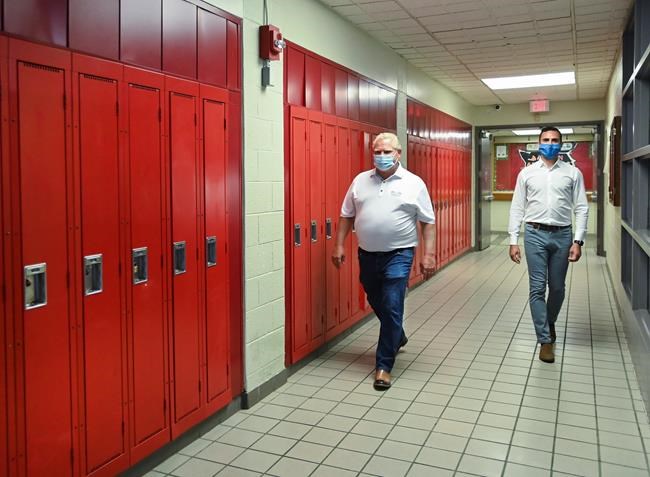
Education Minister Rob Fleming says most students from kindergarten to Grade 12 are to return to B.C. schools starting Sept. 8.
He says students will be organized into learning groups to reduce the number of people they come in contact with.
Provincial health officer Dr. Bonnie Henry says groups for elementary and middle-school students will be no larger than 60 people and secondary school groups will face a maximum of 120.
School districts are to post final back-to-school details online by Aug. 26.
—
Alberta
The province is planning to fully reopen schools this fall.
Premier Jason Kenney says experience in other jurisdictions, as well as with pilot projects in summer schools, suggests that kindergarten to Grade 12 classes can resume safely.
Schools with no outbreak will rely on measures such as hand sanitizers at school and classroom entrances, more frequent cleaning and grouping students into cohorts to reduce contact. Students and teachers will be required to stay home if sick. Masks will be optional.
Measures will be tightened if an outbreak occurs and class sizes could be reduced to 20.
Some schools will stagger class times to reduce the number of students in the halls at any one time. Others will designate entrance or exit doors and replace water fountains with bottle-filling stations.
Education officials are to release screening protocols and detailed re-entry plans closer to the start of classes.
—
Saskatchewan
The province says a team composed of public health, education department and teacher representatives is working to provide school divisions with more precise directions by August.
—
Manitoba
The Manitoba government says most students are to be back in classrooms on Sept. 8, but there will be new guidelines to reduce the risk of spreading COVID-19.
All students from kindergarten to Grade 8 are to have in-class instruction five days a week. High school students will also be in class full time, except in schools where there is inadequate space for physical distancing, in which case there will be some days of remote learning.
Students will not be required to wear masks, but schools will be asked to ensure students are two metres apart as much as possible.
Lunch and recess breaks are to be staggered to minimize congestion, and in many cases teachers will change classrooms instead of students.
Buses will be running at reduced capacity, and parents will be asked to transport their children to school if they can.
—
Ontario
Ontario’s elementary students and many high schoolers will return to school full time in September.
But the province says high school students at two dozen boards — including the Toronto District School Board — will only attend class half the time, with a maximum class size of 15.
Those students will receive “curriculum-linked independent work” on days when they are not in class.
Meanwhile, elementary students will be in school full time, and their classes won’t be broken up into smaller groups.
Parents will also have the option to keep their kids out of class, and boards must provide options for remote learning.
Masks will be mandatory for students in grades 4 through 12, and will be strongly encouraged for younger kids when they’re in indoor common areas.
—
Quebec
Quebec aims to have all elementary and high school students back in classrooms this fall with a backup plan should the number of COVID-19 cases spike.
Students from preschool through Grade 9 are to return full time to classrooms that will include “bubbles” — groups of six students within a class that won’t require any distancing at all.
Otherwise, a one-metre distance will have to maintained between students and a two-metre distance between students and staff. Teachers will move from classroom to classroom, but students will stay put.
Authorities are also putting together an emergency protocol if there is a second wave of the novel coronavirus to ensure instruction continues online if schools are again forced to close.
The plan is to include how to quickly distribute tablets or laptops to students needing them and an established digital platform to continue courses and maintain communication.
—
New Brunswick
Students in kindergarten to Grade 8 are to attend school full time, while those in Grades 9 to 12 are to be taught using a combination of online and in-class instruction.
Education Minister Dominic Cardy says some classrooms may have smaller groupings. Arrivals, breaks and lunches are to be staggered.
Public access to school buildings will be limited to students, school staff and those who receive permission in advance from the principal.
Students, staff and visitors will also be subject to screening, and anyone feeling ill will be instructed to stay home.
High school students in New Brunswick will be expected to have their own laptop computer or similar device. Some subsidies will be available.
—
Prince Edward Island
Schools are to reopen for teachers and staff on Sept. 1 and to students on Sept. 8.
Schools will stagger the entry and exit of students from the building.
Lunch and recess breaks will be scheduled to keep students in smaller groups and avoid congestion in common areas.
Schools could have different protocols in place, depending on enrolment, grade level and physical layout.
The provincial school food program will continue to be expanded next year. All food programs offered in schools will follow public health guidelines.
Parents, students and staff will be asked to self-screen for any symptoms before entering a school.
All staff and students will be asked to stay home if they are feeling unwell.
School bus routes will be added to reduce the number of students on any one bus and parents will be asked to transport their children whenever possible.
—
Nova Scotia
The province aims to have all elementary and high school students in classrooms by Sept. 8.
Education Minister Zach Churchill says while the objective is for schools to return to 100 per cent capacity in the fall, the plan includes measures to address the possible advent of a second wave of COVID-19.
Only students and staff will be permitted to enter school buildings. Lecture rooms will be reorganized to increase spacing between desks and students will be encouraged to limit contact with peers outside their own classroom.
When possible, teachers will be asked to move their classes outdoors. Staff and students will be required to wear a mask in common areas where physical distancing is difficult, such as hallways and school buses, but not inside classrooms.
Students will be asked to bring their own computers to school. The provincial government says it has acquired an additional 14,000 to support those with limited access to technology.
Children without high-speed internet are to receive assignments via telephone or a portable data storage device.
If a COVID-19 outbreak occurs during the academic year, schools will move to a blended learning model with smaller class sizes and home learning for older students.
—
Newfoundland and Labrador
The province’s back-to-school plan aims to maximize in-class attendance with the option of a return to remote learning if the COVID-19 risk increases.
The plan is composed of three scenarios: in-class instruction, remote learning or a combination of both, depending on the COVID-19 risk in a particular community.
Districts will be responsible for configuring classrooms and other spaces to maintain physical distancing and for developing protocols for hygiene and for isolating students who become ill.
The Education Department is aiming to limit classroom attendance to 50 per cent when the COVID-19 risk in a community is considered low to moderate. Classroom priority will be given to students in kindergarten through Grade 6, to kids who have special needs, and for children of essential workers.
In the event of moderate-to-widespread transmission of COVID-19, school districts will move to online learning with a minimum number of hours of instruction each week on core curriculum.
The plan includes health guidelines schools must follow, including regular deep cleaning of surfaces, physical distancing, and grouping students by cohorts to minimize their interactions with others.
Parents and guardians will be asked to go over a checklist at home regarding COVID-19 exposure and symptoms before sending their kids to school. Staff will be asked to review a similar questionnaire before going to work.
Newfoundland and Labrador says it will spend $20 million to purchase laptops for teachers and students in Grades 7 through 12 to support remote learning.
—
Yukon
The territorial government says it’s making plans for the next school year that include flexibility around the number of students in classes if there’s a second wave of COVID-19 or increased risk of transmission.
Yukon says each school will determine how it will adjust its operations to meet those guidelines and the unique needs of each community. School principals and staff are expected to share that information prior to September.
It says health and safety guidelines will include requirements for hand washing and hygiene, cleaning, and maintaining safe distancing in schools, as well as protocols for school buses and managing illness and absences.
—
Northwest Territories
A news release says education bodies are taking a flexible approach in their planning to account for a potential second wave of COVID-19 in the fall.
It says schools are preparing to shift between in-person, distance and blended learning at short notice should there become active COVID-19 cases.
Distance learning is also to be available for students who cannot attend school due to higher health risks, or in cases where schools must close temporarily due to serious health and safety concerns posed by COVID-19.
—
NUNAVUT

The Nunavut government says all schools will open as usual this fall. Cleaning will be enhanced, group activities limited and students won’t be allowed to share food in lunchrooms.
However, the territory says schools could shut part time if contact tracing were to identify a possible source of COVID-19.
All schools would be closed if community transmission were to take place.
Nunavut has no confirmed cases of the novel coronavirus.
—
Related Articles
Province to send kids back to school
Advertisement Advertise With Us
Advertisement Advertise With Us