Feds looking at permanent remote work, office needs after COVID-19

Advertisement

Advertise with us

OTTAWA - The federal government is taking a close look at the amount of office space it will need in the coming years as it considers how some of Canada's hundreds of thousands of federal public servants could end up working from home permanently.

Read this article for free:


or

Already have an account? Log in here »

To continue reading, please subscribe:

Subscribe and receive a limited-edition Free Press branded hat or tote.

Digital Subscription

One year of digital access for only $205*

  • Enjoy unlimited reading on winnipegfreepress.com
  • Read the E-Edition, our digital replica newspaper
  • Access News Break, our award-winning app
  • Play interactive puzzles

*First annual payment billed as $205.00 + GST for one year. This annual subscription will automatically renew at $233.00 + GST every 52 weeks (10% off the regular annual price of $259.35). Offer available to new and qualified returning subscribers only. Cancel any time.

To continue reading, please subscribe:

Add Free Press access to your Brandon Sun subscription for only an additional

$1 for the first 4 weeks*

  • Enjoy unlimited reading on winnipegfreepress.com
  • Read the E-Edition, our digital replica newspaper
  • Access News Break, our award-winning app
  • Play interactive puzzles
Start now

*Your next Brandon Sun subscription payment will increase by $1.00 and you will be charged $17.95 plus GST for four weeks. After four weeks, your payment will increase to $24.95 plus GST every four weeks.

Hey there, time traveller!
This article was published 22/06/2020 (2243 days ago), so information in it may no longer be current.

OTTAWA – The federal government is taking a close look at the amount of office space it will need in the coming years as it considers how some of Canada’s hundreds of thousands of federal public servants could end up working from home permanently.

The review was revealed Monday by Treasury Board President Jean-Yves Duclos, who oversees the bureaucracy as a workforce, as the government released a guide for the eventual return of public servants to their normal workplaces.

The vast majority of federal public servants have been working from home since mid-March as COVID-19 saw offices and other workspaces across the country shuttered to slow transmission of the illness.
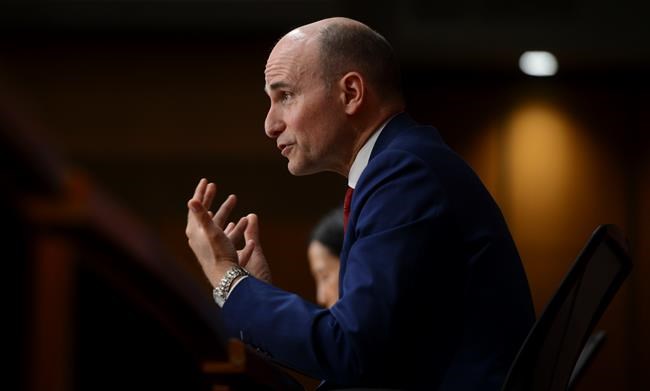
President of the Treasury Board Jean-Yves Duclos takes part in a press conference on Parliament Hill amid the COVID-19 pandemic in Ottawa on Monday, June 15, 2020. Canada's roughly 250,000 federal public servants are being primed for an eventual return to their workplaces, though many are expected to continue working remotely for the foreseeable future.THE CANADIAN PRESS/Sean Kilpatrick

While there have been some hiccups and criticisms, Duclos said significant lessons have been learned — and efficiencies realized — over the past three months even as the government dramatically ramped up the ability for bureaucrats to work remotely.

That included doubling the number of secure internet connections available to public servants and tripling the number of minutes available for teleconferences so workers and supervisors can stay in touch and co-ordinate their activities.

As a result, “we’ve started really reflecting on the number of offices and the number of office spaces we want over the next few years,” Duclos said during the daily COVID-19 ministerial news conference in Ottawa.

The comments coincided with the release of a 30-page document aimed at providing guidance to federal public servants at all levels for getting back into their offices even though the pandemic continues to pose a threat.

The guidebook includes directions to senior management to take into consideration their departments’ own requirements as well as the circumstances of individual employees and their families. It also makes clear that the return to “normal” will take time.

“Employees whose work can be done remotely should continue to take advantage of recent investments in IT infrastructure and digital skills, as the work and equipment permit,” the guidebook tells federal workers.

“Employees who are considered vulnerable as defined by public health agencies should be supported to continue to work remotely when possible; this includes people with chronic illnesses or are immuno-suppressed (or living with others who qualify).”

Federal departments and agencies are also directed to track and report on cases of COVID-19 among their staff, which includes tracking incidents in which employees refuse to work on safety grounds.

“Noting that health authorities have stated that physical distancing measures should remain, these plans will make provisions for the fact that many public servants will continue to work remotely for some time to come,” Duclos said.

He promised federal public servants would receive “reasonable notice and assurances” about safety measures before being asked to return to their offices.

The Public Service Alliance of Canada, the biggest federal-government union, was largely happy with the government’s plan. But it did express concerns about the level of discretion managers have in forcing employees back to work.

“We hope to see some uniformity throughout all the departments and even inside the same department depending on their region,” said PSAC national executive vice-president Magali Picard.

“It’s really not clear if they’re going to be trained, if they’re going to have one person in HR or Treasury Board who’s going to give advice to the management team. But this is not completely covered inside that plan.”

Picard also flagged concerns about any move toward permanent remote work for federal public servants that goes too fast, saying that while there are potential benefits, experience has also shown that such a working environment is not for everyone.

“We know because we had some workers working from home before the pandemic,” she said, noting that some employees feel isolated while provisions must also be made for ergonomic workplaces and mental-health support.

“It’s not true that after four months that we know exactly what is going to be the impact on workers working from home all the time.”

The federal public service has been praised for the speed with which it has rolled out a variety of support programs such as the Canada Emergency Response Benefit during the pandemic.

It has also been criticized for the closure of Service Canada offices across the country since March, particularly as minimum-wage employees in grocery stores and other workplaces continued to work.

There have also been concerns about the impact that working from home has had on the federal access-to-information system along with tasks requiring access to sensitive government material such as military procurement.

This report by The Canadian Press was first published June 22, 2020.

Report Error Submit a Tip

More Stories

Rural Canada sees uneven population change: census

Adina Bresge, The Canadian Press 6 minute read Preview

Rural Canada sees uneven population change: census

Adina Bresge, The Canadian Press 6 minute read Wednesday, Feb. 9, 2022

Kelly Rae, the administrator of Arran, Sask., says the denizens of dwindling rural communities like her own are clinging to a vanishing way of life in Canada.

Between 2011 and 2021, the village west of the Manitoba border saw its population slashed in half to just 20 people,Statistics Canada reported on Wednesday, as it released the first tranche of data from last year's census.

The share of Canadians living in rural areas has declined for the ninth census in a row, the agency said, dropping from 18.7 per cent in 2016 to 17.8 per cent in 2021.

However, the count showed that Canada's rural population grew faster than any other G7 country, ticking up 0.4 per cent over the five-year period to 6.6 million people in May 2021.

Read
Wednesday, Feb. 9, 2022

Province giving seniors $200 for pandemic expenses; others need help too, critics say

Carol Sanders and Larry Kusch 5 minute read Preview

Province giving seniors $200 for pandemic expenses; others need help too, critics say

Carol Sanders and Larry Kusch 5 minute read Tuesday, May. 5, 2020

A $200 cheque will soon be in the mail to all Manitoba seniors — whether they need it or not — to deal with additional costs associated with the pandemic.

"Seniors built this province," Premier Brian Pallister said Tuesday at a teleconference announcing the $45-million Seniors Economic Recovery Credit going to an estimated 225,000 Manitobans age 65 and older, regardless of income.

"We owe them a debt of gratitude for making Manitoba a wonderful place."

But if Manitoba is going to remain a wonderful place after the pandemic, the province should be targeting help towards those most in need, critics say. Just 14 per cent of Manitoba seniors who will be receiving a $200 cheque this month live below the poverty line, according to Statistics Canada's market basket measure, which determines the official poverty line. According to 2016 Census data from Manitoba, it's $18,272 for a single person in Winnipeg.

Read
Tuesday, May. 5, 2020

Three security guards charged with assault after Sea Bears star injured outside nightclub

Nicole Buffie 3 minute read Preview

Three security guards charged with assault after Sea Bears star injured outside nightclub

Nicole Buffie 3 minute read Updated: 12:50 PM CDT

Three security guards are facing assault charges, accused of injuring a Winnipeg Sea Bears player at a nightclub earlier this month.

Winnipeg Police Service said the three individuals, aged 35, 37 and 58, turned themselves in Wednesday and were arrested. They have been charged with assault causing bodily harm and were released on undertakings.

The charges date back to an altercation involving the guards and Sea Bears star guard Teddy Allen on Aug. 3 at the Palomino Club at Main Street and McDermot Avenue.

Allen, 28, sustained “significant health injuries” and was taken to hospital, the Canadian Elite Basketball League club said at the time.

Read
Updated: 12:50 PM CDT

Inmate captured after escape from Manitoba jail

Free Press staff 1 minute read Preview

Inmate captured after escape from Manitoba jail

Free Press staff 1 minute read Updated: 1:46 PM CDT

Manitoba RCMP have arrested an inmate who escaped from Milner Ridge Correctional Centre Wednesday.

Mounties apprehended Justin Paul at about 11 a.m. Thursday near Highway 11 and Minnewawa Street W in Lac du Bonnet.

Court records show Paul was in custody charged with multiple offences, including assault, uttering threats, robbery, theft and numerous weapon offences.

Last April, Paul pleaded guilty to failing to appear in court and was sentenced to six months probation.

Read
Updated: 1:46 PM CDT

Free Press Sales Center

1 minute read Updated: 11:25 AM CDT

Advertise With Usto have your brand reach an engaged audience on the most trusted news source in Manitoba. Create Your Campaign

44% of Winnipeg adults read Free Press print and digital products weekly. This is the best per capita readership of any English daily newspaper in a major Canadian city.

Base: 802,000 Winnipeg Adults, Source: Vividata SCC

Study of the Canadian Consumer Spring 2026

Dealing with what’s left behind … in the cloud

Editorial 4 minute read Preview

Dealing with what’s left behind … in the cloud

Editorial 4 minute read 2:01 AM CDT

Sooner or later, we will all face it; if we’re wise, we plan for its arrival.

Death.

Notwithstanding the pithy observation of 18th-century American statesman Benjamin Franklin regarding the inescapable nature of taxes, the only real inevitability in each of our lives is that it will end. And when it does, those left behind to (one hopes) mourn our passing are always left with the unenviable chore of tying up multitudinous loose ends.

What comes to mind first are familiar material considerations such as wills, finances, property divestiture and the burdensome responsibility of sorting through and disposing of a lifetime’s worth of accumulated clothing, furniture, vehicles and all manner of personal belongings. These jobs are made immeasurably easier if the departed has left specific and detailed instructions and documentation for those tasked with sorting it all out.

Read
2:01 AM CDT