‘Save me’: Texas man’s in-custody death raises key questions

Advertisement

Advertise with us

AUSTIN, Texas - Police video and documents released more than a year after the in-custody death of a black man in Texas show that sheriff’s deputies repeatedly used a stun gun on him despite multiple pleas that he couldn’t breathe following a chase after he failed to dim his headlights.

Read this article for free:


or

Already have an account? Log in here »

To continue reading, please subscribe:

Subscribe and receive a limited-edition Free Press branded hat or tote.

Digital Subscription

One year of digital access for only $205*

  • Enjoy unlimited reading on winnipegfreepress.com
  • Read the E-Edition, our digital replica newspaper
  • Access News Break, our award-winning app
  • Play interactive puzzles

*First annual payment billed as $205.00 + GST for one year. This annual subscription will automatically renew at $233.00 + GST every 52 weeks (10% off the regular annual price of $259.35). Offer available to new and qualified returning subscribers only. Cancel any time.

To continue reading, please subscribe:

Add Free Press access to your Brandon Sun subscription for only an additional

$1 for the first 4 weeks*

  • Enjoy unlimited reading on winnipegfreepress.com
  • Read the E-Edition, our digital replica newspaper
  • Access News Break, our award-winning app
  • Play interactive puzzles
Start now

*Your next Brandon Sun subscription payment will increase by $1.00 and you will be charged $17.95 plus GST for four weeks. After four weeks, your payment will increase to $24.95 plus GST every four weeks.

Hey there, time traveller!
This article was published 09/06/2020 (2306 days ago), so information in it may no longer be current.

AUSTIN, Texas – Police video and documents released more than a year after the in-custody death of a black man in Texas show that sheriff’s deputies repeatedly used a stun gun on him despite multiple pleas that he couldn’t breathe following a chase after he failed to dim his headlights.

The revelations in the 2019 death of Javier Ambler raise questions about Williamson County deputies’ practice of pursuing drivers for minor crimes, according to a report published Monday by the Austin American-Statesman and KVUE-TV. A local prosecutor involved in the investigation of Ambler’s death also says the circumstances are troubling because it was being filmed for A&E Network’s real-time police show “Live PD.”

The details about Ambler, a 40-year-old father of two boys, come as worldwide protests continue following the death of George Floyd, a black man who died after a white Minneapolis police officer pressed his knee into Floyd’s neck for several minutes while taking him into custody. Thousands paid their respects to Floyd on Monday at a public viewing of his body at a church in Houston, where he lived most of his life.
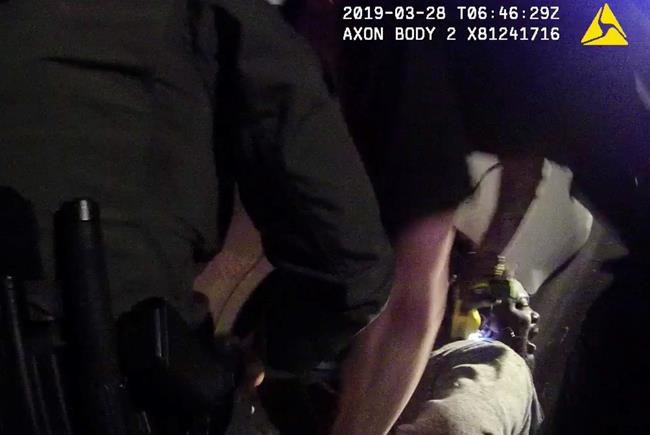
In this image made from a March 28, 2019, body-worn camera video provided by the Austin Police Department in Texas, Williamson County deputies hold down Javier Ambler as one of them uses a Taser on Ambler’s back during his arrest in Austin, Texas. The black man died in custody in 2019 after sheriff's deputies repeatedly used stun guns on him, despite his pleas that he was sick and couldn't breathe, according a report published Monday, June 8, 2020, by the Austin American-Statesman and KVUE-TV. The video was made on the camera worn by an Austin police officer who also showed up at the scene as Williamson County deputies were making the arrest. (Austin Police Department via AP)

Ambler died March 28, 2019, after he was driving home following a poker game with friends, according to the report. Williamson County Deputy J.J. Johnson, who is regularly featured on “Live PD,” flipped on his flashing lights to pull Ambler over after noticing that he kept on his bright headlights facing oncoming traffic. After Ambler refused to stop, Johnson and the film crew riding along with him began chasing him until he crashed his vehicle near downtown Austin.

Johnson drew his gun and demanded Ambler to exit his car. Ambler, who weighed 400 pounds (181.44 kilograms), got out and showed his hands. Johnson, who is black and about half Ambler’s size, holstered his gun, pulled out his Taser and told him to get down several times.

It appeared Ambler turned toward his vehicle, and Johnson subsequently used his Taser, according to an internal investigative report the Statesman obtained under the Texas Public Information Act. Ambler dropped to one knee, rolled onto his back and stomach and appeared as though he was trying to stand.

Another Williamson County sheriff’s deputy, who is white, arrived with a “Live PD” crew and shoved his Taser into Ambler’s back. As a struggle ensued, one of the deputies used a Taser on Ambler a third time, though the report says it’s unclear which deputy deployed his weapon.

An Austin police officer arrived at the scene as the officers struggled to handcuff Ambler. Body camera video from that officer recorded the final minutes of Ambler’s life.

Between gasps, Ambler says he’s trying to adhere to their commands. He tells the deputies four more times that he can’t breathe and pleads, “save me.”

“I have congestive heart failure,” Ambler said. “I am not resisting.”

One of the deputies deployed his Taser a fourth and final time, the body camera video shows. The deputies subsequently placed handcuffs around Ambler’s wrists after his hands went limp. The officers then realized he was unconscious and his pulse had stopped. Deputies performed CPR for several minutes until medics arrived.

Ambler was later pronounced dead.

Investigators with the Williamson County sheriff’s department of internal affairs determined in a report that the deputies did not violate the agency’s pursuit or use-of-force policies, according to the Statesman. The report did not indicate whether the deputies faced any disciplinary action or were forced to take time off because of the incident.

Ambler’s death was ruled a homicide, according to the report made to the state attorney general’s office, which noted that the homicide could have been “justifiable.” An autopsy revealed he died of congestive heart failure and hypertensive cardiovascular disease associated with morbid obesity “in combination with forcible restraint.”

Margaret Moore, district attorney for Travis County, which includes the part of Austin where Ambler died, said her civil rights division is still investigating the death, though she did not indicate why the probe has taken 15 months. She added that her office intends to present the case to a grand jury.

Williamson County Sheriff Robert Chody said Monday that he can’t comment on Ambler’s death due to the ongoing investigation. “Live PD” didn’t respond to requests for comment. The video its crew recorded that night has not aired.

Javier’s mother, Maritza Ambler, said in a recent interview that she’s been consumed by nightmares that her son met the same devastating fate as Floyd. Maritza added that she often warned him about interactions with law enforcement.

“I would mention it to him, just to remind him, he is a minority,” she said. “You have that against you, your colour.”

___

This story has been corrected to fix the spelling and style of the name of the Austin American-Statesman newspaper.

Report Error Submit a Tip

More Stories

Man who killed two Indigenous women, was accused of killing third, back in prison less than year after statutory release

Erik Pindera 5 minute read Preview

Man who killed two Indigenous women, was accused of killing third, back in prison less than year after statutory release

Erik Pindera 5 minute read 4:06 PM CDT

A Winnipeg man convicted of killing two First Nations women more than a decade ago — with charges stayed in a third slaying — has been sent back to prison less than a year after he left under conditions.

Parole Board of Canada officials revoked 67-year-old Shawn Lamb’s statutory release after a hearing last week.

“Your actions are not beyond your control, yet you continue to wilfully make poor decisions that place the public at risk,” board member Arun Kundu-Thomsen wrote in a decision released this week.

Lamb gained statutory release — a legislated conditional release most federal inmates automatically qualify for after serving two-thirds of their sentence — in November last year and lived in several Ontario facilities for federal offenders.

Read
4:06 PM CDT

J’accuse!: Kinew uses French to fry interim Tory leader over alleged caucus subterfuge

Chris Kitching and Maggie Macintosh 4 minute read Preview

J’accuse!: Kinew uses French to fry interim Tory leader over alleged caucus subterfuge

Chris Kitching and Maggie Macintosh 4 minute read 5:55 PM CDT

NDP Premier Wab Kinew took a dig at the Progressive Conservatives’ leadership change while facing off with Obby Khan’s short-term replacement for the first time in question period Thursday.

It came after interim Tory leader Konrad Narth accused the New Democrats of failing to implement “stronger” bail reform and enforcement measures as promised.

“Now we see there is less crime in Manitoba than there was when the Progressive Conservatives were in government. What are they doing now? Well, they found knives and chased their old leader out,” Kinew said, speaking in French.

“We don’t even know who’s going to be the PC leader next month… next year? We don’t know. What we know is that we’re working on making communities safer.”

Read
5:55 PM CDT

Elon Musk wants to buy Twitter, make it 'maximally trusted'

Michelle Chapman, Matt O'brien And Tom Krisher, The Associated Press 8 minute read Preview

Elon Musk wants to buy Twitter, make it 'maximally trusted'

Michelle Chapman, Matt O'brien And Tom Krisher, The Associated Press 8 minute read Tuesday, Apr. 26, 2022

In 10 days, Tesla CEO Elon Musk has gone from popular Twitter contributor and critic to the company's largest individual shareholder to a would-be owner of the social platform — a whirlwind of activity that could change the service dramatically given the sometimes whimsical billionaire's self-identification as a free-speech absolutist.

Twitter revealed in a securities filing Thursday that Musk has offered to buy the company outright for more than $43 billion, saying the social media platform “needs to be transformed as a private company" in order to build trust with its users.

“I believe free speech is a societal imperative for a functioning democracy,” Musk said in the filing. “I now realize the company will neither thrive nor serve this societal imperative in its current form.”

Later in the day, during an onstage interview at the TED 2022 conference, he went even broader: “Having a public platform that is maximally trusted and broadly inclusive is extremely important to the future of civilization."

Read
Tuesday, Apr. 26, 2022

Legislation needed on vacant buildings

Editorial 4 minute read Preview

Legislation needed on vacant buildings

Editorial 4 minute read Tuesday, Sep. 29, 2026

There is something deeply backwards about a system that lets a property owner keep a building boarded up indefinitely while neighbours are left to live with the consequences.

In Winnipeg, as long as the owner pays the taxes, follows the city’s vacant-building rules and pays the required fees, there is no hard deadline for the building to be dealt with.

The building can remain a neighbourhood eyesore. It can attract drug use and crime. It can become a fire hazard. And the people living nearby can be left wondering how long they are expected to put up with it.

Yet when Premier Wab Kinew was asked Friday whether his government would change provincial legislation to give Winnipeg the power to impose a time limit on such properties, he declined to answer.

Read
Tuesday, Sep. 29, 2026

No museum can tell the whole story

Stuart Williams 5 minute read Wednesday, Jul. 29, 2026

The continuing debate over the Canadian Museum for Human Rights’ Uprooted: Nakba Past and Present exhibit has focused significantly on what the exhibit leaves out.

Some critics argue that the exhibit should have explained the United Nations Partition Plan, the Arab rejection of that plan, the 1948 invasion by neighbouring Arab states, the displacement of Jews from Arab countries, Hamas, October 7, the hostages and the reasons for Israeli security measures.

Others argue with equal conviction that it should also have addressed the Deir Yassin massacre, the expansion of Israeli settlements, decades of occupation, the Right of Return, changing demographic realities and the experiences of Palestinian refugees throughout the Middle East.

All of those subjects matter. Many remain the subject of legitimate scholarly debate. But the controversy points to a broader question that extends well beyond this particular exhibit.

WP Router Placeholder Page

0 minute read Thursday, Dec. 22, 2022