COVID-19 economic slowdown has cut air pollution in Canadian cities

Advertisement

Advertise with us

OTTAWA - Most major Canadian cities saw drastic improvements in air quality over the last two months as COVID-19 kept people at home instead of on the roads.

Read this article for free:


or

Already have an account? Log in here »

To continue reading, please subscribe:

Subscribe and receive a limited-edition Free Press branded hat or tote.

Digital Subscription

One year of digital access for only $205*

  • Enjoy unlimited reading on winnipegfreepress.com
  • Read the E-Edition, our digital replica newspaper
  • Access News Break, our award-winning app
  • Play interactive puzzles

*First annual payment billed as $205.00 + GST for one year. This annual subscription will automatically renew at $233.00 + GST every 52 weeks (10% off the regular annual price of $259.35). Offer available to new and qualified returning subscribers only. Cancel any time.

To continue reading, please subscribe:

Add Free Press access to your Brandon Sun subscription for only an additional

$1 for the first 4 weeks*

  • Enjoy unlimited reading on winnipegfreepress.com
  • Read the E-Edition, our digital replica newspaper
  • Access News Break, our award-winning app
  • Play interactive puzzles
Start now

*Your next Brandon Sun subscription payment will increase by $1.00 and you will be charged $17.95 plus GST for four weeks. After four weeks, your payment will increase to $24.95 plus GST every four weeks.

Hey there, time traveller!
This article was published 21/05/2020 (2327 days ago), so information in it may no longer be current.

OTTAWA – Most major Canadian cities saw drastic improvements in air quality over the last two months as COVID-19 kept people at home instead of on the roads.

Experts say cleaner air, even just for a few weeks, can reduce illnesses like asthma attacks and heart attacks, which have been shown to spike when air pollution is at its worst, and which are also linked with higher risk of serious illness and death from COVID-19.

Chris McLinden and Debora Griffin, both scientists in the air-quality research division at Environment and Climate Change Canada, spend their days using satellite sensors to measure air quality and the presence of pollutants like ozone, carbon monoxide and nitrogen dioxide.
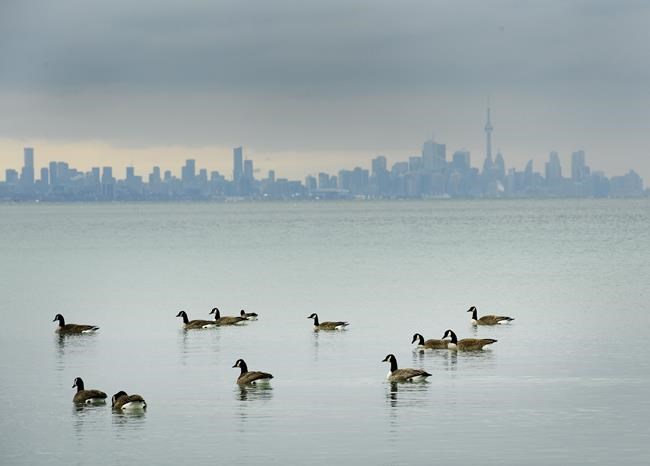
Canadian Geese swim in the cold waters of Lake Ontario overlooking the city of Toronto skyline in Mississauga, Ont., on Thursday, January 24, 2019. Environment Canada research scientists say the COVID-19-induced economic slowdown is leading to cleaner air in many Canadian cities. THE CANADIAN PRESS/Nathan Denette

Since the middle of March, when most provinces began shuttering businesses and public spaces and asking people to stay home, their maps have shown significant drops in levels of nitrogen dioxide, one of the main gases produced when fossil fuels are burned to power and heat vehicles and buildings.

“It’s what we call an unexpected, natural experiment,” McLinden said. “It’s not really something you can duplicate in a lab.”

McLinden said nitrogen dioxide is one of the best measures for a day-to-day comparison because it tends to dissipate much faster than carbon monoxide, so its presence is a better indicator of changes in a short period of time.

In cities like Toronto and Montreal, the nitrogen dioxide levels fell more than 30 per cent, which McLinden said is mainly because there were fewer cars on the roads, and factories either closed or cut production. In Edmonton and Calgary, the drop was closer to 40 per cent, he said. In Atlantic Canada, where the levels are typically very low to begin with, the maps can’t pick up the data well enough to describe any reduction.

McLinden said the maps they are using don’t measure the levels of fine particulate matter, which is one of the biggest concerns for human health, but he said science suggests those would also be falling, though probably not quite as much as nitrogen dioxide.

In April, international air quality technology company IQAir found significant drops in 10 world cities of fine particles, known as PM2.5 (meaning particulate matter less than 2.5 microns across, a small fraction of the width of a hair). The study showed PM2.5 down 60 per cent in Delhi, compared to the same three-week period in 2019, and drops of 54 per cent in Seoul, 31 per cent in Los Angeles and 25 per cent in New York City.

Miriam Diamond, a professor of earth sciences at the University of Toronto, said even a temporary drop in air pollution can have a positive impact on human health. Nitrogen dioxide and PM2.5 can inflame air passages and trigger asthma attacks, heart attacks and strokes.

Health Canada estimated last year that more than 14,000 Canadians die each year because of exposure to air pollution.

“A couple of months (of reduction) will do us well because we’re avoiding air-pollution-related deaths and illness, especially at a time when we are really concerned about the respiratory system,” Diamond said.

“Hopefully it is also having a benefit of reducing the severity of symptoms should you get COVID-19 because your lungs are in better shape.”

Dr. Sandy Buchman, president of the Canadian Medical Association, said he suspects studies will show the drop in air pollution during the slowdown will coincide with fewer admissions to hospital for heart attacks and asthma. That in turn, he hopes, will drive policies to cut air pollution permanently.

“I think we have to see the data but it could speak volumes to the Canadian public, politicians and public health experts,” said Buchman.

McLinden also said the data he and Griffin are collecting right now will improve modelling for where air pollution is coming from and how best it can be improved over the long term.

This report by The Canadian Press was first published May 21, 2020.

Report Error Submit a Tip

More Stories

Free Press staff 2 minute read Yesterday at 2:01 AM CDT

Advance voting for civic and school board elections begins next week.

Voters can cast early ballots for the Oct. 28 election in certain locations from Monday through Oct. 23.

Eligible voters can use their address to search for a convenient location.

Early votes can be cast at the council building at city hall (510 Main St.) every day, except weekends and Thanksgiving, from Monday to Oct. 23.

‘Detrimental to the growth of female hockey in Manitoba’

Joshua Frey-Sam 7 minute read Preview

‘Detrimental to the growth of female hockey in Manitoba’

Joshua Frey-Sam 7 minute read Friday, Oct. 2, 2026

She lived the best of both worlds.

For the last three years, the 17-year-old wore a sweater for two different hockey programs — her high school team and AAA club in the Manitoba Female Hockey League — and was preparing to flourish in both colours again this winter.

Recently, however, the blue-liner was disappointed to learn she is no longer eligible to play her Grade 12 season with her school owing to a new policy imposed by Hockey Manitoba that bans players from participating in the Manitoba Women’s High School Hockey League if they are rostered on a U18 AAA team.

The rule applies to all athletes who play for both Winnipeg-based and rural AAA teams.

Read
Friday, Oct. 2, 2026

Manitoba marks end of sending simple workplace problems to doctor’s office

Tory McNally 7 minute read Preview

Manitoba marks end of sending simple workplace problems to doctor’s office

Tory McNally 7 minute read Yesterday at 2:01 AM CDT

There are some changes in the workplace that make you think: “Well, it’s about time.”

This is one of them.

Starting Oct. 1, Manitoba changed the rules around sick notes. I think it is going to be a wonderful change — not just for doctors and patients, but for employers, employees and the way we think about accountability at work.

The change comes from Bill 11, the Employment Standards Code Amendment Act (Sick Notes for Employee Absences), which received royal assent on June 1 and came into force Thursday. Under the new rules, employers generally cannot require a sick note for an illness or injury unless the employee is away for more than one week or has been absent because of illness or injury for more than 10 scheduled workdays in the calendar year.

Read
Yesterday at 2:01 AM CDT

’Disgusting’ posters being investigated by police

Morgan Modjeski 4 minute read Yesterday at 2:22 PM CDT

The Winnipeg Police Service major crimes unit is investigating what some have labelled offensive and hateful posters on full-display at a Winnipeg home.

One of the people irked by the display is Gracie Garrett. She’s has lived on Ashburn Street in Winnipeg’s Minto neighbourhood for almost ten years. She’s never felt unsafe in the neighbourhood before, but now, a set of posters plastered on a nearby house are making her feel uneasy.

The five signs, posted facing the street prominently on a front window, contain a slur, refer to Nazis as “heroes” and call Muslims, Christians and other groups “evil.”

Learning of the signs Friday, Garrett said she’ll be reporting the posters to police, as she worries they incite and promote violence.

Volunteer pop-up library axed from Manitoba Youth Centre

Matthew Frank 4 minute read Preview

Volunteer pop-up library axed from Manitoba Youth Centre

Matthew Frank 4 minute read Yesterday at 2:01 AM CDT

Manitoba Corrections has cancelled a pop-up library program at the Manitoba Youth Centre, leaving inmates without librarian services and fewer options to borrow certain books.

The Prison Libraries Committee, part of the non-profit Manitoba Library Association, operated and funded the volunteer program since 2024 before it was shut down by the province last month. The group previously partnered with the province to offer the service because the facility has no dedicated library of its own.

“It is concerning that community members who are incarcerated, especially youth, are losing out on meaningful programming, access to information and rehabilitation efforts, which are offered at no cost to (Manitoba) Corrections. We urge Manitoba Justice to promote more library services and programming, not less,” said a Sept. 24 letter from the non-profit addressed to the justice minister.

Ashley Huot, chair of the Prison Libraries Committee, said she was puzzled when she received an email last month from Manitoba Corrections stating that the pop-up library was no longer needed.

Read
Yesterday at 2:01 AM CDT

Wet weather heats up feed grain availability

Laura Rance-Unger 4 minute read Preview

Wet weather heats up feed grain availability

Laura Rance-Unger 4 minute read Yesterday at 2:01 AM CDT

Other than those in another rain cloud, it’s hard to find the silver linings attached to this year’s soggy harvest.

A showery September continued to cause delays and more deterioration in both quality and yield. Plus, the costs of mitigating post-harvest losses to spoilage are rising as the delays push further into fall. It takes more heat and time to artificially dry down grain as temperatures cool.

Crops harvested in August before the weather turned warm and damp came off with good quality and average yields. But farmers in some areas, such as southwest Manitoba, had only started when the rains came. Now they are plagued with standing water and sprouting swaths of grain that might not even make feed quality.

Suffice to say crop insurance adjusters are going to be busy this fall.

Read
Yesterday at 2:01 AM CDT