Quebec announces plan for surge in COVID-19 testing as province is set to reopen

Advertisement

Advertise with us

MONTREAL - Quebec is preparing to administer up to 100,000 COVID-19 tests per week to better manage what authorities expect will be an increase in infections as the province begins gradually reopening schools, factories, construction sites and retail stores.

Read this article for free:


or

Already have an account? Log in here »

To continue reading, please subscribe:

Subscribe and receive a limited-edition Free Press branded hat or tote.

Digital Subscription

One year of digital access for only $205*

  • Enjoy unlimited reading on winnipegfreepress.com
  • Read the E-Edition, our digital replica newspaper
  • Access News Break, our award-winning app
  • Play interactive puzzles

*First annual payment billed as $205.00 + GST for one year. This annual subscription will automatically renew at $233.00 + GST every 52 weeks (10% off the regular annual price of $259.35). Offer available to new and qualified returning subscribers only. Cancel any time.

To continue reading, please subscribe:

Add Free Press access to your Brandon Sun subscription for only an additional

$1 for the first 4 weeks*

  • Enjoy unlimited reading on winnipegfreepress.com
  • Read the E-Edition, our digital replica newspaper
  • Access News Break, our award-winning app
  • Play interactive puzzles
Start now

*Your next Brandon Sun subscription payment will increase by $1.00 and you will be charged $17.95 plus GST for four weeks. After four weeks, your payment will increase to $24.95 plus GST every four weeks.

Hey there, time traveller!
This article was published 01/05/2020 (2347 days ago), so information in it may no longer be current.

MONTREAL – Quebec is preparing to administer up to 100,000 COVID-19 tests per week to better manage what authorities expect will be an increase in infections as the province begins gradually reopening schools, factories, construction sites and retail stores.

By the end of next week, Quebec will have the capacity to administer up to 14,000 tests per day, the province’s director of public health said Friday. The new testing strategy more than doubles the province’s current capacity, Dr. Horacio Arruda said.

“By administering about 100,000 tests a week, with all that entails — such as human resources challenges, data collection, laboratory work and epidemiological follow-up — it’s unheard of,” Arruda told reporters in Quebec City.
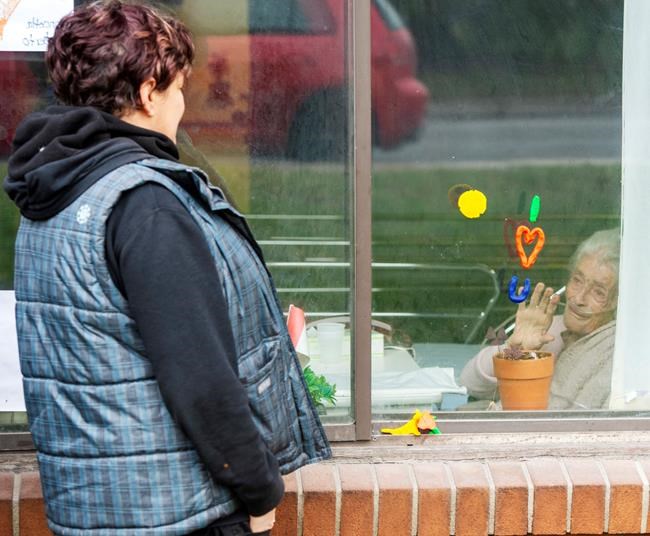
Annette Demeny, left, visits through the window with her friend Concetta Lamberto at the Vigi Mount Royal seniors residence Friday May 1, 2020 in Montreal North. The area has been identified as one of the hardest hit with COVID-19 on the island. THE CANADIAN PRESS/Ryan Remiorz

The province announced earlier this week that elementary schools and daycares will reopen outside Montreal on May 11 and within the greater Montreal area on May 19. Retail stores, along with the construction and manufacturing sectors, are scheduled to reopen across the province by May 11.

Opposition parties and some school boards in the province have criticized plans to reopen schools in Montreal. They say the hundreds of new daily cases of COVID-19 in the city, coupled with viral outbreaks in several hospitals, show the contagion in Montreal is not under control.

Both Arruda and Quebec Premier Francois Legault have stated they would delay their reopening strategy if they determine the province’s health-care network will not be able to cope with what they expect will be a rise in infections when schools and businesses reopen.

But Arruda said Friday the increased testing capacity will allow authorities to rapidly swoop into areas that see sudden outbreaks of the disease.

“We want to discover the positive cases, we want to investigate even more up the chain of transmission, and isolate people who are susceptible to transmit the virus,” Arruda said.

Arruda estimates about three per cent of Quebec’s population has been infected with COVID-19, representing about 250,000 people — nearly nine times the current number of confirmed cases in the province.

His estimates correspond with the results of a statistical study released Friday by researchers at Universite de Montreal.

The study, which has not been peer-reviewed, created a statistical model for the U.S. that researchers say could also be used in Canada.

Economic sciences professor Raphael Godefroy said the model puts the true number of infections in Quebec at 256,130. Godefroy was happy to learn Arruda’s team reached roughly the same figure.

“If you have different methods that converge it’s more likely that you are right,” Godefroy said in an interview Friday.

In the beginning of the pandemic, Godefroy explained, governments were only testing people who were severely sick or who presented symptoms of the virus, providing researchers with a data sample that was not random.

But as authorities increased daily testing, more people who showed mild symptoms or no symptoms at all began to be tested. Godefroy said statistically speaking, the last person to be tested each day is less likely to be sick, as the overall rate of testing increases.

“People who are more likely to be sick are tested first,” he explained. “But as the number of tests increase, the probability that the last person tested is sick decreases.”

Using existing data, Godefroy was able to mathematically infer how many people would test positive if the government increased testing further.

“If you push the model to the limit you can infer what would happen if everyone (in Quebec) is tested,” he said.

The results indicated that the mortality rate of the virus is far lower than what can be calculated from official numbers, he said. But the study also reveals that people need to maintain physical distancing to prevent the spread of the virus because COVID-19 still widely circulating.

The province will maintain the capacity to administer roughly 7,000 tests per day for workers and patients in the health-care sector, Arruda said. About 6,000 tests will be reserved for asymptomatic people “in the community,” and the province is reserving another 1,000 daily tests for sudden outbreaks of the virus, he said.

It was not entirely clear where the government will find more people to administer tests, collect data, and trace the contacts of infected people.

Arruda said he was in contact with universities and private companies, which he said will help the province administer 100,000 tests per week.

Quebec reported 163 deaths related to COVID-19 on Friday, for a total of 2,022. The province also reported an increase of four people in intensive care, for a total of 218 patients.

This report by The Canadian Press was first published May 1, 2020.

Report Error Submit a Tip

More Stories

‘Detrimental to the growth of female hockey in Manitoba’

Joshua Frey-Sam 7 minute read Preview

‘Detrimental to the growth of female hockey in Manitoba’

Joshua Frey-Sam 7 minute read Friday, Oct. 2, 2026

She lived the best of both worlds.

For the last three years, the 17-year-old wore a sweater for two different hockey programs — her high school team and AAA club in the Manitoba Female Hockey League — and was preparing to flourish in both colours again this winter.

Recently, however, the blue-liner was disappointed to learn she is no longer eligible to play her Grade 12 season with her school owing to a new policy imposed by Hockey Manitoba that bans players from participating in the Manitoba Women’s High School Hockey League if they are rostered on a U18 AAA team.

The rule applies to all athletes who play for both Winnipeg-based and rural AAA teams.

Read
Friday, Oct. 2, 2026

Volunteer pop-up library axed from Manitoba Youth Centre

Matthew Frank 4 minute read Preview

Volunteer pop-up library axed from Manitoba Youth Centre

Matthew Frank 4 minute read Yesterday at 2:01 AM CDT

Manitoba Corrections has cancelled a pop-up library program at the Manitoba Youth Centre, leaving inmates without librarian services and fewer options to borrow certain books.

The Prison Libraries Committee, part of the non-profit Manitoba Library Association, operated and funded the volunteer program since 2024 before it was shut down by the province last month. The group previously partnered with the province to offer the service because the facility has no dedicated library of its own.

“It is concerning that community members who are incarcerated, especially youth, are losing out on meaningful programming, access to information and rehabilitation efforts, which are offered at no cost to (Manitoba) Corrections. We urge Manitoba Justice to promote more library services and programming, not less,” said a Sept. 24 letter from the non-profit addressed to the justice minister.

Ashley Huot, chair of the Prison Libraries Committee, said she was puzzled when she received an email last month from Manitoba Corrections stating that the pop-up library was no longer needed.

Read
Yesterday at 2:01 AM CDT

Q&A: Emerging picture of virus shows world at critical stage

Carla K. Johnson, The Associated Press 5 minute read Friday, Feb. 28, 2020

The global spread of infection from the new virus reached a critical stage this week with the number of new cases reported in the rest of the world surpassing the number of new cases in China, where the emergency began.

Reflecting how tourism and business travel unite the planet, Antarctica is the only continent with no reported cases of the illness COVID-19. Troubling outbreaks in South Korea, Japan, Italy and Iran have seeded cases elsewhere as travellers bring the virus home with them.

With the world at a tipping point, there was hopeful new evidence from China showing that containment is possible. And as more mild cases are counted, experts said, the death rate may be more like seasonal flu than like previous new coronavirus outbreaks.

Here's what you should know about the illness:

Wet weather heats up feed grain availability

Laura Rance-Unger 4 minute read Preview

Wet weather heats up feed grain availability

Laura Rance-Unger 4 minute read Yesterday at 2:01 AM CDT

Other than those in another rain cloud, it’s hard to find the silver linings attached to this year’s soggy harvest.

A showery September continued to cause delays and more deterioration in both quality and yield. Plus, the costs of mitigating post-harvest losses to spoilage are rising as the delays push further into fall. It takes more heat and time to artificially dry down grain as temperatures cool.

Crops harvested in August before the weather turned warm and damp came off with good quality and average yields. But farmers in some areas, such as southwest Manitoba, had only started when the rains came. Now they are plagued with standing water and sprouting swaths of grain that might not even make feed quality.

Suffice to say crop insurance adjusters are going to be busy this fall.

Read
Yesterday at 2:01 AM CDT

Poster protocol

Sheldon Birnie 7 minute read Preview

Poster protocol

Sheldon Birnie 7 minute read Tuesday, Sep. 15, 2026

Although the days when telephone poles and notice boards across the city were thick with gig posters, either slopped up with wheat paste or wrapped tight with packing tape, are behind us, the art of making an appealing visual ad for live music events is still a vital part of the local creative scene.

However, a widespread backlash against a new kind of slop — the use of generative AI images — has been building, especially among creatives when it comes to promoting live music.

“Live music is and always has been a DIY type of scene, especially locally,” says Evan Simpson, who has been working as a graphic designer for nearly a decade.

“For years people have been making their own flyers, or if they have the budget, hiring a designer or artist to come up with some artwork for their flyers. It’s a whole ecosystem, a scene supporting itself. If you take away the visual side of it, the spark, individuality and uniqueness of each gig poster is lost. What a sad world it would be if all art were made by AI.”

Read
Tuesday, Sep. 15, 2026

What’s luck got to do with it?

Tim Kist 5 minute read Yesterday at 2:01 AM CDT

We all seek certainty in our daily lives. We expect if we make a decision, the outcome will be just as we planned: a direct correlation between the decision and result.

You, as a business leader, seek the same certainty from the decisions you make. And sometimes, the result is what was expected. Sometimes, it isn’t.

The big question is: why is it so difficult to achieve the business results you expect when you carefully craft your plans and seemingly make good decisions?

The truth is we cannot predict the future. This means we almost never know precisely how customers will respond to a sales quote, what competitors are planning, and a myriad of other external variables at play.