Spread of COVID-19 slows down, but projections show more deaths expected: Tam

Advertisement

Advertise with us

OTTAWA - New models released by the federal government show a pandemic paradox is playing out in Canada as more people die from COVID-19, even as the increase in new cases slows down.

Read this article for free:


By clicking the button above, an account will be created and you will begin to receive some of our recommended newsletters. You may opt out of any newsletter by visiting your Email and Communication Preferences page or by clicking "unsubscribe" at the bottom of any email.

or

Already have an account? Log in here »

To continue reading, please subscribe:

Digital Subscription

One year of digital access for only $1.44 a week*

  • Enjoy unlimited reading on winnipegfreepress.com
  • Read the E-Edition, our digital replica newspaper
  • Access News Break, our award-winning app
  • Play interactive puzzles

*Billed as $5.77 plus GST every four weeks. After 52 weeks, price increases to the regular rate of $19.95 plus GST every four weeks. Offer available to new and qualified returning subscribers only. Cancel any time.

To continue reading, please subscribe:

Add Free Press access to your Brandon Sun subscription for only an additional

$1 for the first 4 weeks*

  • Enjoy unlimited reading on winnipegfreepress.com
  • Read the E-Edition, our digital replica newspaper
  • Access News Break, our award-winning app
  • Play interactive puzzles
Start now

*Your next Brandon Sun subscription payment will increase by $1.00 and you will be charged $17.95 plus GST for four weeks. After four weeks, your payment will increase to $24.95 plus GST every four weeks.

Hey there, time traveller!
This article was published 28/04/2020 (2376 days ago), so information in it may no longer be current.

COVID-19 CANADIAN DEATHS SCENARIOS

OTTAWA – New models released by the federal government show a pandemic paradox is playing out in Canada as more people die from COVID-19, even as the increase in new cases slows down.

Canada’s chief public health officer Dr. Theresa Tam said the number of total cases is levelling out in several provinces.

She credits physical distancing measures meant to slow the spread of the novel coronavirus for cutting transmission rates in half over the last three weeks.

Chief Public Health Officer Theresa Tam speaks during a technical briefing, Tuesday, April 28, 2020 in Ottawa. THE CANADIAN PRESS/Adrian Wyld

At the same time, the models show there will likely be more deaths than initially expected.

“We are seeing the tragic paradox of the epidemic playing out,” Tam said Tuesday in Ottawa.

“As the epidemic comes under control, and the growth of cases slows, the severe outcomes and deaths continue to accrue, as COVID-19 takes a heavy toll among highly susceptible populations.”

The initial case fatality rate of 2.2 per cent used for the government’s April 9 projections underestimated the number of deaths, Tam said. A large number of outbreaks in long-term care homes meant the fatality rate was actually much higher.

The government has since increased the fatality rate to 5.5 per cent, and now forecasts between 3,227 and 3,883 deaths by May 5.

The fatality rate in Canada is likely to continue to fluctuate, Tam said.

“Outbreaks in long-term care and seniors’ homes are driving epidemic growth in Quebec, Ontario and Nova Scotia and are responsible for the majority of all deaths in Canada,” she said.

The greatest challenges are currently in Ontario and Quebec, which account for about 80 per cent of cases in Canada.

The good news is the spread is slowing drastically. Earlier in the pandemic, each infected person was statistically likely to infect 2.19 people. Distancing measures have reduced the rate of transmission so that infected people now infect only one.

The goal is to make sure infected people don’t pass the virus on to anyone.

Canada’s case count has increased more slowly than most countries. Three weeks ago, when the government first presented its projections for the virus, the number of cases in Canada was doubling every three to five days. Today, it takes closer to 16 days to double.

That has Canada tracking along the best-case scenario in the government’s long-term model, although Tam warned it is less reliable because it is based on projections rather than real data.

According to that model, Canada can expect between 4,000 and 44,000 deaths if less than 10 per cent of the population becomes infected.

Those projections have not been updated to reflect the high rate of fatality seen in the last few weeks, however. And Tam warned that fatality rate could climb higher still.

“Until the epidemic is over you actually don’t know the true case-fatality rate,” she explained.

What ultimately happens will depend largely on how the epidemic plays out in long-term care homes, Tam said.

In the best-care scenario, the first wave across Canada would come under control before autumn.

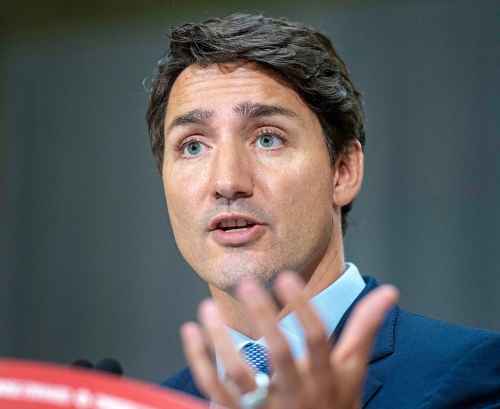
Prime Minister Justin Trudeau said the measures put in place to slow the spread of the virus are working, but warned Canada is not out of the woods yet.

“We’re in the middle of the most serious public health emergency Canada has ever seen and if we lift measures too quickly, we might lose the progress we’ve made,” Trudeau said Tuesday at his regular briefing outside his residence at Rideau Cottage.

He said everyone needs to be very careful to protect themselves and the most vulnerable, like those in long-term care homes.

“How many new cases there are, how many losses we have to mourn, whether our hospitals can continue to cope. It’s all up to all of us,” he said.

This report by The Canadian Press was first published April 28, 2020.

Report Error Submit a Tip

More Stories

A fond farewell to the Hercules

Editorial 4 minute read Preview

A fond farewell to the Hercules

Editorial 4 minute read 2:00 AM CDT

Fans at the NHL’s outdoor Heritage Classic game last weekend were no doubt thrilled by the sight and sound of two CF-18 Hornet fighter jets conducting a flyover at Princess Auto Stadium shortly before the puck was dropped for the much-anticipated Winnipeg Jets/Montreal Canadiens matchup.

Flyovers such as these always create a spectacular scene, as the speed and power of the jets are on full display for the brief moments they’re in view above the stadium bowl. But fans who maintained their skyward gaze for a few seconds after the Hornets’ blink-and-you’ll-miss-it appearance were treated to a much more poignant aeronautical exhibition, as a CC-130H Hercules aircraft passed over the stadium in the fighter jets’ wake.

Compared to the supersonic CF-18s, the massive, propeller-driven transport plane probably seemed to be doing more of a “crawl-over”; what most folks at the outdoor game probably didn’t realize, however, was that this was almost certainly the last time they’ll see one of these ubiquitous Canadian Forces aircraft in the sky.

The CC-130H is being retired after more than half a century as the RCAF’s combat, rescue and transport workhorse. The “Herc” will be replaced by more modern aircraft, including the smaller and more nimble CC-295 Kingfisher, which will be used for search-and-rescue missions out of 17 Wing Winnipeg, beginning next month.

Read
2:00 AM CDT

Letters, Oct. 30

7 minute read 2:00 AM CDT

Embarrassed by turnout

I am ashamed by the poor turnout of voters in the recent municipal election in Winnipeg. Just 38 per cent of eligible voters is a disgrace to the thousands of men and women who gave their lives in past wars, where they were defending democracy and the right to vote.

My grandfather was an infantry soldier in the First World War, and my father-in-law flew in Avro Lancasters in the Second World War. For both I am grateful.

Maybe the 62 per cent that had a flimsy excuse for not voting will keep this mind for the next election. People died for our right to vote.

Just say no (to deficits during good economic times)

Tom Brodbeck 5 minute read Preview

Just say no (to deficits during good economic times)

Tom Brodbeck 5 minute read Wednesday, Oct. 2, 2019

When a political party pledges to run small, “manageable” deficits if elected, it almost always means it will go deeper into the red if it wins government.

It’s human nature.

After all, as a government, if you get the blessing of the public to spend beyond your means, what’s a few billion more a year in overspending?

The problem is, it doesn’t usually end there. When those same politicians seek re-election, they often want permission to post even larger deficits. In some cases, they’ve abandoned the idea of balancing the books altogether, arguing perpetual deficit financing is acceptable, as long as the debt doesn’t exceed a certain percentage of the economy.

Read
Wednesday, Oct. 2, 2019

Fact Check

1 minute read Thursday, Nov. 30, 2023

Fact Check

Having problems with the form?Contact Us Directly |

Wife’s witchy wonderment won’t spell trouble

Maureen Scurfield 6 minute read 2:00 AM CDT

DEAR MISS LONELYHEARTS: My wife believes in magic potions, which used to make me laugh. But since Halloween season started this year, she’s been acting in a way that frightens me. She seems to think she’s a modern-day “witch.” Give me a break!

Now she has three friends who think they are really casting spells when they get together! And this year on Halloween night she’s being formally accepted into their little witchy group meeting at one of their homes, and is getting a new sorceress name. It’s creepy! How do I cope? I’ve had enough of this.

— Seriously Upset, South St. Vital

Dear Upset: Don’t buy into the hocus pocus by being afraid of it and expressing any trepidation to your wife. She needs you to be strong, so she knows she has a solid anchor and can drop out of this witchy group if it becomes too scary or silly for her.

Brian Bowman wins mayoral battle

Aldo Santin and Mary Agnes Welch 6 minute read Preview

Brian Bowman wins mayoral battle

Aldo Santin and Mary Agnes Welch 6 minute read Thursday, Oct. 23, 2014

In the end, it wasn’t even close.

A mayoral race that was supposed to be a head-to-head battle between privacy lawyer Brian Bowman and former NDP MP and MLA Judy Wasylycia-Leis turned into a rout on election night. Wasylycia-Leis, the experienced politician, had held what looked like an unassailable lead for months, but Bowman, the outsider who promised Winnipeggers a better, prosperous future, chipped doggedly away at it.

“I’m excited to tell you that positive change is coming to city hall,” Bowman told roaring supporters at the Inn At The Forks after making his way into the small ballroom accompanied by his wife and two young sons.

He said he hadn’t expecting such a landslide victory, but had believed that the campaign was building momentum.

Read
Thursday, Oct. 23, 2014