Plants ‘operating 24/7’ to meet consumer demand for food amid COVID-19

Advertisement

Advertise with us

Campbell Soup Company's production goes into overdrive during what executives dub "soup season." Starting in October and ending with the close of winter, Campbell's manufacturing centres run non-stop, staffed by extra employees.

Read this article for free:


or

Already have an account? Log in here »

To continue reading, please subscribe:

Subscribe and receive a limited-edition Free Press branded hat or tote.

Digital Subscription

One year of digital access for only $205*

  • Enjoy unlimited reading on winnipegfreepress.com
  • Read the E-Edition, our digital replica newspaper
  • Access News Break, our award-winning app
  • Play interactive puzzles

*First annual payment billed as $205.00 + GST for one year. This annual subscription will automatically renew at $233.00 + GST every 52 weeks (10% off the regular annual price of $259.35). Offer available to new and qualified returning subscribers only. Cancel any time.

To continue reading, please subscribe:

Add Free Press access to your Brandon Sun subscription for only an additional

$1 for the first 4 weeks*

  • Enjoy unlimited reading on winnipegfreepress.com
  • Read the E-Edition, our digital replica newspaper
  • Access News Break, our award-winning app
  • Play interactive puzzles
Start now

*Your next Brandon Sun subscription payment will increase by $1.00 and you will be charged $17.95 plus GST for four weeks. After four weeks, your payment will increase to $24.95 plus GST every four weeks.

Hey there, time traveller!
This article was published 19/04/2020 (2362 days ago), so information in it may no longer be current.

Campbell Soup Company’s production goes into overdrive during what executives dub “soup season.” Starting in October and ending with the close of winter, Campbell’s manufacturing centres run non-stop, staffed by extra employees.

Since the arrival of the COVID-19 pandemic, consumer demand has soared, eclipsing that of the company’s busiest time. In March, there were more orders during one week than are typically seen in the entire month.

“Our plants are operating 24/7 right now, which is fairly unusual for April, to be honest,” said Beth Jolly, vice-president of communications at the company’s meal and beverages division, which includes Campbell Canada. “It’s really just been a dramatic shift to a full-out production increase.”
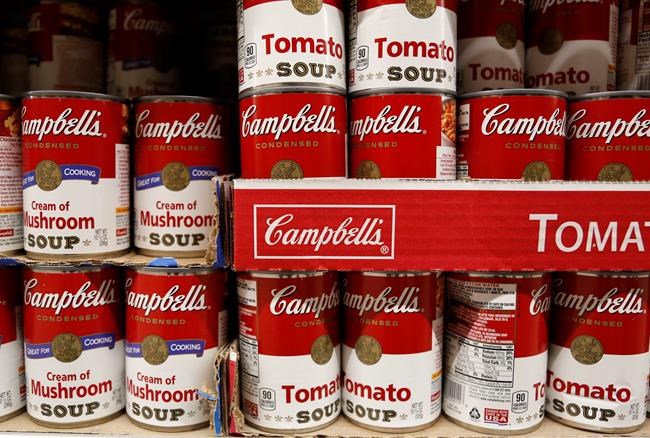
Cans of Campbell's soup are displayed at a supermarket in Englewood, N.J. on May 22, 2017. Since the arrival of the COVID-19 pandemic, consumer demand has soared, eclipsing that of Campbell Soup Company's busiest time. In March, there were more orders during one week than are typically seen in the entire month. THE CANADIAN PRESS/AP, Seth Wenig

Demand for food, particularly non-perishable products, has surged as physical distancing measures keep Canadians close to home. Grocers are ordering more from manufactures, who like Campbell have hired more workers, increased operating hours and enacted other measures to increase production.

At Campbell’s, weekly case orders for that one week in March jumped about 366 per cent at the company’s meal and beverage division, Jolly said.

Kraft Heinz Canada, meanwhile, reported an 80 per cent increase in demand for its signature Kraft Dinner product last month compared to March 2019, the company says.

To meet that demand, both manufacturers had to make several changes to ramp up production.

Kraft’s Montreal-area production facility — where more than 90 per cent of its food for the Canadian market is produced — now operates 24 hours a day, seven days a week, said Av Maharaj, chief administrative officer for Kraft Heinz Canada.

The company is considering new ways to increase efficiency. It may prove simpler to produce only one type of packaging for Kraft Dinner rather than a variety of box designs, Maharaj said.

“From an efficiency perspective — you don’t want to stop your line, change packaging, build out the other one for a smaller packaging line,” he said. “But rather, produce the most popular brand, popular size and that gets more product to the market.”

More difficult is changing production lines. Demand is down from food service clients, such as restaurants and hotels. But transforming a food service production line to one making grocery products is not so simple.

“In many ways, it’s like, you know, a giant Lego system where every piece is connected,” said Maharaj.

It can be very expensive to switch a production line and take months to do, he said.

“You can’t sort of switch overnight from one product to the next.”

The company has been in talks to see if any of its food service products, such as single-serve peanut butter packets, can be sold at grocery stores.

Campbell’s, meanwhile, is trying to focus more on its most popular varieties of soup.

“It’s a bit of a balance,” said Jolly, since the company has to ensure it has enough ingredients to match the increased production.

“It’s not as if we can just put out chicken noodle and tomato.”

Campbell’s also dipped into its existing stockpiles. The company had about 1.5 million cans with limited-edition Andy Warhol labels ready to release in May, but decided to forgo the promotional activity and release the product in April to address demand.

These changes allowed the companies to make more of their products quicker.

Kraft typically makes about seven million Kraft Dinner boxes a month, according to the company. Last month, it made roughly 15 million.

Once the product is made another challenge is getting the extra goods to distribution centres and eventually grocery stores.

“Most food manufacturers don’t own their own trucks,” said Maharaj, and Kraft hires local trucking firms to transport its goods from production facilities to distribution centres.

“Very often, that can be a bottleneck because everyone needs trucks right now to get food out the door,” he said, noting the company’s logistics team has been working hard and “for the most part, we’ve been able to find the trucks that we need.”

In some cases, Kraft is bypassing distribution centres entirely and instead shipping straight to grocers.

“That’s one of the ways we’re speeding up getting product to customers.”

This story by The Canadian Press was first published April 19, 2020.

Report Error Submit a Tip

More Stories

Wasteful operations should be held accountable

Barry E. Prentice 5 minute read Preview

Wasteful operations should be held accountable

Barry E. Prentice 5 minute read Yesterday at 2:00 AM CDT

Rising water bills are a top-of-mind issue for residents of Winnipeg going into the fall election. Management of the water and waste system is under question, with citizen’s groups, as well as the Free Press, calling for proper oversight of rates (Time for the PUB to review Winnipeg water rates, Editorial, Sept. 26).

The need to increase rates to build the North End sewage plant is understandable. Siphoning off utility proceeds to make up other tax revenue shortfalls is another matter. But it is not the only questionable practice. If there was Public Utilities Board oversight of Winnipeg’s water and sewer rates, it would certainly be asking why the city is spending more than $3 million annually to operate the 164-kilometre-long, Greater Winnipeg Water District railway (GWWD) on ratepayers’ behalf.

The GWWD has come to the attention of the Railway Relocation Study, led by Lloyd Axworthy. All existing rail lines within the city are under review, as is the feasibility of a new railway bypass.

The GWWD is an example of a railway that has outlived its usefulness and sits on a pocket of land close to downtown that could be converted to higher-value uses.

Read
Yesterday at 2:00 AM CDT

Residents reeling after man shot, killed by police

Nicole Buffie 5 minute read Preview

Residents reeling after man shot, killed by police

Nicole Buffie 5 minute read Thursday, Oct. 3, 2024

Van Ho was inside his sixth-floor Main Street apartment when he heard a ruckus in the hall around noon Wednesday afternoon.

Ho looked out his window to see police and emergency vehicles surrounding the 10-storey North Point Douglas Manor. When he peeked into the hallway, he saw the body of his next-door neighbour being carried away.

“I thought somebody was fighting, then I open my door and that’s what I see,” Ho saidThursday afternoon.

The Vietnamese immigrant moved to the building four years ago. He said his neighbour, who has not been identified, moved into the Manitoba Housing complex about two months ago, but often caused excessive noise at night and kept him awake.

Read
Thursday, Oct. 3, 2024

Odermatt wins super-G, keeps season title hopes alive

The Associated Press 3 minute read Preview

Odermatt wins super-G, keeps season title hopes alive

The Associated Press 3 minute read Sunday, Mar. 7, 2021

SAALBACH-HINTERGLEMM, Austria - Marco Odermatt dominated the penultimate men’s World Cup super-G of the season Sunday to keep himself in the race for the discipline title.

The Swiss skier finished his gutsy run on the Schneekristall course 0.62 seconds ahead of runner-up Matthieu Bailet.

The Frenchman was the 2016 junior world champion and earned his first podium result on the World Cup circuit.

Vincent Kriechmayr, the double world champion from Austria, trailed Odermatt by 0.81 in third, a day after he won the downhill on the same hill. Another Austrian, Raphael Haaser, finished two-hundredths behind Kriechmayr in fourth.

Read
Sunday, Mar. 7, 2021

Letters, Oct. 6

6 minute read 2:00 AM CDT

High road not so easy

Re: Khan should’ve taken high road: Goertzen (Oct. 3)

Politics is a tough game. Just ask former provincial Liberal leader Dougald Lamont. He got thrown under the bus by a prominent Manitoba/Canadian Liberal who advised people to vote NDP in the last provincial election.

As Lamont said when he lost the election, he is “human” and what happened to him “hurt.” Khan is also human. It is easy to criticize him for not taking the “high road.”

Tokyo Olympic aftermath still being untangled a year later

Stephen Wade, The Associated Press 7 minute read Preview

Tokyo Olympic aftermath still being untangled a year later

Stephen Wade, The Associated Press 7 minute read Thursday, Jul. 21, 2022

TOKYO (AP) — The Tokyo Olympics survived the COVID-19 postponement, soaring expenses and some public opposition. A year later, the costs and benefits remain as difficult to untangle as the Games were to pull off.

In his speech at the closing ceremony, IOC President Thomas Bach said a major accomplishment of the Games was simply reaching the end.

“We did it,” Bach said. “We did it together," he repeated, crediting the athletes, Japanese government officials, and deep-pocketed broadcasters for refashioning the Games despite no fans, disappointed sponsors, and no buzz around the city.

Organizers said the Games would drive tourism, showcase Japan's technological prowess, and create memories similar to the 1964 Tokyo Olympics. The pandemic erased that.

Read
Thursday, Jul. 21, 2022

Ribbon cutting marks new roads, buildings start in Water Tower District

Matthew Frank 4 minute read Preview

Ribbon cutting marks new roads, buildings start in Water Tower District

Matthew Frank 4 minute read Yesterday at 7:03 PM CDT

Work is underway transforming land previously home to the massive Canada Packers building into St. Boniface’s latest development.

Alberta-based Olexa Developments and Winnipeg’s Shindico Realty Inc. held a ribbon-cutting ceremony on Monday to unveil the names of two completed streets running through the new Water Tower District and mark the start of building construction.

Crews broke ground last month on the first multifamily residential building, which is expected to have 500 units. The developers have City of Winnipeg approval for 2,800 units across the 165-acre community, up from the previous 2,000-unit limit.

Dan Cristall, founder and CEO of Olexa, said the project has high potential because it can utilize existing infrastructure by being an inner-city development.

Read
Yesterday at 7:03 PM CDT