Canadians reporting more wildlife sightings during COVID-19 isolation

Advertisement

Advertise with us

MONTREAL - When Josianne Plante looked out her window on a recent morning, she was surprised to see a pair of large, bare-headed wild turkeys going for a stroll through her east-end Montreal neighbourhood.

Read this article for free:


or

Already have an account? Log in here »

To continue reading, please subscribe:

Subscribe and receive a limited-edition Free Press branded hat or tote.

Digital Subscription

One year of digital access for only $205*

  • Enjoy unlimited reading on winnipegfreepress.com
  • Read the E-Edition, our digital replica newspaper
  • Access News Break, our award-winning app
  • Play interactive puzzles

*First annual payment billed as $205.00 + GST for one year. This annual subscription will automatically renew at $233.00 + GST every 52 weeks (10% off the regular annual price of $259.35). Offer available to new and qualified returning subscribers only. Cancel any time.

To continue reading, please subscribe:

Add Free Press access to your Brandon Sun subscription for only an additional

$1 for the first 4 weeks*

  • Enjoy unlimited reading on winnipegfreepress.com
  • Read the E-Edition, our digital replica newspaper
  • Access News Break, our award-winning app
  • Play interactive puzzles
Start now

*Your next Brandon Sun subscription payment will increase by $1.00 and you will be charged $17.95 plus GST for four weeks. After four weeks, your payment will increase to $24.95 plus GST every four weeks.

Hey there, time traveller!
This article was published 19/04/2020 (2357 days ago), so information in it may no longer be current.

MONTREAL – When Josianne Plante looked out her window on a recent morning, she was surprised to see a pair of large, bare-headed wild turkeys going for a stroll through her east-end Montreal neighbourhood.

“They were just walking down the street and sidewalk like nothing was happening,” the Pointe-aux-Trembles resident said in a recent interview.

“I’ve never seen anything like that before here.”
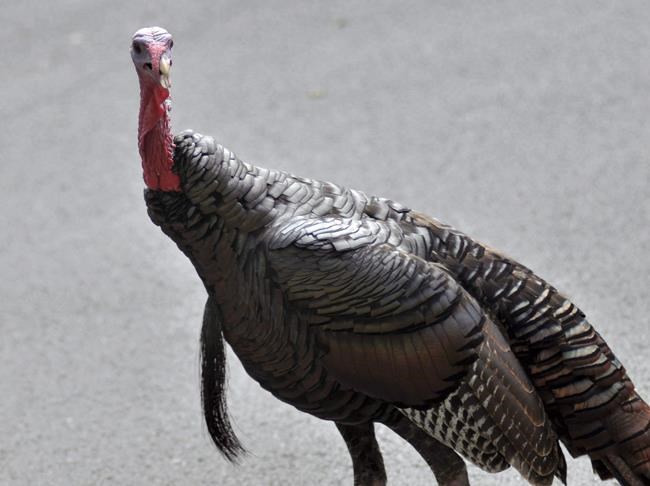
A wild turkey walks through a residential neighborhood in Brookline, Mass. on Sept. 27, 2017. When Josianne Plante looked out her window on a recent morning, she was surprised to see a pair of large, bare-headed wild turkeys going for a stroll through her east-end Montreal neighbourhood. THE CANADIAN PRESS/AP/Collin Binkley

With countries around the world on lockdown due to COVID-19, many people have been reporting seeing more wildlife, and Canada is no exception.

David Rodrigue, the executive director of the Ecomuseum Zoo in Ste-Anne-de-Bellevue, Que., says there has been an uptick in sightings of common urban species such as skunks, raccoons, white-tailed deer, rabbits and foxes in the greater Montreal area since the pandemic began.

He said that fewer vehicles and quieter streets and parks likely mean normally shy animals are roaming more freely.

“That lessens the pressure of disturbance on those animals, who seem to be wandering more,” he said.

Rodrigue said that for the most part, the animals being noticed are those which were already present in the city, although the turkeys are an exception.

“They’re a very wary species and they’re hard to approach,” he said.

“That some of them came into an urban setting speaks volumes about the effect of fewer people walking around.”

He said he’s heard reports of birds flocking in large numbers in normally busy areas, including Montreal’s Old Port.

Perhaps surprisingly, coyotes, which have grabbed headlines in Montreal in recent years, haven’t been sighted in higher numbers. The most frequently spotted? Rats.

Increased sightings of wildlife have been occurring all across Canada, according to James Page of the Canadian Wildlife Federation.

Page said there were 15,000 new sightings reported in the first days of April at inaturalist.ca, an online database that allows citizens to input their plant and animal observations, compared to 9,500 for the same period last year.

But Page, a species at risk and biodiversity specialist, says it’s too early to talk about a “re-wilding” of cities or of nature bouncing back.

He said that while animals are probably more visible, part of the increase is likely because people are staying home due to the pandemic, and therefore are more likely to spot wildlife.

Marie-Eve Muller, a spokeswoman for the Quebec-based Group for Research and Education on Marine Mammals, said it’s too soon to know if a reduction in boat traffic could have a positive impact on marine mammals.

She said shipping traffic in the St-Lawrence River hasn’t diminished so far, but a reduction in pleasure boats and whale-watching could be beneficial to whales, which are known to be disturbed by engine noise and vibrations.

Both Page and Rodrigue said it remains to be seen whether there will be a lasting effect on animal populations.

In the short term, they say less disturbance during breeding season could allow some species to raise larger litters, while a reduction in vehicle traffic could reduce fatal collisions.

But Page said that the human impact on animals is still enormous, including from roads and dams that cut through their habitats.

Rodrigue and Page suggest people keep garbage containers sealed and avoid feeding wild animals, which often causes them problems down the line.

But both experts say that seeing wildlife can offer people a rare bright spot in a difficult time, and give us a small glimpse of what the world could looks like with better cohabitation.

“Maybe it can give us a pause to think about our relationship with nature and what it could look like, going forward,” Page said.

This report by The Canadian Press was first published April 19.

Report Error Submit a Tip

More Stories

Prairie sculptor Joe Fafard pays tribute to revered Dutch master

Alan Small 6 minute read Preview

Prairie sculptor Joe Fafard pays tribute to revered Dutch master

Alan Small 6 minute read Tuesday, Jul. 10, 2018

Vincent van Gogh has been inspiring artists for close to 150 years. For sculptor Joe Fafard, the Dutch master’s life and art have been objects of fascination for many of his 75 years.

So much so that Fafard’s latest Winnipeg exhibition, The Essential Joe Fafard — Van Gogh and Other Inspirations, which opened Friday at Mayberry Fine Art, includes several sculptures of van Gogh, who began painting in 1881 but lived a short, turbulent life, fraught with mental illness, before committing suicide in 1890 at the age of 37.

“Starting about 1983, I started doing portraits of van Gogh,” Fafard says in a phone conversation from his home near Regina.

“Essentially, people used his life, his career and his anguish as sort of a stereotype of an artist’s blueprint for artistic endeavour. I became quite fascinated to see that he was the Christ and other artists were the apostles.”

Read
Tuesday, Jul. 10, 2018

Gillingham talks trash, pledges big bin boost

Joyanne Pursaga 4 minute read Preview

Gillingham talks trash, pledges big bin boost

Joyanne Pursaga 4 minute read 2:01 AM CDT

Scott Gillingham says he would add hundreds of locked garbage bins downtown to prevent unsightly trash piles if re-elected as mayor.

Gillingham led a program that added about 120 locked garbage bins along Portage Avenue and Main Street last fall, after trash was repeatedly strewn around the area. If he wins a second term, he plans to add at least 200 more of the receptacles.

A look at how one locked Main Street recycle/garbage bin in front of city hall fared offers an example of the bins’ success so far, he said.

“Every day, you would see the lids up, and people had been rifling through it, or someone left the lid up and the wind picked up the garbage and (spread) it everywhere. It’s much more difficult now. Once the garbage is in, the garbage stays in,” said Gillingham.

Read
2:01 AM CDT

Stable incomes, not more weapons, provide security

David Olive - Star Business Columnist, Toronto Star 5 minute read Preview

Stable incomes, not more weapons, provide security

David Olive - Star Business Columnist, Toronto Star 5 minute read Thursday, Apr. 7, 2022

Even amid a global arms race, a hike in Canadian defence spending should be a tough sell, David Olive writes.

Read
Thursday, Apr. 7, 2022

Winnipeg, source d’inspiration pour la philanthropie canadienne

Camille Harper 7 minute read Preview

Winnipeg, source d’inspiration pour la philanthropie canadienne

Camille Harper 7 minute read Saturday, Sep. 19, 2026

Dirigé par le Franco-Manitobain d’origine Jean-Marc Mangin, l’organisme Fondations philanthropiques du Canada (FPC) sera à Winnipeg du 23 au 25 septembre prochains pour sa conférence nationale, organisée tous les deux ans. Une première pour FPC, et un retour au bercail attendu pour son président-directeur général.

Pour la première fois depuis 26 ans que l’organisme existe, FPC a choisi le Manitoba pour sa grande conférence nationale de 2026. “On a été dans plusieurs gros centres urbains du Canada, notamment Ottawa, Montréal, Toronto, Vancouver ou encore Calgary, mais ce sera notre première fois à Winnipeg,” se réjouit le PDG de FPC, Jean-Marc Mangin, lui-même originaire de Saint-Boniface.

Ce n’est toutefois pas la nostalgie de l’enfance qui a fait pencher la balance en faveur du Manitoba, mais plutôt un vent de changement observé par bon nombre dans la capitale manitobaine.

“Nous ne sommes pas les seuls dans le secteur caritatif à choisir Winnipeg,” constate Jean-Marc Mangin. “Plusieurs organismes y tiennent leurs conférences nationales cette année ou la suivante. Et ça, ça dit quelque chose sur ce qui se passe au Manitoba : c’est très actif, il y a beaucoup d’innovation sociale qui prend place.”

Read
Saturday, Sep. 19, 2026

Crusaders football celebrates 95th anniversary

Joshua Frey-Sam 4 minute read Preview

Crusaders football celebrates 95th anniversary

Joshua Frey-Sam 4 minute read Friday, Sep. 25, 2026

Few understand better than Stacy Dainard how steeped the St. Paul’s High School football program is in history.

The head coach of the Crusaders’ varsity team for the last 25 years has watched the institution’s presence on the gridiron blossom over four decades since he donned the maroon and white as a player from 1984-87.

Dainard figures he will harken back to those days more this weekend when a flock of Crusaders alumni from across the country gather to commemorate the football program’s 95th anniversary.

“We were a competitive team. We had some very committed coaches and some very committed student-athletes,” said Dainard, who reached the provincial championship in each of his first three seasons as a student-athlete. “It was a good time. Football wasn’t as big as it is now, or at least high school football wasn’t as big as it is now. But it was a very competitive league.”

Read
Friday, Sep. 25, 2026

Twenty-seven new COVID cases in New Brunswick

The Canadian Press 2 minute read Preview

Twenty-seven new COVID cases in New Brunswick

The Canadian Press 2 minute read Thursday, Jan. 28, 2021

FREDERICTON - New Brunswick is reporting 27 new cases of COVID-19 today, including 14 in the hard-hit Edmundston region, which has been under lockdown since Sunday.

Health officials say 11 new cases were identified in the Moncton area and two in the Saint John region.

Moncton remains at the red pandemic-alert level while the rest province — outside Edmundston — is at the lower, orange level.

Indoor and outdoor gatherings are prohibited in Edmundston as is non-essential travel in and out of the region.

Read
Thursday, Jan. 28, 2021