COVID expected to kill thousands just in Ontario even with stiff restrictions

Advertisement

Advertise with us

TORONTO - As known COVID-19 cases rose nationally and almost all construction in the country's economic heartland was idled on Friday, health authorities in Ontario said the death toll in that province alone could be kept below a still-staggering 15,000 — if stringent isolation measures prove effective in curbing the pandemic.

Read this article for free:


or

Already have an account? Log in here »

To continue reading, please subscribe:

Subscribe and receive a limited-edition Free Press branded hat or tote.

Digital Subscription

One year of digital access for only $205*

  • Enjoy unlimited reading on winnipegfreepress.com
  • Read the E-Edition, our digital replica newspaper
  • Access News Break, our award-winning app
  • Play interactive puzzles

*First annual payment billed as $205.00 + GST for one year. This annual subscription will automatically renew at $233.00 + GST every 52 weeks (10% off the regular annual price of $259.35). Offer available to new and qualified returning subscribers only. Cancel any time.

To continue reading, please subscribe:

Add Free Press access to your Brandon Sun subscription for only an additional

$1 for the first 4 weeks*

  • Enjoy unlimited reading on winnipegfreepress.com
  • Read the E-Edition, our digital replica newspaper
  • Access News Break, our award-winning app
  • Play interactive puzzles
Start now

*Your next Brandon Sun subscription payment will increase by $1.00 and you will be charged $17.95 plus GST for four weeks. After four weeks, your payment will increase to $24.95 plus GST every four weeks.

Hey there, time traveller!
This article was published 03/04/2020 (2378 days ago), so information in it may no longer be current.

TORONTO – As known COVID-19 cases rose nationally and almost all construction in the country’s economic heartland was idled on Friday, health authorities in Ontario said the death toll in that province alone could be kept below a still-staggering 15,000 — if stringent isolation measures prove effective in curbing the pandemic.

In a sobering presentation, a top health official said the coronavirus might have killed as many as 100,000 people in Ontario had economy-crushing restrictions not been imposed.

“If we do everything that we can think of — everything that already has been done stays in place (and) all of the other measures which are being considered (are) put in place — I think we could reduce the death toll in Ontario to somewhere between 3,000 and 15,000,” said Dr. Peter Donnelly, head of Public Health Ontario.
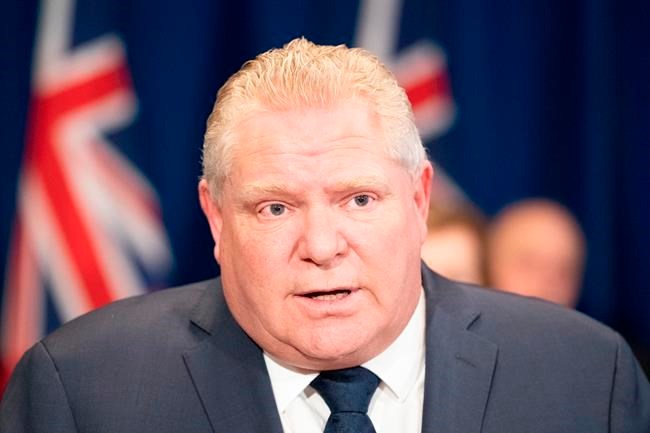
Ontario Premier Doug Ford answers questions during the daily briefing on the COVID-19 pandemic at Queen's Park in Toronto on Thursday April 2, 2020. THE CANADIAN PRESS/Frank Gunn

The latest data indicate more than 12,000 Canadians have contracted the virus. Of those, about 180 have died, but the numbers could be higher given gaps in reporting.

Ontario released its worst-case projections for the COVID-19 as its known caseload — and those of other provinces — climbed again. The province has now seen 3,255 cases and 67 deaths.

Given the “extremely serious” situation, Premier Doug Ford announced a halt to almost all industrial construction.

“We’ve told the vast majority of Ontario’s work force to stay home,” a grim Ford said. “Lives are on the line.”

The pandemic and the unprecedented stay-at-home measures to fight it have taken a brutal toll on the economy and jobs, with no sign of near-term improvement.

Prime Minister Justin Trudeau announced the latest in a string of federal measures to cushion the blow: More aid to low-income people will flow through the GST credit this month, rather than in May. Qualifying adults will receive up to $300, plus $150 for each child.

Trudeau also said the military would move into northern Quebec, at the province’s request, to help remote communities cope.

Canada’s top public health official, Dr. Theresa Tam, noted a sharp increase in deaths but said the health-care system was coping. The national death rate stands at about one per cent of those testing positive.

British Columbia, with 31 deaths, had previously projected its worst case would see a shortage of about 182 intensive care beds and at least 38 ventilators. But it also said distancing measures appeared to have mitigated that threat. Donnelly said Ontario was more closely tracking the hard-hit United States than B.C.

Quebec, which reported 25 more deaths on Friday for a total of 61 and a caseload of more than 6,000, said medical authorities would present COVID projections on Tuesday. New Brunswick, Nova Scotia and Prince Edward Island said they would also do so next week.

Overall mortality among those 80 years and older in Ontario has reached 20 per cent in coronavirus cases. A hard-hit nursing home in Bobcaygeon, Ont., reported four more resident deaths on Friday, bringing the toll to 20 at the 65-bed facility.

Experts advise frequent hand-washing and staying at least two metres from others to save the health-care system from overload. Front-line doctors have expressed worry about having to choose who lives and who dies if crucial ventilators run short.

In a tribute to health-care personnel, all ships in B.C. waters planned to sound their horns at 7 p.m. local time. Toronto’s CN Tower has been lighting up blue in a similar show of solidarity.

Health Minister Patty Hajdu late Thursday stood by her earlier estimate that between 30 per cent and 70 per cent of Canadians will likely become infected.

“Having 70 per cent of people get COVID is not the end of the world,” Hajdu said. “It is, though, if it all happens at once. And that’s what we’re trying to prevent.”

Globally, the pandemic has infected more than one million people and killed more than 58,000, according to the latest official figures. Italy, with almost 15,000 deaths and Spain with about 11,000, have been hit hardest. The United States, however, leads the world in cases — a quarter of a million to date — and has reported more than 6,000 deaths.

—with files from Canadian Press reporters across the country.

This report by The Canadian Press was first published April 3, 2020.

Report Error Submit a Tip

More Stories

Uber bans city driver facing sexual assault charge

Matthew Frank 2 minute read 12:43 PM CDT

A Winnipeg Uber driver has been permanently banned from the platform after police charged the man for allegedly sexually assaulting a passenger last month.

A woman reported that she used the ride service on Sept. 27 and the 27-year-old driver sexually assaulted her once the vehicle reached its destination in the Weston neighbourhood, the Winnipeg Police Service said in a news release.

Police said the woman was able to escape and get to safe place. The driver was arrested on Sept. 28 at an apartment complex on Kennedy Street. He was later released with conditions.

An Uber spokesperson said the driver is permanently banned, and the company is assisting police with the investigation.

Messing credits teammates for support

Lori Ewing, The Canadian Press 6 minute read Preview

Messing credits teammates for support

Lori Ewing, The Canadian Press 6 minute read Friday, Jan. 17, 2020

MISSISSAUGA, Ont. - The rink had always felt like home for Keegan Messing. But in the days and weeks after his brother's death, the Canadian figure skater struggled to find solace on the ice.

In a sport that requires steely nerves to reel off big jumps, and the ability to dig deep to push through searing pain, Messing had lost his will.

"It was the question of: why am I doing this?" Messing said. "In the grand scheme of life, it was: should I still do this? Can I still do this?"

Less than four months after his younger brother Paxon died in a motorcycle crash in Anchorage, Messing is aiming for his first national title at the Canadian figure skating championships, and a spot on the world championship team. He credits fellow Canadian skaters Nam Nguyen and Piper Gilles for getting him to the start gate.

Read
Friday, Jan. 17, 2020

Horoscope

Georgia Nicols 4 minute read Preview

Horoscope

Georgia Nicols 4 minute read Tuesday, Sep. 29, 2026

Moon alert: Avoid shopping (except food and gas) and important decisions until 1 p.m. After that, there are no restrictions to shopping or important decisions. The moon is in Gemini.

Aries (March 21-April 19)

A busy, chatty day. Your communication skills are excellent. Wait until the moon alert is over to commit to any important decisions or ideas. Tap into your creative talents. It’s also a lovely day to schmooze and enjoy sports and kids’ activities.

Taurus (April 20-May 20)

Read
Tuesday, Sep. 29, 2026

This week’s silly geopolitical spat

Gwynne Dyer 4 minute read 2:01 AM CDT

“I would not like to call this an incident. Let’s say it’s a diplomatic misunderstanding,” said Ukrainian Foreign Affairs Minister Andrii Sybiha. But the South Korean president definitely sees it as a serious incident, and he has already gone public with it.

“If (Ukraine’s) refusal to acknowledge the facts and issue a public apology continues, we will take additional measures,” President Lee Jae-myung wrote on X. He probably means cutting the non-military aid South Korea gives to Ukraine. (There is no military aid, since the constitution bans Seoul from providing arms to a country actively involved in a war).

What monstrous misdeed did the Ukrainian government commit to deserve such harsh words from a country that is generally sympathetic to Ukraine’s struggle against its giant neighbour? Have the South Koreans discovered Ukrainian spies in the Blue House?

No, it’s what we professionals call a “spat.”

Climate change a clear and present danger to the already-shrinking polar bear population

Sarah Lawrynuik 18 minute read Preview

Climate change a clear and present danger to the already-shrinking polar bear population

Sarah Lawrynuik 18 minute read Friday, Oct. 30, 2020

The rocks fly out from beneath the tires of Angela Mak’s Ford F-150 as she cruises down the gravel road along the coast of Hudson Bay just east of Churchill.

It’s a routine. Every day from July until November she comes out here looking for polar bears.

Mak and her husband Bill Fong are originally from Hong Kong, but moved to Vancouver in the early ‘90s. In 2017 they travelled to Churchill during bear season — October and November, when the bears move out onto the sea ice.

After that one trip, their hearts were set on Churchill. First they bought a house in town to host friends and other guests, then they bought a small hotel when it went on the market in 2019.

Read
Friday, Oct. 30, 2020

Letters, Oct. 7

6 minute read 2:01 AM CDT

On diet and humanity

Re: “Maybe ASI will need us” (Letters, Oct. 5)

Mr. Martin, humans eating animals is not part of the circle of life. Many cultures with abundant plant resources, or for religious beliefs, have historically subsisted on largely or strictly vegetarian diets. Likewise, in extreme environments such as the Arctic, Inuit rely heavily on animal products due to the near-absence of arable land. Humans adapt locally to their environments and do not have a single ancestral diet.

Clearly vegetarian or vegan diets are not fringe, as evidenced by plant-based products on main-stream grocery store shelves. To suggest the Free Press is morally endorsing a fringe diet is rubbish, (the newspaper) merely gives the public a platform for diverse opinions, thus generating individual, thought-provoking ideas and conversations — a practice that is desperately needed these days.