WEATHER ALERT

Ontario doctor rigs up solution to double ventilator capacity in rural hospital

Advertisement

Advertise with us

OTTAWA - A doctor in Ontario has improvised a way to double his small hospital's ventilator capacity in preparation for a possible COVID-19 outbreak.

Read this article for free:


By clicking the button above, an account will be created and you will begin to receive some of our recommended newsletters. You may opt out of any newsletter by visiting your Email and Communication Preferences page or by clicking "unsubscribe" at the bottom of any email.

or

Already have an account? Log in here »

To continue reading, please subscribe:

Digital Subscription

One year of digital access for only $1.44 a week*

  • Enjoy unlimited reading on winnipegfreepress.com
  • Read the E-Edition, our digital replica newspaper
  • Access News Break, our award-winning app
  • Play interactive puzzles

*Billed as $5.77 plus GST every four weeks. After 52 weeks, price increases to the regular rate of $19.95 plus GST every four weeks. Offer available to new and qualified returning subscribers only. Cancel any time.

To continue reading, please subscribe:

Add Free Press access to your Brandon Sun subscription for only an additional

$1 for the first 4 weeks*

  • Enjoy unlimited reading on winnipegfreepress.com
  • Read the E-Edition, our digital replica newspaper
  • Access News Break, our award-winning app
  • Play interactive puzzles
Start now

*Your next Brandon Sun subscription payment will increase by $1.00 and you will be charged $17.95 plus GST for four weeks. After four weeks, your payment will increase to $24.95 plus GST every four weeks.

Hey there, time traveller!
This article was published 18/03/2020 (2420 days ago), so information in it may no longer be current.

OTTAWA – A doctor in Ontario has improvised a way to double his small hospital’s ventilator capacity in preparation for a possible COVID-19 outbreak.

Anesthetist Dr. Alain Gauthier, who has a PhD in respiratory mechanics and works in Perth, west of Ottawa, spotted the idea in a YouTube video.

In basic terms, the rig involves running two hoses from one ventilator and doubling the power.
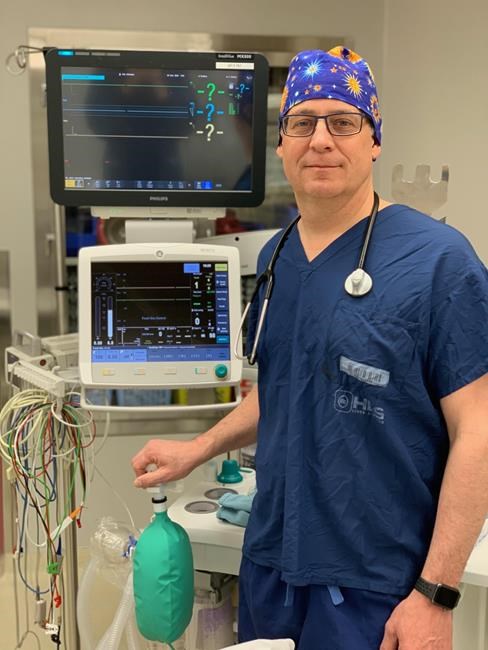
Dr Alain Gauthier is shown in a handout photo. Gauthier has improvised a way to double his rural hospital's ventilator capacity in preparation for a possible COVID-19 outbreak. THE CANADIAN PRESS/HO-Alian Gauthier MANDATORY CREDIT

In just ten minutes with the help of some extra tubing, Gauthier made it possible to double the number of patients ventilated in the hospital at once, if needed.

But there’s a catch: the two patients attached to the same ventilator need to be of similar size and lung capacity. And if one patient declines things will need to be adjusted.

It’s not perfect, but as Gauthier put it, “if it comes to last resort, I’m prepared to use it.”

Gauthier said the population the Perth and Smiths Falls District Hospital serves may be at greater risk if hit with the COVID-19 outbreak. Many of the 60,000 people in the region are older, with underlying health conditions like diabetes and chronic pulmonary disease.

His hospital recently received four new ventilators, and keeps four old ones in reserve that are still functioning, but can’t be repaired if they break down.

In a rural health-care setting, the hospital’s ability to increase its surge capacity may be limited in the event of a widespread outbreak.

The idea to double up patients on a single ventilator was studied in theory by American Drs. Greg Neyman and Charlene Babcock in 2006. It was tried once, successfully, in the aftermath of the 2017 mass shooting of the Route 91 harvest music festival in Las Vegas.

Babcock, an emergency physician in Michigan, created a how-to video on YouTube to help doctors around the world respond to COVID-19. That’s where Gauthier got the idea.

The goal, Gauthier said, is to avoid the kinds of difficult ethical decisions facing Italian physicians who have had to choose which critical patients should get a ventilator, because there aren’t enough to go around.

His efforts speak to the lengths doctors across the country are going to prepare their hospitals and staff for the worst-case scenario, a sudden onslaught of COVID-19 cases, he said.

“We are concerned, we’re trying to get ready as much as possible,” he said.

His colleagues were incredibly enthusiastic about his ability to potentially double the ventilator capacity of the hospital, he said.

Dr. Alan Drummond, an emergency physician at the hospital, said he even broke social distancing protocol to give Gauthier a hug.

But Gauthier said he wants no credit.

He said he’s only doing what every Canadian health care worker is doing right now: trying to brace for what’s to come.

“A lot of work is being done by pretty much everyone,” he said.

The federal government is also ordering additional ventilators, which will be distributed to provincial and territorial health authorities.

This report by The Canadian Press was first published March 18, 2020.

Report Error Submit a Tip

More Stories

Say What?! Sports guys travel to new destination

Steve Lyons and Paul Wiecek 16 minute read Preview

Say What?! Sports guys travel to new destination

Steve Lyons and Paul Wiecek 16 minute read Thursday, Jan. 30, 2020

Say What?! is an email conversation between sports editor Steve Lyons and sports columnist Paul Wiecek. Look for us regularly but intermittently on the Free Press website.


Steve Lyons: Heya. How you doing? How’s 2020 treating you so far?

Few things to get us started:

Read
Thursday, Jan. 30, 2020

Fact Check

1 minute read Thursday, Nov. 30, 2023

Fact Check

Having problems with the form?Contact Us Directly |

Winnipeg novelist's latest offering a riveting fictional account of missionaries' plight

Reviewed by Julienne Isaacs 5 minute read Preview

Winnipeg novelist's latest offering a riveting fictional account of missionaries' plight

Reviewed by Julienne Isaacs 5 minute read Saturday, Sep. 7, 2019

In 1955, five American missionary couples set out to evangelize the Waorani, an Indigenous people group of the Ecuadorian rainforest that had never had contact with the outside world. They dubbed their mission “Operation Auca.”

After a few months of airdropping gifts, the five men — Jim Elliot, Peter Fleming, Nate Saint, Ed McCully and Roger Youderian — opted to set up camp on a beach near a Waorani settlement. Just a few days later, they were all speared to death. Thanks to the swift arrival of a Life magazine photographer, the brutal conclusion to Operation Auca became global news.

In her new novel, Five Wives, Winnipeg writer Joan Thomas tells this story again.

“In the missionaries’ memoirs, ‘God’s leading’ explains almost every impulse,” Thomas writes in a postscript. “I set out to peer behind that, to explore in human terms actions that astonished me.”

Read
Saturday, Sep. 7, 2019

Imperialist crusades: 21st-century style

John R. Wiens 5 minute read Preview

Imperialist crusades: 21st-century style

John R. Wiens 5 minute read Wednesday, Jul. 8, 2026

In the 11th century and lasting into the 13th, the papacy launched a series of at least eight military campaigns we now refer to as the Crusades, or Holy Wars. They were an imperialistic call to arms for Christians to retake Jerusalem, which was at the time under Muslim rule.

Spiritual rewards for participation were implied, and other incentives offered, to dull the extra taxation demanded to fund the campaigns. Over time, the “crusades” morphed to become massacres of not only Muslims but also Jews and Christian dissidents — in other words, any enemies of the papacy. If today’s news sounds like déjà vu all over again, it probably should.

The stories keep repeating themselves in many forms. We now know that two 20th century world wars, global in scope, were caused by imperialistic ambitions, changes in the balance of international powers and corresponding arms races. The first was attributed to the assassination of the heir to the Austro-Hungarian throne by a Bosnian Serb, a kind of “regime change” initiative. The second resulted from rising tensions between Allied and Axis powers, triggered by the rise of European fascism and Japanese militarism. The human toll of both was unimaginable.

In the First World War, 15 to 22 million people, including soldiers and civilians, were killed and another 23 million were wounded. These numbers do not account for those otherwise affected — victims of chemical warfare whose compromised health shortened their lives; of the subsequent Spanish flu epidemic amplified by the displacement of peoples; others who died from other diseases caused by war conditions; and those who were malnourished or starved. Nor do they account for the ongoing trauma and resentments passed on intergenerationally to this day.

Read
Wednesday, Jul. 8, 2026

SNC planned U.S. move if no deal: documents

Jordan Press and Christopher Reynolds, The Canadian Press 5 minute read Preview

SNC planned U.S. move if no deal: documents

Jordan Press and Christopher Reynolds, The Canadian Press 5 minute read Thursday, Mar. 28, 2019

OTTAWA - SNC-Lavalin warned federal prosecutors last fall about a possible plan to split the company in two, move its offices to the United States and eliminate its Canadian workforce if it didn't get a deal to avoid criminal prosecution, newly obtained documents show.

The documents, part of a PowerPoint presentation obtained by The Canadian Press, describe something called "Plan B" — what Montreal-based SNC might have to do if it can't convince the government to grant a so-called remediation agreement to avoid criminal proceedings in a fraud and corruption case related to projects in Libya.

Under that plan, SNC would move its Montreal headquarters and corporate offices in Ontario and Quebec to the U.S. within a year, cutting its workforce to just 3,500 from 8,717, before eventually winding up its Canadian operations.

“The government of Canada needs to weigh the public interest impact of the prosecution of SNC-Lavalin," the presentation reads.

Read
Thursday, Mar. 28, 2019

‘We’re just all thankful to have some baseball’

Mike McIntyre 6 minute read Preview

‘We’re just all thankful to have some baseball’

Mike McIntyre 6 minute read Wednesday, Jun. 24, 2020

Driving more than 2,000 kilometres in less than a day might seem like the equivalent of getting a root canal to many. But it's a journey Winnipeg Goldeyes manager Rick Forney was happy to make this week, one that started from his residence in Maryland and ended in his most unusual temporary baseball home of Fargo, N.D.

Unable to play games at Shaw Park this summer owing to COVID-19 restrictions banning large gatherings for sporting events until at least September, the Fish will instead fly in enemy territory. An abbreviated spring training gets underway Thursday followed by an abbreviated 60-game American Association baseball season starting July 3.

Forney's 24th season with the Goldeyes, including the past 15 as skipper, is going to be unlike any other.

"It's not ideal, but it's not a reason to not work. If the Goldeyes are going to operate in any fashion, then I want to be a part of it," Forney said by telephone as he passed the midway point of his solo trek just outside Chicago.

Read
Wednesday, Jun. 24, 2020