Tips for better handwashing: lather longer and skip the hand dryer

Advertisement

Advertise with us

TORONTO - The internet is awash in lists of things that many of us get wrong on a regular basis: the way we peel bananas, the direction we hang toilet paper, the way we fold clothes.

Read this article for free:


or

Already have an account? Log in here »

To continue reading, please subscribe:

Subscribe and receive a limited-edition Free Press branded hat or tote.

Digital Subscription

One year of digital access for only $205*

  • Enjoy unlimited reading on winnipegfreepress.com
  • Read the E-Edition, our digital replica newspaper
  • Access News Break, our award-winning app
  • Play interactive puzzles

*First annual payment billed as $205.00 + GST for one year. This annual subscription will automatically renew at $233.00 + GST every 52 weeks (10% off the regular annual price of $259.35). Offer available to new and qualified returning subscribers only. Cancel any time.

To continue reading, please subscribe:

Add Free Press access to your Brandon Sun subscription for only an additional

$1 for the first 4 weeks*

  • Enjoy unlimited reading on winnipegfreepress.com
  • Read the E-Edition, our digital replica newspaper
  • Access News Break, our award-winning app
  • Play interactive puzzles
Start now

*Your next Brandon Sun subscription payment will increase by $1.00 and you will be charged $17.95 plus GST for four weeks. After four weeks, your payment will increase to $24.95 plus GST every four weeks.

Hey there, time traveller!
This article was published 05/03/2020 (2389 days ago), so information in it may no longer be current.

TORONTO – The internet is awash in lists of things that many of us get wrong on a regular basis: the way we peel bananas, the direction we hang toilet paper, the way we fold clothes.

But none of those life hacks have the impact of a crucial task many of us likely botch daily: handwashing.

It took the arrival of a frightening new coronavirus to put fresh scrutiny on a healthy habit that global health officials say is one of the best ways to prevent infection.
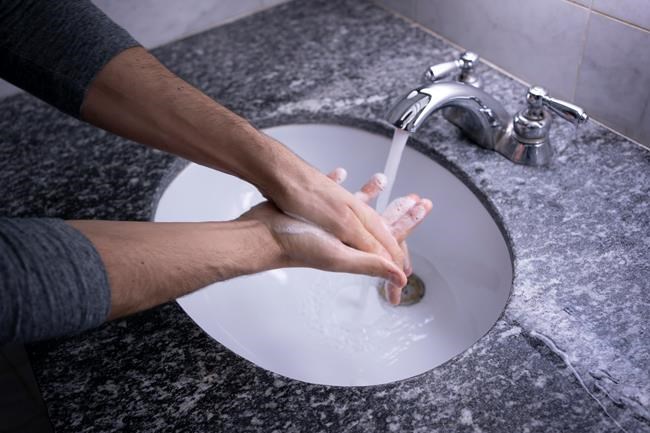
A man washes his hands in Montreal on Tuesday, March 3, 2020. It took the arrival of a frightening new coronavirus to put fresh scrutiny on a healthy habit that global health officials say is one of the best ways to prevent infection: handwashing. But are we really that bad at something all of us ostensibly do multiple times a day? Yes, and specatularly so, according to an infection control epidemiologist at the University of Toronto. THE CANADIAN PRESS/Paul Chiasson

But are we really that bad at something all of us ostensibly do multiple times a day? Yes, and spectacularly so, according to an infection control epidemiologist at the University of Toronto.

Colin Furness, who teaches knowledge management in the faculty of information, says a study he co-authored in 2014 found organ transplant patients recovering post-surgery at a Toronto hospital washed an average of 30 per cent of the time after visiting the bathroom and just shy of 40 per cent of the time before a meal.

The data was gathered using automated sensors that followed the movements of patients and recorded each time a soap or sanitizer dispenser was used.

Using the same system to measure hospital staff, hygiene rates tripled when an auditor was present to witness behaviour, he says, suggesting that the awareness of being watched is a strong factor in driving good hygiene.

“If no one’s around, it’s highly likely that people are not washing,” says Furness, who adds that’s why people should be especially wary of germs on bathroom door knobs.

“I’m not a germaphobe but I will, based on my work, always use a paper towel to exit. And then now of course, you get bathrooms where it’s paper-free and it’s just hand dryers and that is simply less safe.”

That’s because if you’re not washing diligently, paper towels can go a long way towards removing germs that remain, agrees Ottawa respirologist Dr. Shawn Aaron.

And why is all this important?

Because COVID-19 is believed to be spread by droplets emitted when an infected person coughs or sneezes, explains Aaron.

“If that person touches a knob or touches an object or a counter, (the virus) presumably is living for at least several days on that surface,” says Aaron, who works at the Ottawa Hospital and is on the Lung Association’s research advisory committee.

“If anyone else comes along and touches that same counter or doorknob, (the virus) is now on their hands.”

Health officials have repeatedly stressed the best way to prevent the spread of COVID-19 or influenza is to wash hands frequently, avoid touching your face, and cover your mouth when you cough or sneeze.

“Wash your hands like you’ve been chopping jalapenos and you need to change your contacts,” B.C. Health Officer Dr. Bonnie Henry advised earlier this week.

Indeed, if there’s a common error most make it’s that we often fail to wash long enough — at least 20 seconds — and thoroughly enough.

For the newly hyper-conscious, there can be other vexing questions: Liquid or bar soap? Aerated foam soap or not? Does water temperature matter?

First, the basics.

The Public Health Agency of Canada website says to wash hands often, especially after coughing, sneezing or using tissues, before and after eating, before preparing food, after handling raw meat, after petting an animal, and after using the bathroom.

The best method is to wet your hands with warm water, then add soap and lather. Rub your hands together and make sure to lather all surfaces — front and back, including thumbs, between fingers, the back of the hand and fingernails — for at least 20 seconds.

That’s about as long as it takes to sing “Happy Birthday,” recite your ABC’s, or belt the chorus to the appropriately titled Bee Gees song, “Stayin’ Alive.” More 20-second suggestions are all over Twitter.

Use paper towel to turn off the tap to avoid re-contaminating your hands and when using a public bathroom, use the same paper towel to open the door when you leave, the agency states.

If frequent washing causes skin dryness, use a moisturizer because dry, cracked skin can also invite infection, says Furness.

Whether soap is liquid or bar, foam or not, means less than the ingredients and how strong it is, adds Furness.

As for water temperature, warmer water may help soap dissolve more easily but it likely matters more for personal comfort, says Aaron.

Other tips from the public health agency: Don’t use a common damp cloth to wash children’s hands, or a common hand towel.

Aaron also encourages people to stop shaking hands, and using knuckles instead of fingertips to touch elevator buttons and light switches.

“Keep your hands by your side and don’t touch things,” chuckles Aaron, acknowledging that worrying about the myriad ways contamination can occur is enough to drive anyone crazy.

“There’s no way to stay sterile and in modern life right? I mean none of us can live in a bubble.”

This report by The Canadian Press was first published March 5, 2020.

Report Error Submit a Tip

More Stories

Today’s horoscope

Georgia Nicols 4 minute read Preview

Today’s horoscope

Georgia Nicols 4 minute read 2:01 AM CDT

MOON ALERT: After 12:15 a.m., there are no restrictions to shopping or important decisions today. The moon is in Capricorn.

ARIES (March 21-April 19)

This is a tricky day. Don’t be too ambitious. It’s totally OK to kick back and relax. But be aware that communications with parents and authority figures might be confused, vague or subject to misunderstandings. Nevertheless, romance is sweet and cosy!

TAURUS (April 20-May 20)

Read
2:01 AM CDT

A guide to back-to-school rules across the country

The Canadian Press 16 minute read Friday, Aug. 7, 2020

Plans are being made across the country for how to safely send students back to school in the fall as the COVID-19 pandemic continues.

Here is a look at what the various provinces have said about getting kids back to classes.

---

BRITISH COLUMBIA

Family account spiced with magic realism, geopolitical intrigue and a ghost story

Reviewed by Zilla Jones 4 minute read Preview

Family account spiced with magic realism, geopolitical intrigue and a ghost story

Reviewed by Zilla Jones 4 minute read 2:01 AM CDT

Tom Lin’s second novel Babylon, South Dakota moves beyond a historical account of an immigrant family’s struggle, delightfully blending and bending genres.

Lin is a Chinese-born novelist whose family emigrated to the U.S. when he was four years old. His debut novel, The Thousand Crimes of Ming Tsu, won the 2022 Andrew Carnegie Medal for Excellence in Fiction, making him the youngest ever recipient of that award. He earned a PhD in English from the University of California Davis and is currently an assistant professor of English and creative writing at the University of Iowa.

Babylon, South Dakota takes place in an unspecified time period that can be understood to be during the Mao era — likely the 1950s or ’60s. A young Chinese couple, the Hsuis, immigrate to the rural community that gives the book its title. They take the names Saul and Mei and settle on a 160-acre homestead left to them by a distant relative.

Saul’s dream is to breed and sell chrysanthemums from seeds he brought from China, while Mei wants to raise livestock. They speak no English, know nothing of life in the United States, are unprepared for the harshness of winter and the isolation of the farm and bring nothing with them except some gold, which Mei hides around the house for emergencies. Their only link to the outside world is a discarded and marginally functioning TV set, which Saul rescues and rigs up.

Read
2:01 AM CDT

Dramatic views and vintage treasures tell a unique story

Colleen Zacharias 7 minute read Preview

Dramatic views and vintage treasures tell a unique story

Colleen Zacharias 7 minute read 2:01 AM CDT

Every garden, large or small, has its own personal narrative to tell. Its design is a canvas for the owners to express themselves through visual elements like colour, shapes and composition.

Karl and Mary Loepp have a broad, living canvas with breathtaking garden vistas around every curve. Situated near the end of a winding road framed by majestic trees in historic St. Andrews, their stunning half-hectare property is a story of surprise and discovery.

Formerly a farmer’s field bereft of a single tree when the Loepps purchased the property and built their home in 2002, it was an apple orchard decades ago. When Karl first began working the soil and building the garden, he found coins dating back to 1908.

Both Karl and Mary spent their childhoods on family farms. They have a deep connection to nature and a passion for preserving history. Avid collectors of vintage farm equipment and hand tools, they are regulars at auctions, always searching for that one special piece to integrate into their garden where it becomes an intentional focal point.

Read
2:01 AM CDT

Dynacare must treat workers fairly: health minister

Carol Sanders 4 minute read Preview

Dynacare must treat workers fairly: health minister

Carol Sanders 4 minute read Wednesday, Sep. 16, 2026

Manitoba’s health minister defended the government’s contract with Dynacare, saying the for-profit company is expected to treat its workers fairly — but wouldn’t say if that expectation was spelled out in the deal.

The 350 private lab workers, who are represented by the Manitoba Association of Health Care Professionals, have been without a contract since March 31 and went on strike on Sept. 8.

The Manitoba Labour Board ordered them back to work and they returned to the job one day later.

Health Minister Uzoma Asagwara was asked Wednesday about the lack of an essential services agreement and why the government didn’t intervene in March, knowing that a labour dispute could interrupt community lab services.

Read
Wednesday, Sep. 16, 2026

Canadian politicians speaking with one voice

Editorial 4 minute read Preview

Canadian politicians speaking with one voice

Editorial 4 minute read 2:01 AM CDT

It was something that seems unusual in politics in recent years: politicians of different stripes taking the same side and together supporting what Canada needs to do, and is doing, to address U.S. trade attacks.

Take former prime minister Stephen Harper, closing out a major Toronto investment meeting set up by Prime Minister Mark Carney with a speech where Harper said he not only supported Carney’s decision to walk away from trade talks with the U.S., but that he would have done the same thing.

The deal the Americans were demanding “leaves no choice but for Canada to pursue diminished reliance on the U.S.,” Mr. Harper said. “There will be significant costs to this effort, but those are costs that I hope and believe Canadians are able and prepared to accept.”

And, Harper said, Canada has plenty to offer to other countries that want to trade with us: integrity.

Read
2:01 AM CDT