Ontario nurses group urges strict protections against novel coronavirus

Advertisement

Advertise with us

TORONTO - Ontario health officials say some frontline workers scarred by their experience with SARS are stepping up precautions against the novel coronavirus.

Read this article for free:


or

Already have an account? Log in here »

To continue reading, please subscribe:

Subscribe and receive a limited-edition Free Press branded hat or tote.

Digital Subscription

One year of digital access for only $205*

  • Enjoy unlimited reading on winnipegfreepress.com
  • Read the E-Edition, our digital replica newspaper
  • Access News Break, our award-winning app
  • Play interactive puzzles

*First annual payment billed as $205.00 + GST for one year. This annual subscription will automatically renew at $233.00 + GST every 52 weeks (10% off the regular annual price of $259.35). Offer available to new and qualified returning subscribers only. Cancel any time.

To continue reading, please subscribe:

Add Free Press access to your Brandon Sun subscription for only an additional

$1 for the first 4 weeks*

  • Enjoy unlimited reading on winnipegfreepress.com
  • Read the E-Edition, our digital replica newspaper
  • Access News Break, our award-winning app
  • Play interactive puzzles
Start now

*Your next Brandon Sun subscription payment will increase by $1.00 and you will be charged $17.95 plus GST for four weeks. After four weeks, your payment will increase to $24.95 plus GST every four weeks.

Hey there, time traveller!
This article was published 28/01/2020 (2435 days ago), so information in it may no longer be current.

TORONTO – Ontario health officials say some frontline workers scarred by their experience with SARS are stepping up precautions against the novel coronavirus.

Ontario Nurses Association president Vicki McKenna says she fully supports members who wish to wear N95 masks even if they’re not required to, as well as those who prefer the more protective respirator masks reserved for invasive procedures like intubation.

Infection experts believe the new virus is likely spread through airborne droplet transmission, such as through the coughs or sneezes of an infected person, and generally requires close personal contact to spread.
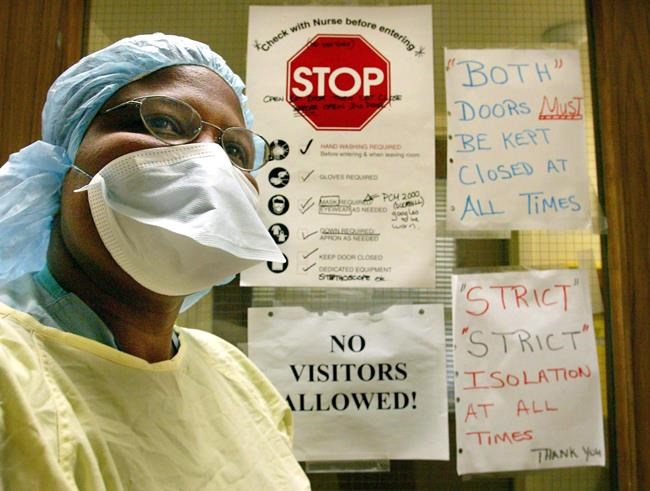
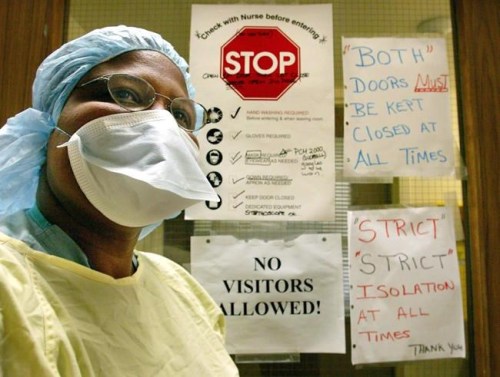
A nurse wears the protective clothing used when treating patients with atypical pneumonia (SARS) outside the door of a quarantined patient diagnosed with the illness in a ward at Sunnybrook and Women's Hospital in Toronto on March 17, 2003. Ontario health officials say some front-line workers scarred by their experience with SARS are stepping up precautions against the novel coronavirus.THE CANADIAN PRESS/Kevin Frayer

Canadian officials say the risk to the public is low, however little remains known about the illness, which emerged in the central Chinese city of Wuhan in December.

Those in contact with suspected cases are typically required to don full protective gear including a fitted N95 mask to cover their nose and mouth. But McKenna says some health-care providers are taking precautions more typically seen when treating a more easily transmissible airborne virus, which requires a “higher level of mask.”

“Certainly the N95s are one thing but the respirators are the other. That’s the level to be prepared. They need the stuff on hand, they need to have the proper masks and the proper interface with patients,” McKenna said Tuesday.

“That absolutely is the highest level of respiratory protection and those are the respirator masks that we are expecting when they’re working with patients who are identified as at risk.”

Toronto has one confirmed case of the illness and is awaiting confirmation on a second. Meanwhile, health officials in British Columbia say a man in his 40s is presumed to have coronavirus and is recovering at home.

McKenna said provincial guidelines for primary care workers were expected from the Ontario government Tuesday and she’s hoping they include strong protective measures for nurses.

Dr. Jeff Powis, medical director of infection prevention and control at the Michael Garron Hospital in east Toronto, said there are definite “SARS scars” among some frontline workers who remember what it was like to face the devastating outbreak of Severe Acute Respiratory Syndrome, which killed 44 Ontarians, including two nurses and a doctor.

“Certainly people are a bit on edge…. They’ve been through this before and that probably is a bit traumatizing for some individuals in particular,” said Powis, who helped develop hospital protocols that include ensuring those in contact with suspected cases wear fit-tested N95 masks, a face shield protecting their eyes, a gown and gloves.

“If they feel they need something different than that or they want to wear precautions when I don’t feel they need to then I’m also trying to be understanding that that’s their right to do so.”

Nevertheless, Doris Grinspun of the Registered Nurses’ Association of Ontario says the panic seen during the SARS epidemic of 2003 does not exist now and that her members feel “well-prepared” and that “the mood is good.”

“We are doing extremely better than what we did with SARS,” Grinspun said of a time marked by a lack of communication, overworked staff and fear of infection among frontline workers.

McKenna said staff who screen those with possible symptoms may also consider added protections, even though they are not required to wear masks because they are generally behind a Plexiglas barrier.

“That’s where it’s most unpredictable, because you don’t know all the facts when someone comes in,” she said, adding that the triage layout in hospitals and clinics can vary but are generally very secure.

“We can’t let our guard down. We have to be prepared. And we have to be able to care for people properly who are ill. That’s what our job is. We want to make sure that the nurses out there are protected, therefore Ontarians will be protected as well.”

This report by The Canadian Press was first published Jan. 28, 2020.

Report Error Submit a Tip

More Stories

SARS scars haunt some facing novel coronavirus

Cassandra Szklarski, The Canadian Press 4 minute read Preview

SARS scars haunt some facing novel coronavirus

Cassandra Szklarski, The Canadian Press 4 minute read Tuesday, Jan. 28, 2020

TORONTO - Ontario health officials say some frontline workers scarred by their experience with SARS are stepping up precautions against the novel coronavirus.

Ontario Nurses Association president Vicki McKenna says she fully supports members who wish to wear N95 masks even if they're not required to, as well as those who prefer the more protective respirator masks reserved for invasive procedures like intubation.

Infection experts believe the new virus is likely spread through airborne droplet transmission, such as through the coughs or sneezes of an infected person, and generally requires close personal contact to spread.

Canadian officials say the risk to the public is low, however little remains known about the illness, which emerged in the central Chinese city of Wuhan in December.

Read
Tuesday, Jan. 28, 2020

Respectful separation: an obvious oxymoron

Judy Waytiuk 6 minute read Preview

Respectful separation: an obvious oxymoron

Judy Waytiuk 6 minute read 2:00 AM CDT

“We want a fair and respectful relationship with Canada,” Alberta separatist leader Keith Wilson told the CBC commentator. He paused. Briefly. “On our terms.”

He followed up with a poorly-veiled threat. Trade goods moving east or west across Canada, especially to and from Vancouver, must pass through Alberta, he mused, so…

Wilson and his ilk are blackmailing Canada. If they win this referendum vote, he intends — with Alberta Premier Danielle Smith’s acquiescence — to pull the pin on a genuine separation referendum grenade. The separatists’ transition plan has been largely anonymously authored — much like Trump’s blueprint Project 2025.

Smith claims Albertans will vote against separation. She’s bluffing. Her precarious personal political survival tightrope as she tries to balance atop the UCP could easily carry Canada down a potentially disastrous road. All it will take is for separatists to turn out en masse (about 25 per cent of Albertans, if you believe the polls), and those supporting Canada to stay home because they think it’s in the bag for them.

Read
2:00 AM CDT

Today’s horoscope

Georgia Nicols 4 minute read Preview

Today’s horoscope

Georgia Nicols 4 minute read 2:00 AM CDT

MOON ALERT: Avoid shopping or important decisions from 4:30 a.m. until 10:15 a.m. After that, the moon moves from Aries into Taurus.

ARIES (March 21-April 19)

Financial discussions, especially about speculation, sports or dealing with your kids, might be confrontational. However, the bigger news is that a partner, spouse or close friend might surprise you by saying or doing something you least expect. Stay tuned.

TAURUS (April 20-May 20)

Read
2:00 AM CDT

COVID-19 vaccine Q-and-A: What you need to know

Melissa Couto Zuber, The Canadian Press 5 minute read Preview

COVID-19 vaccine Q-and-A: What you need to know

Melissa Couto Zuber, The Canadian Press 5 minute read Wednesday, Jan. 13, 2021

Canada's COVID-19 vaccine rollout hits its one-month mark on Thursday, but questions remain about the inoculations themselves, how they're being distributed and what happens next.

The Canadian Press recently spoke with experts in infectious disease, immunology and public health to help get some clarity on popular queries.

WHO'S NEXT IN LINE TO GET THE VACCINE?

Canada's provinces seem to mostly be adhering to recommendations put forward by the National Advisory Committee on Immunization (NACI), which suggests first vaccinating those most vulnerable to severe COVID outcomes, as well as those who care for them.

Read
Wednesday, Jan. 13, 2021

Churches get a chance to show off at Doors Open Winnipeg

Brenda Suderman   5 minute read Preview

Churches get a chance to show off at Doors Open Winnipeg

Brenda Suderman   5 minute read Saturday, May. 20, 2017

EVERY Sunday morning, members of a church in the heart of the Glenelm neighbourhood climb to the top of their roof to sing and pray.

It’s not quite as dramatic as it sounds, since the red brick building housing Gordon-King Memorial United Church was built on top of a high basement used as the worship space for two decades, building manager Dan McCulloch says.

“The floor is actually a tar roof with all the drains in place,” he says of what’s underneath the sloping hardwood floors of the building completed in 1927.

That’s just one of the hidden details on display at the 700-seat modern Gothic building during next weekend’s annual Doors Open Winnipeg.

Read
Saturday, May. 20, 2017

Nobel laureate Toni Morrison dead at 88

Hillel Italie, The Associated Press 18 minute read Preview

Nobel laureate Toni Morrison dead at 88

Hillel Italie, The Associated Press 18 minute read Tuesday, Aug. 6, 2019

NEW YORK - Nobel laureate Toni Morrison, a pioneer and reigning giant of modern literature whose imaginative power in "Beloved," ''Song of Solomon" and other works transformed American letters by dramatizing the pursuit of freedom within the boundaries of race, has died at age 88.

Publisher Alfred A. Knopf announced that Morrison died Monday night at Montefiore Medical Center in New York. Morrison's family issued a statement through Knopf saying she died after a brief illness.

"Toni Morrison passed away peacefully last night surrounded by family and friends," the family announced. "The consummate writer who treasured the written word, whether her own, her students or others, she read voraciously and was most at home when writing."

Few authors rose in such rapid, spectacular style. She was nearly 40 when her first novel, "The Bluest Eye," was published. By her early 60s, after just six novels, she had become the first black woman to receive the Nobel literature prize, praised in 1993 by the Swedish academy for her "visionary force" and for her delving into "language itself, a language she wants to liberate" from categories of black and white. In 2012, Barack Obama awarded her a Presidential Medal of Freedom.

Read
Tuesday, Aug. 6, 2019