How Canadian researchers are using data to track the spread of the coronavirus

Advertisement

Advertise with us

TORONTO - Canadian researchers are making advances in tracking the trajectory of viral illnesses, like the emergent coronavirus, as they try to stay ahead of any potential threat to Canada.

Read this article for free:


or

Already have an account? Log in here »

To continue reading, please subscribe:

Subscribe and receive a limited-edition Free Press branded hat or tote.

Digital Subscription

One year of digital access for only $205*

  • Enjoy unlimited reading on winnipegfreepress.com
  • Read the E-Edition, our digital replica newspaper
  • Access News Break, our award-winning app
  • Play interactive puzzles

*First annual payment billed as $205.00 + GST for one year. This annual subscription will automatically renew at $233.00 + GST every 52 weeks (10% off the regular annual price of $259.35). Offer available to new and qualified returning subscribers only. Cancel any time.

To continue reading, please subscribe:

Add Free Press access to your Brandon Sun subscription for only an additional

$1 for the first 4 weeks*

  • Enjoy unlimited reading on winnipegfreepress.com
  • Read the E-Edition, our digital replica newspaper
  • Access News Break, our award-winning app
  • Play interactive puzzles
Start now

*Your next Brandon Sun subscription payment will increase by $1.00 and you will be charged $17.95 plus GST for four weeks. After four weeks, your payment will increase to $24.95 plus GST every four weeks.

Hey there, time traveller!
This article was published 23/01/2020 (2447 days ago), so information in it may no longer be current.

TORONTO – Canadian researchers are making advances in tracking the trajectory of viral illnesses, like the emergent coronavirus, as they try to stay ahead of any potential threat to Canada.

From global flight patterns to learning the names of individual patients, scientists say they have more ways to monitor infectious diseases than ever.

These insights are drawn from new data-driven technologies, improved communication across public-health agencies and increased transparency in reporting infections.
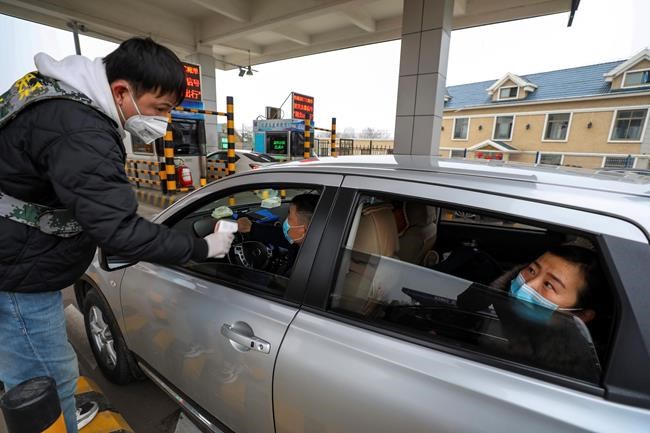
A militia member uses an thermometer gun to take a driver's temperature at a checkpoint at a highway toll gate in Wuhan in central China's Hubei Province, Thursday, Jan. 23, 2020. China closed off a city of more than 11 million people Thursday in an unprecedented effort to try to contain a deadly new viral illness that has sickened hundreds and spread to other cities and countries amid the Lunar New Year travel rush. (Chinatopix via AP)

But as our interconnected world has made it easier to share information, it has also multiplied the opportunities for viruses to spread, said Kamran Khan, a Toronto doctor who specializes in infectious disease.

“On one hand, the world is rapidly changing, where diseases are emerging and spreading faster,” said Khan, a scientist at St. Michael’s Hospital.

“On the other hand, we happen to have growing access to data we can use … to generate insights and spread them faster than the diseases spread themselves.”

The newly identified coronavirus has so far sickened close to 600 people in China and killed at least 17. Other cases have been reported in the United States, Japan, South Korea, Thailand, Singapore, Vietnam and Hong Kong.

Federal Health Minister Patty Hajdu said Thursday that several people in Canada are under observation for signs they may have contracted the pneumonia-like illness, but that the risk to Canadians remains low.

Meanwhile, the World Health Organization determined Thursday that it was “too early” to declare the outbreak a global health emergency, but cautioned that “it may yet become one.”

Khan, the founder and CEO of BlueDot, said his medical analytics company has been monitoring the virus since first detecting signs of an outbreak on Dec. 31 in the central Chinese city of Wuhan, where most of the early cases are concentrated.

Since the rise of commercial air travel, Khan said humans have become the key vectors, or virus carriers, driving the dispersion of diseases around the world.

BlueDot’s AI-powered system analyzes billions of data points, including airline ticket sales and online news reports, to map how viruses spread through the global transportation network and predict regions that are at the highest risk of an outbreak.

Khan said about 80 per cent of travellers from Wuhan to Canada are headed for Toronto and Vancouver, but he noted that there are no non-stop flights from the Chinese city, which means the volume of travel is relatively low.

BlueDot shares such insights with its clients across the private and public sector to keep them posted on the latest developments as an epidemic evolves, so they can co-ordinate their response, said Khan.

However, he admits that every prediction comes with some degree of uncertainty. For example, researchers are still piecing together the scale of the coronavirus outbreak, and how efficiently the virus is transmitted from person to person.

Meanwhile, laboratory networks across the country are working to make sure tests are available wherever cases may crop up, said Yoav Keynan, the scientific lead at the National Collaborating Centre for Infectious Diseases.

The coronavirus comes from same family that caused the 2003 outbreak of severe acute respiratory syndrome, or SARS, which killed at least 774 people worldwide, including 44 people in Canada.

Since then, Canada has taken steps to improve communication between provincial, federal and global public-health agencies, Keynan said.

“I think there’s a greater degree of knowledge-sharing across jurisdictions that allows us to track epidemics,” said Keynan, an associate professor in University of Manitoba’s medical microbiology department.

“Canadians should be encouraged by how much better the public-health infrastructure is compared to what it was 17 years ago.”

David Fisman, an epidemiologist at the University of Toronto’s Dalla Lana School of Public Health, who was part of Ontario’s response to the SARS outbreak, said the new coronavirus could serve as a “stress test” for the protocols that have been implemented since.

For example, the virus appears to be highly transmissible in health-care settings, but not outside of them.

That means overcrowded hospitals and emergency rooms could potentially become petri dishes for the infectious disease.

“We’ve seen this movie before,” said Fisman.

“Our infection-control game is better than it was. But we still have this problem with the physical plant of our hospitals, with our emergency rooms, where people are stuck together cheek-by-jowl, and that creates vulnerability.”

Report Error Submit a Tip

More Stories

Wet weather heats up feed grain availability

Laura Rance-Unger 4 minute read Preview

Wet weather heats up feed grain availability

Laura Rance-Unger 4 minute read Yesterday at 2:01 AM CDT

Other than those in another rain cloud, it’s hard to find the silver linings attached to this year’s soggy harvest.

A showery September continued to cause delays and more deterioration in both quality and yield. Plus, the costs of mitigating post-harvest losses to spoilage are rising as the delays push further into fall. It takes more heat and time to artificially dry down grain as temperatures cool.

Crops harvested in August before the weather turned warm and damp came off with good quality and average yields. But farmers in some areas, such as southwest Manitoba, had only started when the rains came. Now they are plagued with standing water and sprouting swaths of grain that might not even make feed quality.

Suffice to say crop insurance adjusters are going to be busy this fall.

Read
Yesterday at 2:01 AM CDT

Poster protocol

Sheldon Birnie 7 minute read Preview

Poster protocol

Sheldon Birnie 7 minute read Tuesday, Sep. 15, 2026

Although the days when telephone poles and notice boards across the city were thick with gig posters, either slopped up with wheat paste or wrapped tight with packing tape, are behind us, the art of making an appealing visual ad for live music events is still a vital part of the local creative scene.

However, a widespread backlash against a new kind of slop — the use of generative AI images — has been building, especially among creatives when it comes to promoting live music.

“Live music is and always has been a DIY type of scene, especially locally,” says Evan Simpson, who has been working as a graphic designer for nearly a decade.

“For years people have been making their own flyers, or if they have the budget, hiring a designer or artist to come up with some artwork for their flyers. It’s a whole ecosystem, a scene supporting itself. If you take away the visual side of it, the spark, individuality and uniqueness of each gig poster is lost. What a sad world it would be if all art were made by AI.”

Read
Tuesday, Sep. 15, 2026

Giant Tiger decision creates giant void for desperate population

Niigaan Sinclair 5 minute read Preview

Giant Tiger decision creates giant void for desperate population

Niigaan Sinclair 5 minute read Friday, Jul. 31, 2026

A lot of Winnipeggers may shrug, but the end of Giant Tiger’s downtown store is a giant problem for many of the people living in the centre of the city.

It would have been difficult for anyone going into or passing by the Canadian discount chain’s Donald Street and Ellice Avenue location Thursday to miss the red notices posted on the store’s windows advising it will close on Nov. 7.

According to a 2024 Downtown Winnipeg BIZ report, about 18,000 people live in Winnipeg’s downtown.

More than 60,000 people work there, and some days — when there’s a big concert or the Jets play at Canada Life Centre, for example — the number of people spending time in the area increases significantly.

Read
Friday, Jul. 31, 2026

Manitoba marks end of sending simple workplace problems to doctor’s office

Tory McNally 7 minute read Preview

Manitoba marks end of sending simple workplace problems to doctor’s office

Tory McNally 7 minute read Yesterday at 2:01 AM CDT

There are some changes in the workplace that make you think: “Well, it’s about time.”

This is one of them.

Starting Oct. 1, Manitoba changed the rules around sick notes. I think it is going to be a wonderful change — not just for doctors and patients, but for employers, employees and the way we think about accountability at work.

The change comes from Bill 11, the Employment Standards Code Amendment Act (Sick Notes for Employee Absences), which received royal assent on June 1 and came into force Thursday. Under the new rules, employers generally cannot require a sick note for an illness or injury unless the employee is away for more than one week or has been absent because of illness or injury for more than 10 scheduled workdays in the calendar year.

Read
Yesterday at 2:01 AM CDT

Letters, Oct. 3

7 minute read Yesterday at 2:01 AM CDT

A morning in the life …

My very first lesson does not start when I walk into that lecture hall, oh no — it starts long before. It begins when I walk to my car, check the estimated arrival time to the University of Manitoba and hope that Winnipeg traffic agrees with it.

A drive that appears completely manageable changes almost immediately when I’m greeted by a tsunami of orange pylons and a line of cars that appears to go on forever. Traffic moves by the inch, lanes magically disappear and the detour I took yesterday now has a detour of its own. These factors make me do a calculation that I have become all too familiar with. How late can I arrive and still find parking, run to my class across campus and get to class with enough time left to make it worth it?

I have grown used to people saying, “Why not just leave earlier?” I do. But when I’m already leaving for my 8:30 a.m. class at 7 a.m., there’s only so much I can do. This drive that some would think is relaxing is one that feels like an assignment that I didn’t know I had to complete and is due at 8:30 a.m.

’Disgusting’ posters being investigated by police

Morgan Modjeski 4 minute read Yesterday at 2:22 PM CDT

The Winnipeg Police Service major crimes unit is investigating what some have labelled offensive and hateful posters on full-display at a Winnipeg home.

One of the people irked by the display is Gracie Garrett. She’s has lived on Ashburn Street in Winnipeg’s Minto neighbourhood for almost ten years. She’s never felt unsafe in the neighbourhood before, but now, a set of posters plastered on a nearby house are making her feel uneasy.

The five signs, posted facing the street prominently on a front window, contain a slur, refer to Nazis as “heroes” and call Muslims, Christians and other groups “evil.”

Learning of the signs Friday, Garrett said she’ll be reporting the posters to police, as she worries they incite and promote violence.