Still growing strong
Celebrated nonagenarian gardener humble about her many achievements
Advertisement
Read this article for free:
or
Already have an account? Log in here »
To continue reading, please subscribe:

Digital Subscription
One year of digital access for only $205*
- Enjoy unlimited reading on winnipegfreepress.com
- Read the E-Edition, our digital replica newspaper
- Access News Break, our award-winning app
- Play interactive puzzles
*First annual payment billed as $205.00 + GST for one year. This annual subscription will automatically renew at $233.00 + GST every 52 weeks (10% off the regular annual price of $259.35). Offer available to new and qualified returning subscribers only. Cancel any time.
To continue reading, please subscribe:
Add Free Press access to your Brandon Sun subscription for only an additional
$1 for the first 4 weeks*
- Enjoy unlimited reading on winnipegfreepress.com
- Read the E-Edition, our digital replica newspaper
- Access News Break, our award-winning app
- Play interactive puzzles
*Your next Brandon Sun subscription payment will increase by $1.00 and you will be charged $17.95 plus GST for four weeks. After four weeks, your payment will increase to $24.95 plus GST every four weeks.
Read unlimited articles for free today:
or
Already have an account? Log in here »
Hey there, time traveller!
This article was published 18/01/2020 (2438 days ago), so information in it may no longer be current.
Last May Marion Lewis received a phone call from the Governor General’s office. When the caller told Lewis she was to be appointed an Officer to the Order of Canada for her contributions to the prevention and treatment of Rh disease, Lewis modestly replied, “I hope you realize I have spent the last 20 years tending my gardens and my dogs.”
Lewis is 94. She is indeed a keen gardener and each year has maintained flower and vegetable gardens on her riverside property on Turnbull Drive, where she has lived since 1968.
Lewis co-founded the world-renowned Rh Laboratory in Winnipeg. A graduate of Gordon Bell High School, Lewis had plans to be a doctor but with her father overseas and responsibilities at home, she applied instead to be a registered medical technologist. Upon completion, she had an interview with Dr. Bruce Chown, who knew what a bright student she was and told her that together they would learn about Rh disease and research techniques to combat it. It was 1944 and Lewis was 19. “It was war time and all the young men who would have been doing post-operative work would normally have had that opportunity,” says Lewis.
Since it wasn’t known at the time who was at risk for Rh disease, Lewis and Chown showed up at baby deliveries around the clock. “We were on call seven days a week, 24 hours a day,” says Lewis. “Sometimes we would drive out to a rural community, transfuse a baby, drive back to Winnipeg, go to the lab which at that time was located in the basement of Children’s Hospital, then stop in at Grace Hospital to check on another baby. We weren’t always able to save someone’s baby.”
But then over the next 25 years, Dr. Chown and Marion Lewis’ groundbreaking research began making it possible for babies to survive Rh disease. The Manitoba Historical Society says that the discovery by the Winnipeg Rh laboratory of the mechanism of Rh haemolytic disease, its management, and its ultimate prevention, “is perhaps the most outstanding medical discovery ever made in Manitoba.”
Lewis went on to expand her research into the field of genetics. She became an accomplished professor of pediatrics and of human genetics at the University of Manitoba where she was subsequently named professor emerita. During a career that spanned 53 years, Lewis wrote or co-wrote more than 100 papers and gained international recognition.
But what was that about being a gardener? For most of her life, Lewis has subscribed to eating what she grows and growing what she eats. In 1968, when she bought her three-acre property on Turnbull Drive, it was because of the numerous mature trees, space for gardens, and the view of the Red River. Each year she plants seeds for a wide variety of vegetables and preserves and freezes much of what she grows for use during the winter months. Lewis has also planted numerous fruit trees and perennials.
The first time that Lewis took me on a walk through her property I was struck by the layout and placement of her garden beds which are almost formal in nature with their long straight lines. Was the linear perspective of the beds influenced by visits to gardens when she visited Europe for a year in 1949 and cycled all around the British Islands, Holland and Denmark, I asked? During that period she also attended university in Italy and worked at the Lister Institute of Preventative Medicine so she could pay for her trip home. “No,” says Lewis, “the design is just the most practical because the gardens are the same width as the blade on my tractor.”
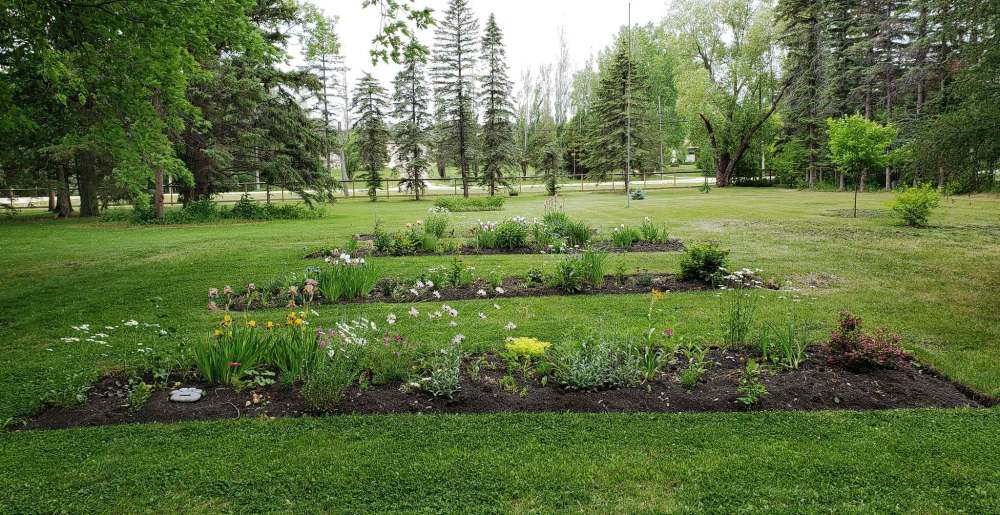
Each flower bed has a width of 120 cm so that Lewis can reach comfortably to the middle from either side when she is weeding. Lewis doesn’t like to use a hoe when she is weeding nor does she wear gloves. Her preference is to get on her hands and knees and wiggle out the roots.
Lewis gets a little help from her long-time friend, Earl Stafford, who drives the tractor and each fall gathers up the huge amount of leaves that pile up on the ground and are then stored to make compost. Stafford is the former music director of the Royal Winnipeg Ballet. Last fall Stafford built Lewis an enclosed garden consisting of nine wooden raised beds. The fence that surrounds it is nearly two meters high. Lewis hopes this will be enough to deter the numerous deer that now visit her property.
Prior to five years ago, says Lewis, deer were never a problem. Now they come in herds — as many as 30 at a time. Lewis attributes the increase to residential expansion in south Winnipeg. Last summer, deer nearly stripped her vegetable garden bare and feasted on the fruit trees that grow in her small orchard. Luckily, on one recently planted apple tree, the deer left two ripe apples. “They were delicious,” says Marion, her humor intact. She harvested a tremendous bounty of pears, though, to make several jars of delicious pear and ginger spread.
In early October, Lewis hired an arborist to prune several mature oak, elm, ash and maple trees. One tree had to be removed. This major pruning job cost $3500.00. Lewis was thrilled at how pristine everything looked. “There was not a twig left on the ground,” she says. Two days later the October ice storm hit causing breakage in the upper canopies of the decades-old trees and strewing branches and debris everywhere.

The arborist will return in spring, but what really concerns Lewis for now is the prospect of another flood. Since 1968, the Red River has been a big part of Lewis’ life. Her property has been impacted by high levels on the Red River in 1969, 1970, 1974, 1979, 1987, 1996, 1997, and 2011. While flood waters have usually come inland just to the point on her property where her shed sits, her house was inundated in 1974 and 1979. In 1974, after repairs to her flood-damaged home were completed, her neighbours – a family of seven plus their dog – moved into Lewis’s small house until flood repairs to their house were completed.

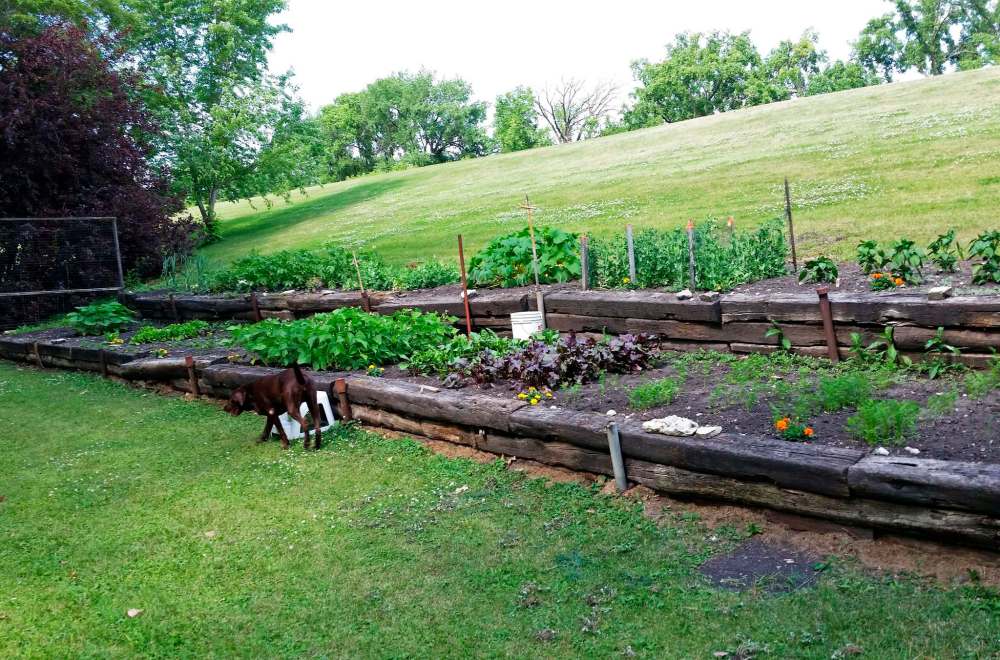
The construction of the massive dike which today borders her property resulted in the removal of 20 of her large elm trees. It also reduced the size of her three-acre property by half. The loss of her view of the river was the hardest part. Today her long vegetable garden sits at the foot of the dike and her new enclosed garden is nearby.
Is the stage set for another flood? Lewis is taking a wait-and-see-approach, but says that her next project will be to replace her shed which has seen flood waters one too many times.
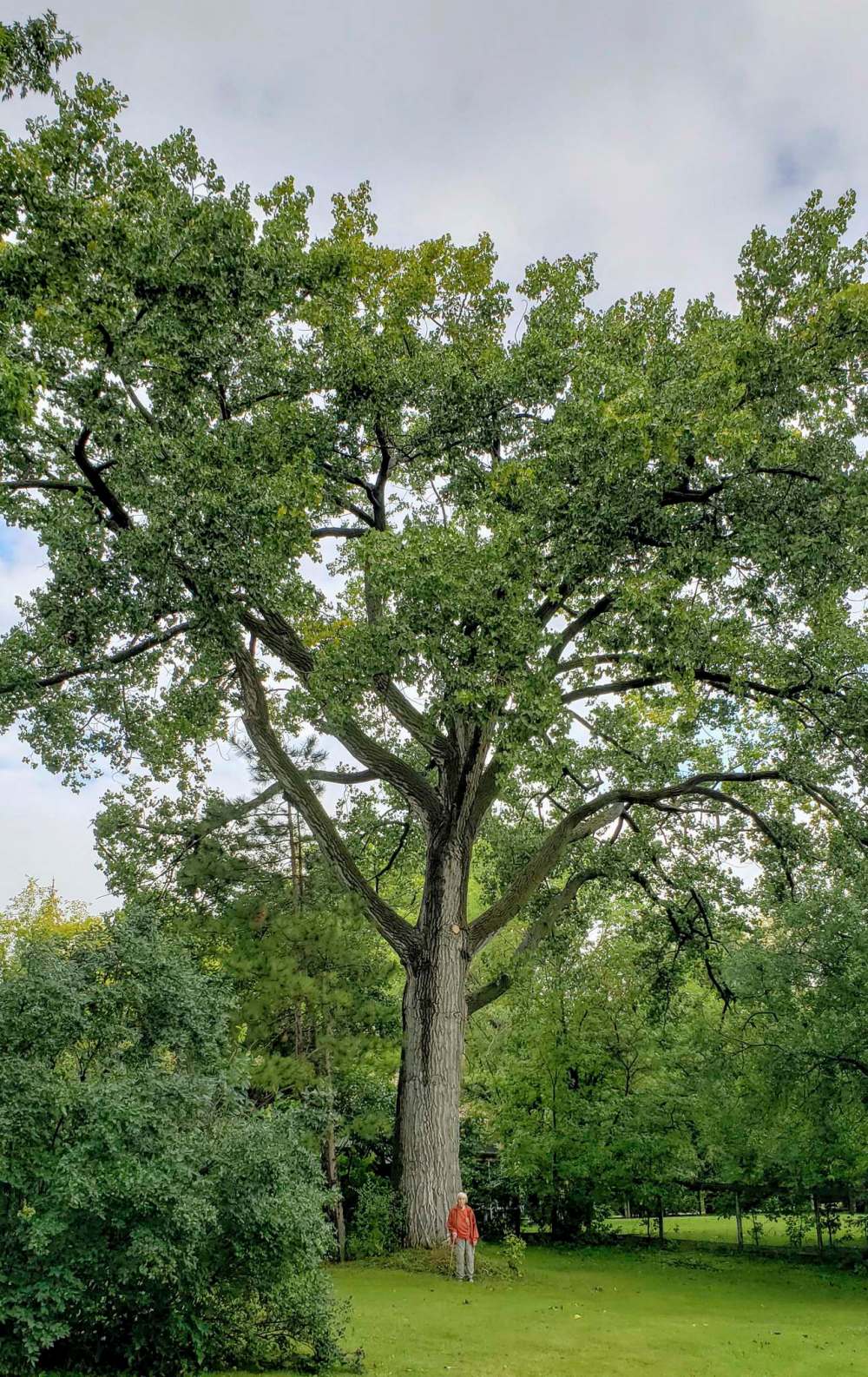
A towering cottonwood tree on Lewis’s property has withstood the test of time. Lewis is of no small stature herself. She was invested as Officer of the Order of Canada by Her Excellency the Right Honourable Julie Payette, Governor General of Canada, at Rideau Hall on Sept. 5, 2019.
colleenizacharias@gmail.com