Canada’s Salvation Army testing out quicker tap-and-go option at kettle stations

Advertisement

Advertise with us

TORONTO - Canada's Salvation Army is testing out a new and faster way to allow cashless donations to its kettle stations via debit and credit card, making the process as quick and easy as dropping a toonie in the bubble.

Read this article for free:


or

Already have an account? Log in here »

To continue reading, please subscribe:

Subscribe and receive a limited-edition Free Press branded hat or tote.

Digital Subscription

One year of digital access for only $205*

  • Enjoy unlimited reading on winnipegfreepress.com
  • Read the E-Edition, our digital replica newspaper
  • Access News Break, our award-winning app
  • Play interactive puzzles

*First annual payment billed as $205.00 + GST for one year. This annual subscription will automatically renew at $233.00 + GST every 52 weeks (10% off the regular annual price of $259.35). Offer available to new and qualified returning subscribers only. Cancel any time.

To continue reading, please subscribe:

Add Free Press access to your Brandon Sun subscription for only an additional

$1 for the first 4 weeks*

  • Enjoy unlimited reading on winnipegfreepress.com
  • Read the E-Edition, our digital replica newspaper
  • Access News Break, our award-winning app
  • Play interactive puzzles
Start now

*Your next Brandon Sun subscription payment will increase by $1.00 and you will be charged $17.95 plus GST for four weeks. After four weeks, your payment will increase to $24.95 plus GST every four weeks.

Hey there, time traveller!
This article was published 15/11/2019 (2487 days ago), so information in it may no longer be current.

TORONTO – Canada’s Salvation Army is testing out a new and faster way to allow cashless donations to its kettle stations via debit and credit card, making the process as quick and easy as dropping a toonie in the bubble.

A pilot project starting Dec. 1 will allow donations at some kettle stations in the Greater Toronto Area to be made through a new tap-and-go machine that eliminates having to swipe a card or enter a cash amount or PIN.

The machine will be mounted on the side of kettle stands and have three discs to tap — one for a $5 donation, another for $10 and another for $20.
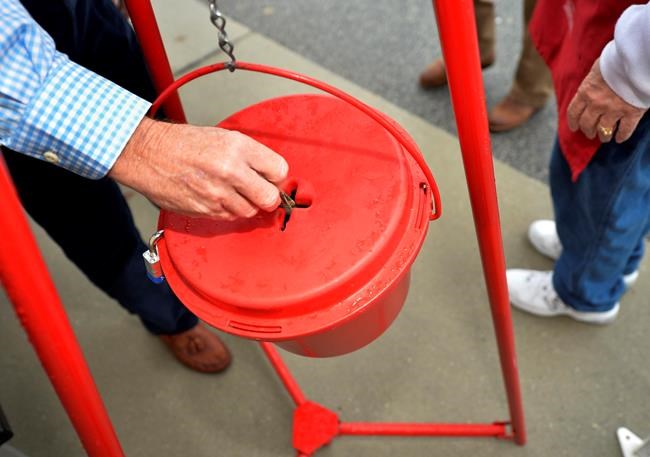
In this Nov. 9, 2018, file photo money gets dropped into the kettle during the Annual Salvation Army Red Kettle and Angel Tree Kick Off outside the Hobby Lobby store in Augusta, Ga. Canada's Salvation Army is testing out a new and faster way to allow cashless donations to its kettle stations via debit and credit card, making the process as quick and easy as dropping a toonie in the bubble. THE CANADIAN PRESS/AP-Michael Holahan/The Augusta Chronicle via AP, File

Those wanting to donate more can tap a disc up to 10 times.

The charitable organization has been offering debit and credit tap donation options during its annual Christmas Kettle Campaign for a couple of years across Canada now, but only through machines that require operator intervention.

Spokesman Maj. Rob Kerr says the new tap-and-go option will streamline the process and be as simple as walking up to the kettle, tapping, waiting for a beep confirming the transaction and leaving.

“We know of the folks who drop money in the kettle, one of the things that’s made it so appealing is that they can drop their cash in the bubble and just keep going,” Kerr said in a phone interview.

“It doesn’t slow them down from their busy day, and we just want to find technology that allows it to work that way, too.”

The new 30-by-30-centimetre tap-and-go machine is a red rectangle card mounted on the side of kettle stands.

It interfaces with Moneris Solutions Corp., a payments card processor.

Unlike the point-of-sale machines currently in use at kettle stations across Canada, the new tap-and-go option doesn’t require training or any action by those operating the stations.

The Salvation Army Christmas Kettle Campaign is already under way across Canada.

Kerr said the new pilot project will only be in certain locations in the GTA this year, but if successful, will expand to more locations next year.

Other cities in Canada can still donate at kettle stations via debit and credit on the regular point-of-sale machines this year.

And, of course, donors can still drop coins and bills into the kettle bubbles — a method Kerr said isn’t waning, despite our so-called cashless society.

“There’s some kind of a rewarding experience in dropping that cash in the bubble and seeing that happen,” Kerr said.

“So I’m not thinking we’re going to see a huge decline. We’re really hoping more and more that this is just going to enhance and augment those who are already giving cash.”

Kerr said Canada’s Salvation Army raised almost $23 million last year through the kettle campaign across the country.

He estimated that was up slightly over the year before. The Salvation Army has seen an increase in donations through the kettle campaign for the last couple of years now, he added.

This year’s donation goal for Canada is $23 million. Donations can also be made online.

“It’s amazing what people are giving to the Salvation Army still in cashless society,” Kerr said.

“They seem to have the loonies, toonies, fives and tens to drop in the bubble when they go by. And it continues to be a strong fundraiser for us.”

This report by The Canadian Press was first published Nov. 15, 2019.

Report Error Submit a Tip

More Stories

The Aqua Townhomes a fine option for first-time, move-up buyers

Todd Lewys 5 minute read Preview

The Aqua Townhomes a fine option for first-time, move-up buyers

Todd Lewys 5 minute read Saturday, Jun. 6, 2026

This is a challenging time for buyers looking for a starter or move-up home.

Two factors are making it incredibly difficult for first time buyers or young families to find an affordable home.

First, there’s the local real estate market, where competition for resale homes has been frantic due to a lack of inventory.

There have been several instances in which homes in desirable areas have sold for $100,000 or more over the asking price, with more than 20 offers, leaving many a first-time buyer out in the cold.

Read
Saturday, Jun. 6, 2026

Smith’s pretzel logic confuses

Editorial 4 minute read Preview

Smith’s pretzel logic confuses

Editorial 4 minute read Yesterday at 2:02 AM CDT

Alberta Premier Danielle Smith had both sides of her mouth working overtime on Aug. 30, when she spoke at an event in Calgary to commemorate Alberta Day, the annual celebration of the province’s entry into Confederation in 1905 (officially Sept. 1, it was celebrated on the weekend).

Smith’s comments — and the things she did not say — revealed a lot about the political tightrope the premier is trying to walk over the challenges currently faced by her province. At the top of that list of challenges is a persistent campaign to separate Alberta from the aforementioned Confederation. A campaign that Smith appears to both support and oppose, depending on which day of the week it is.

Her Alberta Day remarks were an excellent case in point.

Smith has decided that on Oct. 19, Albertans will vote on a series of non-binding propositions in a province referendum. One of those questions will ask Albertans whether they want to hold a referendum on separation, thus making this fall’s vote a “referendum on whether to hold a referendum,” as some observers have dubbed it.

Read
Yesterday at 2:02 AM CDT

Controlling pace of response path to success

Tim Kist 5 minute read Yesterday at 2:02 AM CDT

WITH the recent collapse of Canada-U.S. trade talks, the economic, political and social changes are coming at business leaders on a daily basis.

While you cannot control the pace of these changes, you can control the pace of response and timing of actions your organization takes. This is a time for thoughtful analysis and careful action, not chasing the latest trends.

Artificial intelligence, for example, can write articles, create images, draft emails and perform seemingly countless other tasks. But is this new tool solving a current business problem?

Successful companies know they must develop a strategy before launching any tactics. Otherwise, the strategy is based on “hope” — and we all know hope is not a strategy.

RCMP defends N.S. shooting response

Michael MacDonald and Keith Doucette, The Canadian Press 6 minute read Preview

RCMP defends N.S. shooting response

Michael MacDonald and Keith Doucette, The Canadian Press 6 minute read Wednesday, Apr. 22, 2020

HALIFAX - Under fire for how they alerted the public to a 12-hour massacre that took the lives of 22 people, the Nova Scotia RCMP defended their actions Wednesday, saying their use of Twitter was effective.

Since the horrific string of killings started Saturday night and stretched into Sunday morning, questions have been raised as to why the province did not use an emergency alert system to transmit warnings to Nova Scotians' cellphones and television screens.

RCMP Chief Supt. Chris Leather said Twitter messages from the RCMP started Saturday at 10:26 p.m., when the Mounties warned of a firearms complaint in Portapique, a tiny village about a 130-kilometre drive north of Halifax.

Leather read from a statement Wednesday making it clear he was aware the RCMP's communication with the public was under scrutiny.

Read
Wednesday, Apr. 22, 2020

Letters, Sept. 5

7 minute read Yesterday at 2:02 AM CDT

Clearing the air

Re: QDoc patients in middle of billing dispute (Sept. 4)

QDoc has been fortunate to have a genuine partner in the Manitoba government over the past several years. Premier Wab Kinew and Health Minister Uzoma Asagwara have been consistently clear that no Manitoban should go without care because of where they live, and that commitment is exactly why virtual care exists as a permanent, publicly available option today. We built MediNav, the province’s online appointment booking system, together with Manitoba Health, and that same collaborative spirit has helped make more than 350,000 patient visits possible through our platform — many of them evenings, overnights and weekends, reaching rural and underserviced communities that need it most.

We want to be direct with the people who rely on us: QDoc is not going anywhere. We continue to see patients today, and we will keep doing so tomorrow. The issue reported this week is a technical billing matter, not a service disruption, and we are actively working with the province to resolve it quickly, so we can keep growing our capacity to serve Manitobans rather than limiting it.

Pallister, Filmon, Bowman offer condolences on Prince Philip’s death

Nadya Pankiw 2 minute read Preview

Pallister, Filmon, Bowman offer condolences on Prince Philip’s death

Nadya Pankiw 2 minute read Friday, Apr. 9, 2021

Local officials have extended their sympathies to the Royal Family following the death of Prince Philip, Duke of Edinburgh.

Buckingham Palace announced Friday morning that Prince Philip, 99, died at home.

Premier Brian Pallister said in statement he was "saddened" to learn of Prince Philip's passing and noted the "special relationship" Manitobans had with the Duke of Edinburgh.

Prince Philip's first visit to Manitoba dates back to 1951 during a royal tour. Since then, the Duke of Edinburgh visited the province for the opening of the Pan Am Games in 1967, celebrated Manitoba's Centennial in 1970, presented the Duke of Edinburgh Gold Awards in Thompson in 1984, visited Churchill in 1992 and toured communites affected by the "Flood of the Century" in 1997.

Read
Friday, Apr. 9, 2021