Concert promoters turn away from facial recognition tech

Advertisement

Advertise with us

BOSTON - Concert promoters in the U.S. are stepping back from plans to scan festivalgoers with facial recognition technology, after musicians and others gave it some serious side-eye.

Read this article for free:


or

Already have an account? Log in here »

To continue reading, please subscribe:

Subscribe and receive a limited-edition Free Press branded hat or tote.

Digital Subscription

One year of digital access for only $205*

  • Enjoy unlimited reading on winnipegfreepress.com
  • Read the E-Edition, our digital replica newspaper
  • Access News Break, our award-winning app
  • Play interactive puzzles

*First annual payment billed as $205.00 + GST for one year. This annual subscription will automatically renew at $233.00 + GST every 52 weeks (10% off the regular annual price of $259.35). Offer available to new and qualified returning subscribers only. Cancel any time.

To continue reading, please subscribe:

Add Free Press access to your Brandon Sun subscription for only an additional

$1 for the first 4 weeks*

  • Enjoy unlimited reading on winnipegfreepress.com
  • Read the E-Edition, our digital replica newspaper
  • Access News Break, our award-winning app
  • Play interactive puzzles
Start now

*Your next Brandon Sun subscription payment will increase by $1.00 and you will be charged $17.95 plus GST for four weeks. After four weeks, your payment will increase to $24.95 plus GST every four weeks.

Hey there, time traveller!
This article was published 29/10/2019 (2518 days ago), so information in it may no longer be current.

BOSTON – Concert promoters in the U.S. are stepping back from plans to scan festivalgoers with facial recognition technology, after musicians and others gave it some serious side-eye.

Although it remains entirely possible that music venues will eventually take a second look at the controversial technology.

Live-entertainment giants AEG Presents and Live Nation both recently disavowed any plans to use facial recognition at music festivals, despite earlier indications to the contrary. Their public pronouncements have led a group of musicians to declare victory after a months-long campaign to halt the technology’s use at live shows.
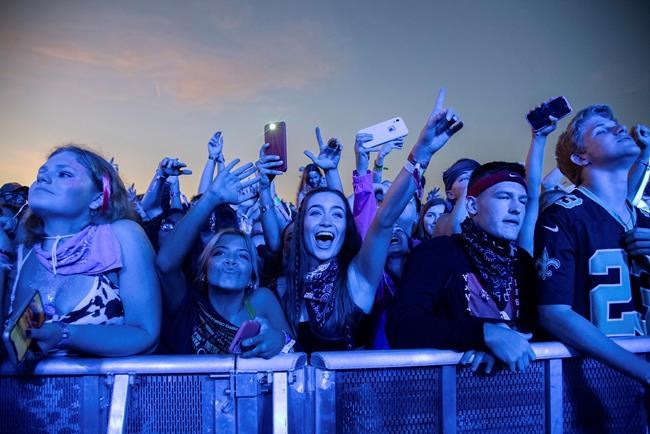
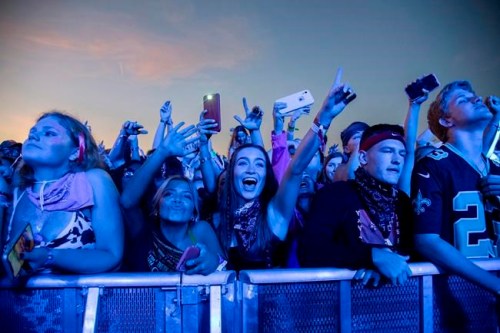
FILE - In this Sunday, Oct. 27, 2019, file photo, festival-goers attend the Voodoo Music Experience in City Park in New Orleans. Major concert promoters in the U.S. are stepping back from plans to scan festival-goers with facial recognition technology, at least for the time being. (Photo by Amy Harris/Invision/AP, File)

Advances in computer vision have enabled businesses to install cameras that can recognize individuals by their face or other biometric characteristics. Venue operators have talked about using the technology at gateways to secure entry for select groups or to offer perks for repeat customers.

Privacy advocates worry that such uses might also pave the way for greater intrusions, such as scanning audience members in real time to analyze their behaviour.

Both concert organizations seemed to be edging toward remembering more faces. In May 2018, for instance, Live Nation subsidiary Ticketmaster announced it was partnering with and investing in Texas facial recognition startup Blink Identity, saying in a note to shareholders that its technology will enable music fans to associate their digital ticket with their image and “then just walk into the show.”

AEG, which operates the Coachella festival in southern California and other major events, updated its online privacy policy earlier this year with language stating that it may collect facial images at its events and venues for “access control,” creating aggregate data or for “personalization” — a term commonly used by retailers trying to tailor advertising or promotions to a specific customer’s behaviour.

Now, however, both organizations have done an about-face. AEG’s chief operating officer for festivals, Melissa Ormond, emailed activists earlier this month to say: “AEG festivals do not use facial recognition technology and do not have plans to implement.” AEG confirmed that statement this week but declined further comment.

Live Nation said in a statement that “we do not currently have plans to deploy facial recognition technology at our clients’ venues.” The company insisted that any future use would be “strictly opt-in,” so that non-consenting fans won’t have to worry about potentially facing the music.

Facial recognition isn’t seen in many musical venues. The biggest location known to employ it is New York City’s Madison Square Garden, which confirmed this week that facial recognition is one of the security measures it uses “to ensure the safety of everyone” in the arena. It declined to say what it looks at and why. The New York Times first reported its use last year.

While the music industry paused, Major League Baseball stole a base by rolling out biometric ticketing in the U.S., usually involving fingerprints or iris scans to get into ballparks. Authorities in some parts of Europe have bounced around the idea of using either facial or voice recognition to keep tabs on unruly soccer fans, such as those participating in racist chants. Police agencies in China have used facial recognition at concerts featuring pop singer Jacky Cheung to identify and arrest people wanted as criminal suspects.

American music event promoters this fall have been pressured to disclose their facial recognition plans by digital rights group Fight for the Future, which asked dozens of festival organizers to pledge not to use a technology it describes as invasive and racially biased.

For some, it was an easy answer. Organizers of the Summer Meltdown Festival outside Seattle said they are “happily free of facial recognition technology.” The hosts of other events, including South by Southwest in Texas and Governors Ball in New York, confirmed they don’t use it.

Rage Against The Machine guitarist Tom Morello co-authored an opinion column in BuzzFeed last week that described the pledge as the “first major blow to the spread of commercial facial recognition in the United States.”

The CEO of Blink Identity says opposition to its Ticketmaster partnership is misguided.

“They’re talking about mass surveillance,” said Mary Haskett, who co-founded the Austin, Texas startup. “We’re against mass surveillance…. Nobody’s talking about doing what they’re protesting against.”

Haskett said Blink’s system allows concertgoers to opt in by taking selfies with their phones, which the company transforms into mathematical representations and deletes. The system might offer access to a shorter line or a VIP section.

But protesting musicians fear their fans’ mugshots could still end up in the hands of law enforcement or immigration authorities.

“Of course it’s going to be used by security,” said Joey La Neve DeFrancesco, a guitarist for Rhode Island punk band Downtown Boys, which played Coachella in 2017. “Of course it’s going to be used by law enforcement.”

Punk rockers aren’t the only ones fixing the technology with a death stare. A June survey by the Pew Research Center found that while people are generally accepting of facial recognition used by police, only 36% said they trust tech companies to deploy it responsibly. Just 18% trust advertisers.

Report Error Submit a Tip

More Stories

Family account spiced with magic realism, geopolitical intrigue and a ghost story

Reviewed by Zilla Jones 4 minute read Preview

Family account spiced with magic realism, geopolitical intrigue and a ghost story

Reviewed by Zilla Jones 4 minute read Yesterday at 2:01 AM CDT

Tom Lin’s second novel Babylon, South Dakota moves beyond a historical account of an immigrant family’s struggle, delightfully blending and bending genres.

Lin is a Chinese-born novelist whose family emigrated to the U.S. when he was four years old. His debut novel, The Thousand Crimes of Ming Tsu, won the 2022 Andrew Carnegie Medal for Excellence in Fiction, making him the youngest ever recipient of that award. He earned a PhD in English from the University of California Davis and is currently an assistant professor of English and creative writing at the University of Iowa.

Babylon, South Dakota takes place in an unspecified time period that can be understood to be during the Mao era — likely the 1950s or ’60s. A young Chinese couple, the Hsuis, immigrate to the rural community that gives the book its title. They take the names Saul and Mei and settle on a 160-acre homestead left to them by a distant relative.

Saul’s dream is to breed and sell chrysanthemums from seeds he brought from China, while Mei wants to raise livestock. They speak no English, know nothing of life in the United States, are unprepared for the harshness of winter and the isolation of the farm and bring nothing with them except some gold, which Mei hides around the house for emergencies. Their only link to the outside world is a discarded and marginally functioning TV set, which Saul rescues and rigs up.

Read
Yesterday at 2:01 AM CDT

Today’s horoscope

Georgia Nicols 4 minute read Preview

Today’s horoscope

Georgia Nicols 4 minute read Yesterday at 2:01 AM CDT

MOON ALERT: After 12:15 a.m., there are no restrictions to shopping or important decisions today. The moon is in Capricorn.

ARIES (March 21-April 19)

This is a tricky day. Don’t be too ambitious. It’s totally OK to kick back and relax. But be aware that communications with parents and authority figures might be confused, vague or subject to misunderstandings. Nevertheless, romance is sweet and cosy!

TAURUS (April 20-May 20)

Read
Yesterday at 2:01 AM CDT

Andre De Grasse was ‘always running, always jumping,’ proud mom says after his sixth Olympic medal

Irelyne Lavery - Staff Reporter, Toronto Star 4 minute read Preview

Andre De Grasse was ‘always running, always jumping,’ proud mom says after his sixth Olympic medal

Irelyne Lavery - Staff Reporter, Toronto Star 4 minute read Friday, Aug. 6, 2021

De Grasse’s mother Beverley encourages other parents to let their children try out a number of sports and ‘let kids be kids.’

Read
Friday, Aug. 6, 2021

Premier’s travel edict a dangerous political move

Dan Lett 5 minute read Preview

Premier’s travel edict a dangerous political move

Dan Lett 5 minute read Wednesday, Feb. 3, 2021

Mr. Blue had already been out of Manitoba for a couple of weeks when he got the news that he was in violation of a new and harshly worded edict from Premier Brian Pallister.

Issued hastily on Monday night, the new commandment declared that any government appointee who travels "for leisure purposes" outside Manitoba could be terminated from their positions. People like Mr. Blue.

A life-long Manitoba Progressive Conservative, Mr. Blue, who asked that his real name not be used, has organized campaigns, recruited candidates and raised money. Currently, he sits on the board of an arm's-length government entity, appointed by Pallister.

And right now, he also happens to be at his vacation property in a popular, warm-weather destination.

Read
Wednesday, Feb. 3, 2021

Canada must not accept another Iranian autocracy

David Matas 5 minute read Yesterday at 2:01 AM CDT

Iran is a state run by a radical government victimizing its citizens and its neighbours. How do we change that? Any regime change that repeats the mistakes of the past is not a solution.

What went wrong in the past which led to the current regime? One answer is the U.K. and American aided coup which led to the ouster in 1953 of a democratically elected government headed at the time by Mohammad Mossadegh and its replacement with an American friendly autocrat, the Shah of Iran, Mohammad Reza Pahlavi.

The Shah imposed his rule through the Iranian National Intelligence and Security Organization — SAVAK, the acronym of its Persian name. SAVAK systematically inflicted torture, arbitrary killings and extra-judicial killings on perceived opponents of the regime. It was only a matter of time before repression of a regime directed to serving foreign interests would be overthrown.

What replaced the regime of the Shah, in 1979, the current regime of the mullahs, is a regime as intolerant and violent as the regime of the Shah and then some. That was not inevitable. But neither was it surprising. The vicious nature of the current regime, following the example set by the Shah, and its hatred for the United States, reacting to the U.S. aided imposition of the Shah, both echoes and reacts to the past. In 1979, the U.S. reaped what it sowed in 1953.

Concert promoters turn away from facial recognition tech

By Matt O'Brien, The Associated Press 5 minute read Preview

Concert promoters turn away from facial recognition tech

By Matt O'Brien, The Associated Press 5 minute read Tuesday, Oct. 29, 2019

BOSTON - Concert promoters in the U.S. are stepping back from plans to scan festivalgoers with facial recognition technology, after musicians and others gave it some serious side-eye.

Although it remains entirely possible that music venues will eventually take a second look at the controversial technology.

Live-entertainment giants AEG Presents and Live Nation both recently disavowed any plans to use facial recognition at music festivals, despite earlier indications to the contrary. Their public pronouncements have led a group of musicians to declare victory after a months-long campaign to halt the technology's use at live shows.

Advances in computer vision have enabled businesses to install cameras that can recognize individuals by their face or other biometric characteristics. Venue operators have talked about using the technology at gateways to secure entry for select groups or to offer perks for repeat customers.

Read
Tuesday, Oct. 29, 2019