Forgiveness can help healing process in cases like Humboldt tragedy: experts

Advertisement

Advertise with us

TORONTO - An emotional sentencing hearing for the truck driver who caused the deadly Humboldt Broncos bus crash laid bare the unrelenting pain of family members who lost loved ones in the sudden tragedy.

Read this article for free:


or

Already have an account? Log in here »

To continue reading, please subscribe:

Subscribe and receive a limited-edition Free Press branded hat or tote.

Digital Subscription

One year of digital access for only $205*

  • Enjoy unlimited reading on winnipegfreepress.com
  • Read the E-Edition, our digital replica newspaper
  • Access News Break, our award-winning app
  • Play interactive puzzles

*First annual payment billed as $205.00 + GST for one year. This annual subscription will automatically renew at $233.00 + GST every 52 weeks (10% off the regular annual price of $259.35). Offer available to new and qualified returning subscribers only. Cancel any time.

To continue reading, please subscribe:

Add Free Press access to your Brandon Sun subscription for only an additional

$1 for the first 4 weeks*

  • Enjoy unlimited reading on winnipegfreepress.com
  • Read the E-Edition, our digital replica newspaper
  • Access News Break, our award-winning app
  • Play interactive puzzles
Start now

*Your next Brandon Sun subscription payment will increase by $1.00 and you will be charged $17.95 plus GST for four weeks. After four weeks, your payment will increase to $24.95 plus GST every four weeks.

Hey there, time traveller!
This article was published 03/02/2019 (2759 days ago), so information in it may no longer be current.

TORONTO – An emotional sentencing hearing for the truck driver who caused the deadly Humboldt Broncos bus crash laid bare the unrelenting pain of family members who lost loved ones in the sudden tragedy.

There were heartbreaking accounts of grief and anger, and calls for the maximum prison time possible.

But there were also glimmers of compassion, as some including widow Christina Haugan pledged forgiveness and peace.
Ryan Remiorz / The Canadian Press 
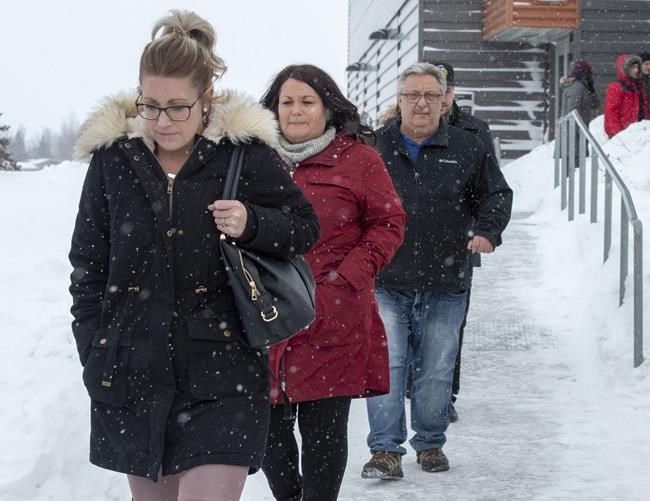
Christina Haugan, left, wife of coach Darcy Haugan who died in the 2018 Humboldt hockey team bus crash, and other family and friends of victims leave after the final arguments in the sentencing hearings for Jaskirat Singh Sidhu, the driver of the truck that collided with the bus carrying the Humboldt Broncos hockey team, at the courthouse in Melfort, Sask., on January 31, 2019. An emotional sentencing hearing for the truck driver who caused the deadly Humboldt Broncos bus crash laid bare the unrelenting pain of family members who lost loved ones in the sudden tragedy. There were heartbreaking accounts of grief and anger, and calls for the maximum prison time possible. But there were also glimmers of compassion, as some including widow Christina Haugan pledged forgiveness and peace.
Ryan Remiorz / The Canadian Press Christina Haugan, left, wife of coach Darcy Haugan who died in the 2018 Humboldt hockey team bus crash, and other family and friends of victims leave after the final arguments in the sentencing hearings for Jaskirat Singh Sidhu, the driver of the truck that collided with the bus carrying the Humboldt Broncos hockey team, at the courthouse in Melfort, Sask., on January 31, 2019. An emotional sentencing hearing for the truck driver who caused the deadly Humboldt Broncos bus crash laid bare the unrelenting pain of family members who lost loved ones in the sudden tragedy. There were heartbreaking accounts of grief and anger, and calls for the maximum prison time possible. But there were also glimmers of compassion, as some including widow Christina Haugan pledged forgiveness and peace.

As difficult as it may be, experts say the ability to forgive can be key to emerging from such a traumatic event.

“Forgiveness is kind of an inner quality of letting go of bitterness, reclaiming one’s own life and not having this negative, hostile overlay around a situation,” says Fred Luskin, author of the book “Forgive For Good” and a clinical psychologist who specializes in researching the concept of forgiveness at California’s Stanford University.

“This is at the heart of forgiveness training: That there is simply the reality of life where things don’t always work out the way you hoped they will and resilience towards that is one of our strongest coping needs.

“We define forgiveness as making peace with the word ‘No.’ …And some of us never make peace with that. Some of us stay arguing with that for 20, 30, 40 years.”

The fate of Jaskirat Singh Sidhu, 30, is now in the hands of a Saskatchewan provincial court judge who last week heard most of 90 victim impact statements submitted over three days.

Sidhu has pleaded guilty to 29 counts of dangerous driving for causing the crash at a rural intersection near Tisdale, Sask. Court heard the inexperienced truck driver sped through a stop sign before his rig slammed into the bus last April, killing 16 people and injuring 13 others, most of them teenage hockey players.

The wife and mother of head coach Darcy Haugan, who died in the crash, each referred to their Christian faith in forgiving Sidhu and vowing to pray that he finds “hope and peace.”

Then there was Scott Thomas, whose 18-year-old son Evan was killed in the crash, who reflected on struggling to learn how to forgive.

“Forgiveness is one of the highest qualities you can achieve as a human being on earth. I wouldn’t consider myself a religious man…but I do consider myself a spiritual being and one of the things we’re trying to reconcile here is my existence on this earth and my ability to find my son in another realm when this is over,” he told reporters at the hearing last week.

Meanwhile, Robin Lukan, the mother of 21-year-old Conner Lukan, suggested she would always blame Sidhu for her loss.

“I have no forgiveness,” Lukan said in her pained statement. “No consequence, no sentence, no apology, no admission of guilt will ever be enough to fill the void that has been left.”

Toronto psychotherapist Christopher Saxton says those with a religious background tend to have an easier time moving from the initial stages of denial, anger, bargaining and depression to a point where they can accept a new reality.

“It gives them a formula — ‘OK, if I do X, Y, Z I know this is when I’m done and I can move forward,” said Saxton, who has a masters in divinity at the University of Toronto for the Anglican Church.

“When they don’t have that frame of reference, it’s really difficult for them. (They say) ‘How do I do this? How do I begin to say goodbye? How do I begin to let go?’ Or in this case, ‘How do I forgive?'”

Luskin is struck by how quickly some relatives have been able to answer that question, noting it often takes years to process the range of emotions that come from such horrendous tragedy.

Those who take longer to accept their reality tend to do so only when they recognize they are “stuck” in their suffering.

“They actually get tired of their inner dialogue and agitation that they recognize they’re drowning in,” says Luskin.

For Luskin, forgiveness requires remembering the past in a different way, perhaps by incorporating things to be grateful for, acknowledging those who supported you during your grief, and recognizing how you may have grown.

Saxton says the families have a long process still ahead of them, even those who say they’ve decided they’re unwilling to forgive.

“We don’t like the unknown, we don’t like change and especially for these families it’s been a huge part of their lives and who they are. The whole nation has been walking with them and grieving with them and the question for them is: ‘OK, are they ready to move on to the next stage of their life?’ There’s no timing for that,” says Saxton, who adds that coming to terms with tragedy does not have to include forgiveness.

“It’s our job if they’re our friends — if they’re loved ones, if they’re companions on this journey of life — to give them that space and that love and let them grieve as they need to grieve, to be angry if they need to be angry, and to forgive when they’re ready to forgive. If they’re ready to forgive.”

—With files from Chris Purdy and Bill Graveland

Report Error Submit a Tip

More Stories

Controversy sparked by APTN series First Contact

Niigaan Sinclair 6 minute read Preview

Controversy sparked by APTN series First Contact

Niigaan Sinclair 6 minute read Monday, Sep. 17, 2018

During the second episode of APTN’s three-episode documentary series First Contact, two distinct factions emerge about how to view Indigenous peoples.

This isn’t a spoiler by the way. This is Canada.

First Contact, for those who haven’t seen it, takes six Canadians with strong opinions about Indigenous peoples on a 28-day tour through Indigenous communities where their beliefs are challenged and contextualized.

Along their journey of education, they are fed and cared for by Indigenous communities, sleep in Indigenous homes, and hear brave stories by those who attended residential schools, lost loved ones, and struggle through poverty and substance abuse. Most episodes feature conversations with Indigenous peoples after participants toss out generalizations such as “reserves are dead-end places” and “Indians get everything for free.”

Read
Monday, Sep. 17, 2018

Letters, Aug. 22

7 minute read Yesterday at 2:01 AM CDT

Foster system must be better

Re: Paralyzed foster girl has system under a microscope (Aug. 18)

Families Minister Nahanni Fontaine’s assertion that “you can’t train people not to be violent” should concern everyone who cares about the safety of children in Manitoba’s child welfare system.

Of course, no training program can guarantee that an individual will never harm a child. But framing these tragedies as the actions of a few “abominable” people risks absolving the system of its responsibility to prevent harm.

Sunshine Fund guarantees a little magic in the summer

Grace Penner 4 minute read Preview

Sunshine Fund guarantees a little magic in the summer

Grace Penner 4 minute read Yesterday at 2:01 AM CDT

To this day, I still remember the morning polar plunges into Moose Lake — a cold shock to the system meant to wake campers up before the sun hit its peak.

Throughout my youth, my siblings and I attended Camps with Meaning, an organization that at the time offered three Mennonite bible camps at Camp Moose Lake, Camp Koinonia, and Camp Assiniboina. I spent many summers at Camp Moose Lake as well as an annual weekend trip with my high school, Westgate Mennonite Collegiate.

I have fond memories of swimming in the lake, picking up a bow and arrow for archery practice, sitting in the cafeteria with all of my friends waiting to devour home-cooked meals, as well as camp-wide games of Manhunt where bouts of giggling echoed around the property.

My parents were able to send all three of us to camp, including my brothers Jonah and Samuel, due to the camp being subsidized by the Mennonite Church. Without the financial assistance, it would have been a strain on my family to support three children going to summer camp on a yearly basis.

Read
Yesterday at 2:01 AM CDT

Residents fear mailbox crime sprees

Morgan Modjeski 5 minute read Preview

Residents fear mailbox crime sprees

Morgan Modjeski 5 minute read Yesterday at 2:01 AM CDT

Some North End residents are concerned new community mailboxes will become a target for vandalism and crime after the base of one was recently lit ablaze — before it was even installed.

The community mailboxes started to show up on Andrews Street within the last two weeks. Some have been installed, while at other locations, only the concrete foundation is in place.

“They just dumped them on the boulevard,” said Stephen Giesbrecht, who lives beside one of the boxes in the St. John’s neighbourhood. “They dumped them on the corner and then they were gone.”

One of the concrete slabs has already played host to a fire and some of the hardware needed to install the mailbox melted.

Read
Yesterday at 2:01 AM CDT

Silver linings at Canadian Lawn Bowling Championships

Grace Penner 1 minute read Preview

Silver linings at Canadian Lawn Bowling Championships

Grace Penner 1 minute read Yesterday at 2:01 AM CDT

There were multiple Manitoban bowls players in the 2026 Canadian Lawn Bowling Championships last week.

Sam Forrest placed silver in the U18 boys’ Canadian Youth and Junior Championships in Hanover, Ont., that was held from Aug. 10-14.

And in the North Vancouver, B.C., leg of the championships that was held Aug. 16-23, the 13-year-old competed with his grandfather, John Bjornson, as well as Rod Rose and Wayne Trindall in the men’s fours. Forrest was honoured with the Spirit Award.

Women’s pairs Shirley Fitzpatrick-Wong and her mother Clarice Fitzpatrick won silver falling short to the B.C. duo they faced.

Read
Yesterday at 2:01 AM CDT

‘Depravity is stunning’: Winnipeg couple who tortured, killed animals on dark web sentenced to 12 years

Dean Pritchard 6 minute read Preview

‘Depravity is stunning’: Winnipeg couple who tortured, killed animals on dark web sentenced to 12 years

Dean Pritchard 6 minute read Wednesday, Feb. 11, 2026

A Winnipeg couple who tortured and killed dozens of cats and other small animals for an online paying audience was sentenced to 12 years in prison Wednesday.

Crown and defence lawyers jointly recommended the sentence for Irene Lima and Chad Kabecz in a case that prompted massive public outrage.

“The depravity is stunning,” said King’s Bench Justice Jeffrey Harris, who banned both offenders from possessing animals for life. “In over 40 years as a lawyer and judge, I have not seen any facts come close to this… I cannot begin to conceive of the suffering of these defenceless animals as you tortured them to death for your own deviant sexual pleasure and profit.”

Lima, 56, crushed the animals to death with her bare feet, while 41-year-old Kabecz recorded the killings, videos of which were shared with paying customers via a chat group where Lima was known as “Goddess May.”

Read
Wednesday, Feb. 11, 2026