Dizzying weather extremes a new fact of life for Canadians, experts say

Advertisement

Advertise with us

As Ottawa limps across the finish line of its snowiest January on record, cherry blossoms are blooming at the legislature in coastal Victoria, B.C.

Read this article for free:


By clicking the button above, an account will be created and you will begin to receive some of our recommended newsletters. You may opt out of any newsletter by visiting your Email and Communication Preferences page or by clicking "unsubscribe" at the bottom of any email.

or

Already have an account? Log in here »

To continue reading, please subscribe:

Digital Subscription

One year of digital access for only $1.44 a week*

  • Enjoy unlimited reading on winnipegfreepress.com
  • Read the E-Edition, our digital replica newspaper
  • Access News Break, our award-winning app
  • Play interactive puzzles

*Billed as $5.77 plus GST every four weeks. After 52 weeks, price increases to the regular rate of $19.95 plus GST every four weeks. Offer available to new and qualified returning subscribers only. Cancel any time.

To continue reading, please subscribe:

Add Free Press access to your Brandon Sun subscription for only an additional

$1 for the first 4 weeks*

  • Enjoy unlimited reading on winnipegfreepress.com
  • Read the E-Edition, our digital replica newspaper
  • Access News Break, our award-winning app
  • Play interactive puzzles
Start now

*Your next Brandon Sun subscription payment will increase by $1.00 and you will be charged $17.95 plus GST for four weeks. After four weeks, your payment will increase to $24.95 plus GST every four weeks.

Hey there, time traveller!
This article was published 31/01/2019 (2829 days ago), so information in it may no longer be current.

As Ottawa limps across the finish line of its snowiest January on record, cherry blossoms are blooming at the legislature in coastal Victoria, B.C.

Millions of Canadians were hiding out this week under extreme cold warnings stretching across the map, even as some East Coast cities enjoyed moderate temperatures.

According to experts, these co-existing extremes have been predicted for some time — and they’re likely here to stay.
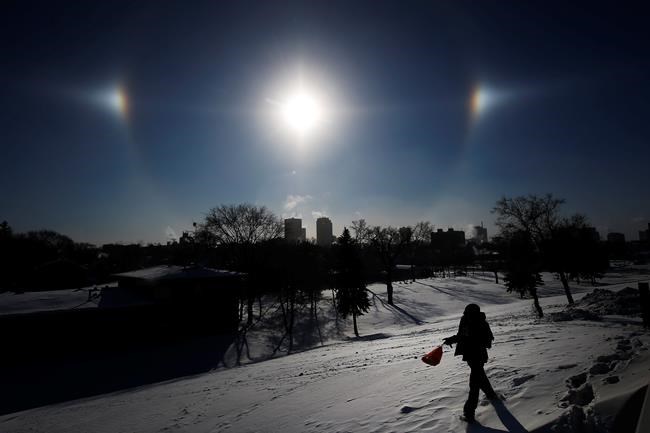
Sun Dogs, formed by the sun reflecting off ice crystals in bitterly cold temperatures, sit over the Winnipeg skyline Wednesday, Jan. 30, 2019. Winnipeg and the region has been experiencing below -35 degree celsius temperatures and windchills of -45 to -50 degree celsius. THE CANADIAN PRESS/John Woods

“This is the kind of thing people have been predicting for years,” said Konrad Gajewski, a professor of geography and environment at the University of Ottawa.

“This kind of pattern of more alternation, more extremes, both in terms of warm and cold conditions is what we’re expecting for the future.”

Central Canada’s cold snap comes from the oscillating upper wind patterns of the jet stream, pushing the cold air down from the north with the polar vortex.

At the same time, the large “waves” in the wind patterns push some warm air north, explaining comparatively warm temperatures on the coasts.

The exact role climate change plays in the pattern’s changes is an ongoing discussion in the scientific community, but a common belief says it’s the result of a warming Arctic.

“It’s thought that as the Arctic warms up because the ice is melting back, we’re going to have more of a situation where you have what we call ‘waviness’ in the polar vortex,” Gajewski said.

This “waviness” in the upper wind’s pattern could be carrying cold further and further south into south and central Canada, and pushing warm air further north along the coast.

Atmospheric physics professor Kent Moore at the University of Toronto says the striking weather patterns show how the world’s climate system is intimately coupled, and how changes in the coldest and warmest regions can be felt in central Canadian cities.

As an example, Moore pointed to the theory that the waves in upper wind patterns are moving slower, with larger amplitudes as a possible result of warming in the Arctic.

“The largest changes in the climate are occurring in the Arctic and some would say, ‘Who cares? I live in mid-latitudes, why should I care about that stuff?'” Moore said.

“The Earth is kind of a small place and so things that happen in the Arctic don’t stay in the Arctic.”

This interconnectedness of the world’s climate system also explains the impacts from El Nino systems on Canada, Moore said.

David Atkinson, a climate professor at the University of Victoria, said the jet stream’s behaviour could also make the increasingly frequent, intense storms on the East Coast gain even more strength.

“If the air is kind of moving apart, it allows surface air to rise more easily,” Atkinson said. “That helps a storm to work, storms depend on rising air.”

Gajewski said the arrival of long-predicted weather patterns means it’s time for all levels of government to seriously plan for changes that are already hitting Canada in the form of sweltering heat waves in the summer and record cold in the winter.

This could mean more snow-clearing and flood response on the municipal level and global warming mitigation efforts across the board.

In Ottawa, Gajewski pointed to some ongoing local efforts like more bicycle lanes and efforts to plow some of them in the winter.

“A lot of it would just be common sense. It’s going to get hotter in the summers and we’re going to get perhaps more snow, more rain, more extreme conditions, more floods,” Gajewski said.

“Cities have to be planned to deal with that kind of thing.”

For cities like Ottawa, which just completed its twelfth straight day of round-the-clock plowing, people shouldn’t plan to retire their shovels any time soon.

“We’re going to have to shovel more often.”

Report Error Submit a Tip

More Stories

Director Schrader returns to silver screen with complex view of religion and belief

Alison Gillmor 4 minute read Preview

Director Schrader returns to silver screen with complex view of religion and belief

Alison Gillmor 4 minute read Thursday, Jun. 14, 2018

Bleak, wintry and rigorously controlled — until it’s not — this Book of Job-like drama from American filmmaker Paul Schrader looks at the challenges of faith.

The 71-year-old Schrader, known for scripting four Martin Scorsese films (including Taxi Driver and Raging Bull) and for directing his own (including American Gigolo, Affliction and Auto Focus), grew up in a strict Calvinist home — he famously did not see a film until he was 17 — and has always been drawn to stories of agonizing and uncertain redemption.

As the Rev. Toller (Ethan Hawke) wrestles with what it means to lead a righteous life in our badly broken world, his spiritual fate remains in doubt. It is certain, however, that First Reformed marks a cinematic rebirth for Schrader after recent disasters like The Canyons and Dog Eat Dog. Serious, complex and moving, this is not a perfect film, but even its flaws are powerful.

Toller is a solitary man who has come to the ministry late in life, after a family tragedy and a failed marriage. First Reformed, a historic church in upstate New York that was once a stop on the Underground Railroad, has since been reduced to an austerely beautiful tourist shop, more of a museum than a place of worship.

Read
Thursday, Jun. 14, 2018

Moving past the Indian Act will take time and trust

Niigaan Sinclair 5 minute read Preview

Moving past the Indian Act will take time and trust

Niigaan Sinclair 5 minute read 4:52 PM CDT

If I had a dime for every time a politician has called for the “abolishment”of the Indian Act, I’d be a rich man.

OK, maybe I’d have enough coins to jingle loudly in my pocket.

My point: a Canadian leader calling for the end of the race-based law passed in 1867 that is designed to give the federal government broad and brutal control over First Nations governments, membership, and reserve land is nothing new.

Premier Wab Kinew became the latest to advocate for this, during the First Nations-first ministers meeting in Ottawa this week.

Read
4:52 PM CDT

Submit a news tip

1 minute read Monday, Mar. 16, 2026

Submit a news tip

Meteorologist behind Rob’s Obs is moving weather station to Ontario

Ben Waldman 7 minute read Preview

Meteorologist behind Rob’s Obs is moving weather station to Ontario

Ben Waldman 7 minute read Monday, Jun. 13, 2022

In a Winnipeg winter, there are always at least two certainties: it will be cold, and it will snow. A third certainty: the people will talk endlessly about how frigid the temperature is, and argue about how much snow is cloaking their driveways. Is it colder than it ever has been? Is there more snow today than the same time last year?

Rob Paola likely knows the answers to those questions.

Paola possesses no super powers. He is but a man with a metre stick and 40 years of professional meteorological experience, in the midst of a lifelong love affair with Mother Nature, a most turbulent mistress who rarely, if ever, reciprocates.

Each year when snow begins to fall, Paola heads outside his Charleswood home to figure out how much. He sticks his ruler in the ground, grabs his clipboard, and clicks his pen. In neat script, he records the temperature, what time precipitation began, how deep the powder is stacked. Then, he shares his data and insights online with thousands of followers who want a clear answer to the eternal questions: Why is this happening? When will it stop? How much snow has fallen in the city of Winnipeg?

Read
Monday, Jun. 13, 2022

Waiting for Cormier verdict the ‘calm before the storm’

Katie May 6 minute read Preview

Waiting for Cormier verdict the ‘calm before the storm’

Katie May 6 minute read Thursday, Feb. 22, 2018

As the jury room door closed behind the seven women and four men who are now deliberating on the evidence against Tina Fontaine’s accused killer, Thelma Favel rose from the chair she’s occupied for most of Raymond Cormier’s second-degree murder trial.

Almost every day over the past three weeks, Favel, the woman who raised 15-year-old Tina, has sat right up front, directly across from the jury box, listening, sobbing and soaking in disturbing details of the teen’s last days that have come to light over the course of Cormier’s second-degree murder trial.

On Wednesday afternoon, after Court of Queen’s Bench Chief Justice Glenn Joyal instructed the jury and sent them off to be sequestered until they decide whether 56-year-old Raymond Cormier is guilty of killing Tina, Favel got up and hugged Crown prosecutor Breta Passler. It was one of many moments, this one shielded from jurors, that have long since proven the emotional impact of the case and the lasting power of Tina’s legacy.

Tina’s death sparked a public outcry that renewed calls for a national inquiry into disproportionately high rates of missing and murdered Indigenous women and girls across Canada, and the criminal trial for the man accused of killing her hasn’t happened in a vacuum.

Read
Thursday, Feb. 22, 2018

Three’s company for new netminder Daws

Mike McIntyre 6 minute read Preview

Three’s company for new netminder Daws

Mike McIntyre 6 minute read 5:09 PM CDT

TAMPA — Nico Daws is still trying to catch his breath.

An unexpected piece of the Connor Hellebuyck blockbuster. A chaotic crash course in his latest hockey home. Joining a fragile club mired in a prolonged losing streak. And now, hitting the road for four tough tests, including one where he will find himself as the last line of defence.

It’s been quite the ride for the newest Winnipeg Jets netminder, who took some time Thursday morning to reflect on the experience.

“A whirlwind of a week. I haven’t even really had time to sit down and digest it,” said Daws.

Read
5:09 PM CDT