Crave some pizza? Hit print
NASA borrows page from Star Trek, funds research into food replicators
Advertisement
Read this article for free:
or
Already have an account? Log in here »
To continue reading, please subscribe:

Digital Subscription
One year of digital access for only $205*
- Enjoy unlimited reading on winnipegfreepress.com
- Read the E-Edition, our digital replica newspaper
- Access News Break, our award-winning app
- Play interactive puzzles
*First annual payment billed as $205.00 + GST for one year. This annual subscription will automatically renew at $233.00 + GST every 52 weeks (10% off the regular annual price of $259.35). Offer available to new and qualified returning subscribers only. Cancel any time.
To continue reading, please subscribe:
Add Free Press access to your Brandon Sun subscription for only an additional
$1 for the first 4 weeks*
- Enjoy unlimited reading on winnipegfreepress.com
- Read the E-Edition, our digital replica newspaper
- Access News Break, our award-winning app
- Play interactive puzzles
*Your next Brandon Sun subscription payment will increase by $1.00 and you will be charged $17.95 plus GST for four weeks. After four weeks, your payment will increase to $24.95 plus GST every four weeks.
Read unlimited articles for free today:
or
Already have an account? Log in here »
Hey there, time traveller!
This article was published 25/05/2013 (4881 days ago), so information in it may no longer be current.
NASA can send robots to Mars, no problem. But if it’s ever going to put humans on the Red Planet, it has to figure out how to feed them over the course of a years-long mission. So the space agency has funded research for what could be the ultimate nerd solution: a 3-D printer that creates entrees or desserts at the touch of a button.
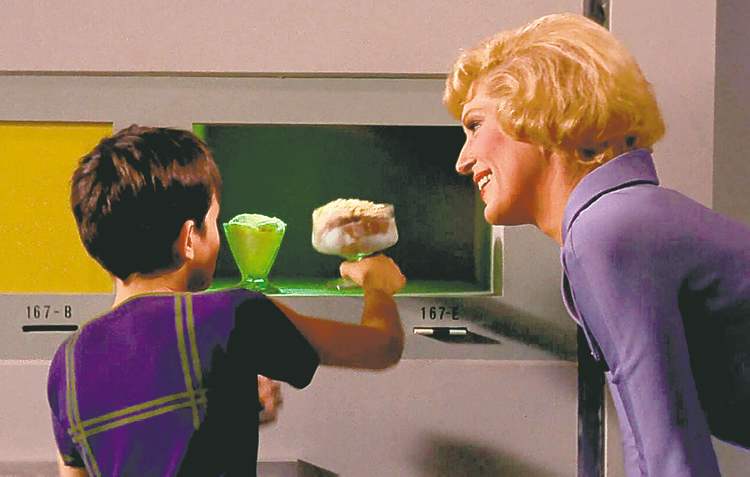
Yes, it’s another case of life imitating Star Trek (remember the food replicator?). In this case, though, the creators hope there is an application beyond deep-space pizza parties. The technology could also be used to feed hungry populations here on Earth.
Texas-based Systems and Materials Research has been selected for a $125,000 grant from NASA to develop a 3-D printer that will create “nutritious and flavorful” food suitable for astronauts, according to the company’s proposal. Using a “digital recipe,” the printers will combine powders to produce food that has the structure and texture of, well, actual food. Including smell.
The project — the details of which NASA plans to finalize this week — was presented at the Humans 2 Mars Summit in Washington this month. At the presentation, Anjan Contractor, an engineer at SMRC and the project manager, explained how the idea originated: He had used a 3-D printer to print chocolate for his wife.
The chocolate experiment led the company to think about other kinds of food that could be printed. A space-food printer doesn’t actually exist yet — it’s still a concept, which the company hopes to develop by the end of the year using NASA’s grant money.
The space agency’s current astro-food system “is not adequate in nutrition or acceptability through the five-year shelf life required for a mission to Mars, or other long duration missions,” NASA spokesman David Steitz said in an e-mailed statement.
Astronauts carry pre-packaged food — not the freeze-dried ice cream for sale in Smithsonian gift shops, but a little like the meals ready to eat, or MREs, consumed by the military. The preparations are short on flavour and heavy on processing, which tends to “degrade the micronutrients in the foods,” Steitz said. There also isn’t much choice or variety, since all combinations of food are predetermined. That can take on big significance after a year or three cooped up in a small metal capsule.
In its proposal, the company said 3-D printed food could be tailored to each individual astronaut’s nutritional needs, improving health and, maybe more importantly, alleviating boredom.
One of the first goals for SMRC’s printer is the humble pizza. It was chosen because it contains a variety of nutrients and flavours, said David Irvin, director of research at SMRC. More importantly, a pizza is made up of layers, a key principle used in 3-D printing technology.
Such printers, which have seen a surge of popularity lately, build a three-dimensional object by adding successive layers of material millions of times over according to a digital blueprint. Hobbyists have been using them to make everything from plastic toys to functioning guns.
In SMRC’s proposal, all the nutrients that go into a meal — such as protein and carbohydrates — would be stored in powdered form in cartridges. When an astronaut chooses a recipe, all the necessary ingredients are deployed into a mixing chamber, where they are blended with water and oil.
The mixture is then heated and sprayed onto a heated base. Layer by layer, the food is formed on the base, until it is ready, hot and fresh from the “oven.”
“The pizza is actually just a way to demonstrate something solid at the bottom, something doughy in the middle and something meatlike at the top,” Irvin said.
Theoretically, homesick astronauts could even get a care package from Mom: The printer would have the ability to communicate with Earth and receive personalized instructions, or “recipes,” the company said.
“Mom designs a cookie in a computer, sends the cookie to the space shuttle and the son or daughter prints out a cookie at Christmas,” Contractor said in his presentation.
NASA said the proposal is intriguing in part because it could save weight on a spacecraft, and because such technology could be used to make other objects, such as tools.
The use of 3-D printers to make food is not a new idea. In 2011, Cornell University designed a printer that could create food using pastes moving through a syringe.
A Dutch research company, TNO, floated the idea that 3-D printers could use several forms of organic life as a protein component — algae, grass or even insects.
SMRC said part of its motivation for seeking the NASA grant is to pursue the even loftier goal of fighting world hunger.

At his Washington presentation, Contractor said printed food could increase the efficiency of food systems on Earth by eliminating waste and making it easier to store and transport nutritional ingredients. The company also envisions printing food for military use, which could cut down on supply runs.
But experts caution against viewing technology as the answer to the world’s nutritional issues.
“There isn’t some silver-bullet technology that’s going to solve hunger problems,” said Gawain Kripke, policy director for food security and hunger at Oxfam America. The idea behind the technology is welcome, he said, but is unlikely to have an impact in the near term.
“What’s more likely to have an impact is simpler technology, such as access to tractors and seeds,” he said.
— Washington Post-Bloomberg