

FFS sparks debate over ‘fair chase’
Forward Facing Sonar could have negative affect on muskellunge population
Advertisement
Read this article for free:
or
Already have an account? Log in here »
To continue reading, please subscribe:

Digital Subscription
One year of digital access for only $205*
- Enjoy unlimited reading on winnipegfreepress.com
- Read the E-Edition, our digital replica newspaper
- Access News Break, our award-winning app
- Play interactive puzzles
*First annual payment billed as $205.00 + GST for one year. This annual subscription will automatically renew at $233.00 + GST every 52 weeks (10% off the regular annual price of $259.35). Offer available to new and qualified returning subscribers only. Cancel any time.
To continue reading, please subscribe:
Add Free Press access to your Brandon Sun subscription for only an additional
$1 for the first 4 weeks*
- Enjoy unlimited reading on winnipegfreepress.com
- Read the E-Edition, our digital replica newspaper
- Access News Break, our award-winning app
- Play interactive puzzles
*Your next Brandon Sun subscription payment will increase by $1.00 and you will be charged $17.95 plus GST for four weeks. After four weeks, your payment will increase to $24.95 plus GST every four weeks.
Read unlimited articles for free today:
or
Already have an account? Log in here »
Hey there, time traveller!
This article was published 23/12/2025 (250 days ago), so information in it may no longer be current.
Technology has experienced consistent and remarkable development in sports fishing. The Global Positioning System has become a feature found in entry-level marine electronics, giving users navigation, geolocation and time information. Once exclusive to military use, it has been available for civilian applications for more than two decades.
Today’s charts — providing a lake or river (or ocean) has been mapped — offer exceptional underwater detail, with main routes, contours, pinnacles and hazards easily identifiable. A direct result of is anglers have the confidence to go further, safely and efficiently locate structures previously unknown or too difficult to identify.
Sonar was with us long before GPS and is an important, relied upon tool. Original down-imaging technology has evolved, with side imaging being the newer directional cousin to conventional downward facing technology. It requires little explanation. One directs the sonar signal down from the transducer, capturing images of fish and structural details such as weeds, trees and large boulders. Side imaging directs the signal horizontally from the transducer, relaying images from the sides of the boat as opposed to below it.
Patrick Nolan Photo
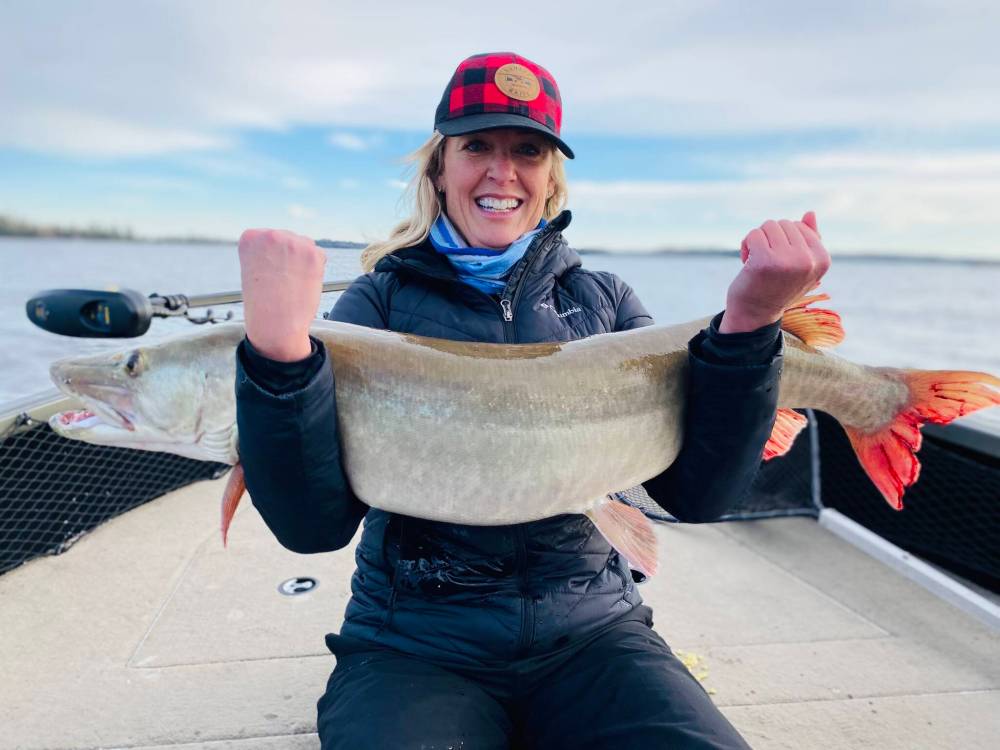
Susan Tinsley poses with a photo of a freshly caught muskellunge (muskie). Forward Facing Sonar has changed not only the odds of interactions with a wild fish, but also how these fish can be manipulated.
Keep in mind the data is historical, not immediate. Global Positioning Systems combined with highly evolved sonar imaging have made for improved safety, increased catch rates and significantly improved overall success. Anglers are locating fish faster and more efficiently, as well as spending less time where the fish aren’t.
New to the field is Forward Facing Sonar (FFS), the latest evolution in imaging technology. It is precisely as described, with the nuance being the user receives a real-time feed rather than historical data. Immediate, live imaging is relayed to the screen allowing anglerers to observe a gamefish’s reaction to a given presentation — whether the fish moves, pursues the bait or remains idle, moves up or down in the water column and, in the hands of an experienced user, discern the size of several fish in one school.
As much as it may be an oversimplification, envision an Ultrasound machine designed for fishing. Applying this comparison, one doesn’t need a great deal of imagination to see the technological shift this has brought to sport fishing. FFS is driving conversations both pro and con.
Many argue this tech has tilted the playing field, offering an unfair advantage to the angler and removing much of the challenge long accepted as part of sport fishing. On the other hand, some contend it’s ‘one more tool in the toolbox’ and people can choose to be a part of the change or get left behind.
With some articulate and intelligent minds on both sides, there is one specialized space seeing much debate — muskie fishing.
The FFS-muskie conversation is drawing so much attention for a few reasons. At the top of the list is muskies are not easy to catch. They are low-density apex predators, known to move from deep water to shallow in unpredictable ways, and have a habit of showing themselves to the angler without striking — what those in the know call “the follow.”
Anyone with experience casting for muskies can attest to how the experience can go from exhilaration to heartbreak in a matter of seconds. Those encounters rely on skill, readiness and often one very brief opportunity to convert the fish from one that is looking to one that is striking.
FFS has changed not only the odds of these interactions, but also how they can be manipulated, which takes us to what is driving the discussion.
Because muskies occur in very low numbers, with unpredictable frequency, and often have a lukewarm attitude to presentations, the concern is some fishers are adopting the technology in a way that disproportionately tilts the odds. There is also legitimate debate about the methods and techniques being used by some anglers, ethics, pressure on the species, and the spirit of fair chase.
FFS is being adopted by some who use it in their array of electronics to scan — in real time — a given body of water or structural feature in ways that “rule in or rule out” the presence or absence of a muskie.
Some guides and other professionals rely on the tool to the extent that if the presence of a fish cannot be confirmed, no cast is made and no lines get wet.
In other cases, many manipulate the tool to observe how the fish reacts to presentations by watching the monitor and in some cases following a fish as it shifts position.
Patrick Nolan Photo
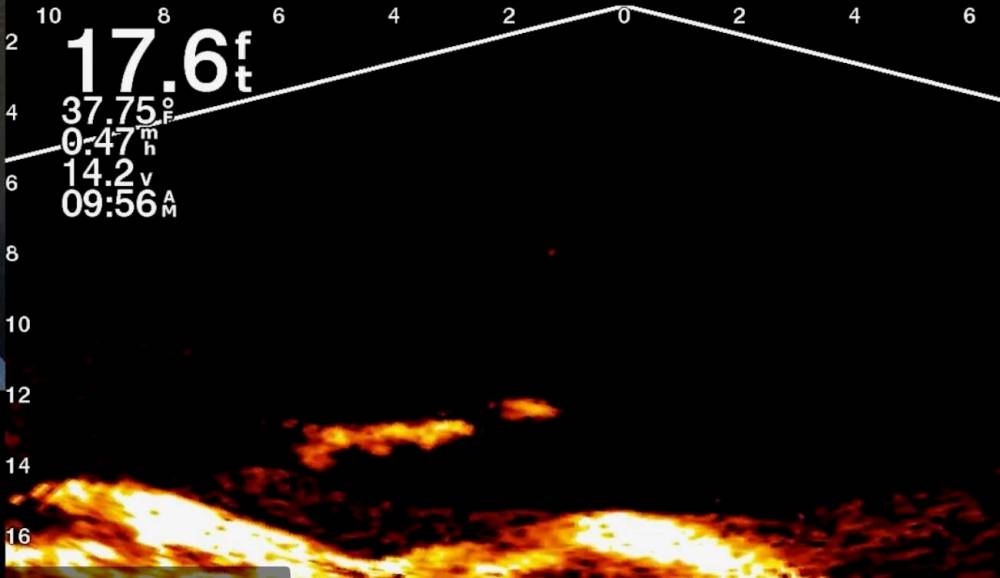
Image from a Forward Facing Sonar monitor screen. The technology uses live images in a real time feed rather than historical data, as is the case with traditional sonar.
In some circles this might be interpreted as harassing the fish; others see it as needlessly bothering a fish that is not interested.
Some will “road hunt” open water for fish, putting bait in front of fish that have an increased likelihood of taking a presentation as well as increased vulnerability to catch and release mortality.
Wherever people may come down on the issue, it raises numerous ethical points and invariably leads to the question if this is still sport fishing, or some new hybridized adaptation of the craft, no longer dependent on experience and knowledge?
Camp owners and guides have a great deal at stake in this conversation, as many depend on muskies and the customers who come to fish for them as a significant contributor to their bottom line year after year.

Gord Bastable, owner of Vermilion Bay Lodge on Eagle Lake, Ont., and part of a group of camp owners asking muskie anglers to make a deliberate choice not to use FFS — takes a pragmatic approach to the issue. However, he also expressed some of the global concerns shaping the conversation.
Bastable spoke of worries over fish being identified and caught in deep water, ethics and the spirit of fair chase. In his words: “If you want to have an impact on FFS, then lead by example and don’t use it.” From that we might conclude Bastable is a detractor. FFS proponents declined to comment for this story.
Technology is evolving and changing faster than ever and, in many cases, it does so in such a way as to make our lives easier, safer and more efficient. Ecosystems are also changing, in many cases in ways that do not offer improvements to the lives of people and animals, either locally or globally.
These technologies are being adopted at warp speed, in many cases in the absence of any careful assessment or analysis of the possible downstream effects. While some will disregard the warning about how a technological advancement could make for a negative effect on something as inoffensive as fishing, perhaps this is one of those moments to slow down, take a closer look, and make a determination what is best for the fish, and not the people. A species may depend on it.
winnipegfreepress.com/sports